Chipp.in Tech News and Reviews

Windows, Security & Privacy, Open Source and more

Menu
  • Home
  • Windows
  • Security & Privacy
  • Gaming
  • Guides
  • Windows 11 Book
  • Contact
  • RSS Feed
Menu

Tag: firefox

Firefox 151 ships with a new tab page and improved privacy protections

Posted on May 20, 2026May 20, 2026 by Martin Brinkmann

Mozilla released a new major stable version of its open source Firefox web browser on May 19th, 2026. Firefox 151 includes several new features and changes, including a new Firefox Home page (new tab page), an option to clear all data in private sessions, and more.

Most Firefox users should receive the update automatically via the built-in updating functionality. Those who do not want to wait can launch the browser and go to Menu > Help > About Firefox to run a manual check for updates. The update to version 151.0 should be picked up at that point and installed automatically.

The very first thing you may — or may not — notice after the mandatory restart is the new home page of the browser. Mozilla says that this is just the first step in a wider redesign of the new tab page. For now, you can play around with new wallpapers by clicking on the pencil icon on the page to customize what you see.

On the privacy front, there are two main changes:

  • A new button in private sessions. Activate the fire-button in the taskbar to get an option to clear all data in the private session and start anew. Previously, you had to close the session and start a new one to do that. Mozilla reveals that this will delete the history, cookies, and all other site data when executed.
  • Protection against fingerprinting. The standard enhanced tracking protection feature of the open source browser now protects against fingerprinting attempts as well. This limits the data that scripts and sites may retrieve about the device and browser by up to 49 percent. Standard is the default mode. Previously, this was limited to the strict tracking protection setting.

Other than that, Linux users may now also back up Firefox profiles locally, just like Windows users. Best of all, these backed up profiles can be restored across platforms. The built-in browsing proxy, which Mozilla calls a VPN for marketing reasons, now supports choosing a location rather than connecting to one that Mozilla picks automatically.

While the selection is limited in comparison to many standalone VPN tools and the rollout is happening over time, it is a welcome addition that should improve the feature for some Firefox users.

Firefox 151, and the simultaneously released ESR-versions, fix several security issues on top of that. The aggregate rating is high and you can check out the list for the stable version here.

Expect more Firefox updates in the future, beginning with Firefox 151

Posted on May 12, 2026May 12, 2026 by Martin Brinkmann

Mozilla releases a new stable version of its open source Firefox web browser every four weeks. This new version introduces new features, bug and security fixes. Up until now, smaller updates were released between two major releases.

These point updates do not include new features usually but fix security issues and/or non-security issues. The releases were not predictable up until now. While you could almost be certain that a point update would be released, it was never really certain when.

This changes with the release of Firefox 151. Mozilla is switching to the same point update release rhythm that Google uses for its Chrome web browser currently.

Put simply, Mozilla plans to release a point update every week going forward. This means three Firefox point releases at the very same day of the week in-between major releases. Three point updates will follow the release of Firefox 151 and any other major browser release that follows.

The organization confirmed the change on the official Wiki (via Sören Hentzschel):

Starting with Fx151, we now have 3 weekly dot releases for Desktop and Android
Release calendar updates will be live shortly

Other than that, there is no explanation from Mozilla regarding the change yet. Considering that Google announced recently to shorten Chrome release cycles to two weeks, it is likely an attempt to stay ahead of major developments and push out fixes faster to the user base.

With AI helping Mozilla find security issues in Firefox, it is probably one reason why the organization decided to push out more updates to get these fixes on user systems as soon as possible.

This is the new Firefox design that is currently in testing

Posted on May 5, 2026 by Martin Brinkmann

News leaked some time ago that Mozilla was working on a new design for its open source Firefox web browser. Now, with the most recent version of the cutting edge Nightly browser comes the first glimpse of that new design.

However, the new Firefox design is not enabled by default and it may take some time before that is going to be the case.

What is Project Nova?

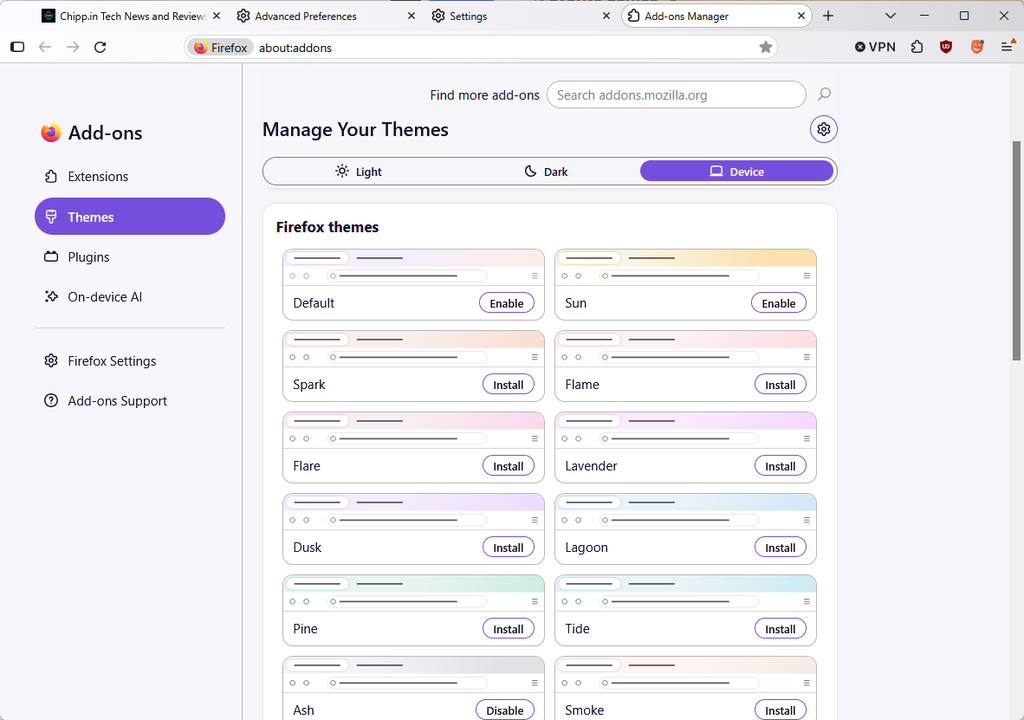
Internally dubbed Project Nova, this redesign departs from Firefox’s current aesthetic in favor of a much softer, modern interface heavily characterized by rounded elements. The most striking changes include the address bar and tabs, which now sit within a segmented, “floating island” UI element.

Additionally, web page content no longer sits flush against the edges of the browser window; instead, it is elegantly framed within a rounded container. Combined with curved hover effects and refreshed icons, Nova gives Firefox a noticeably more fluid and approachable appearance.

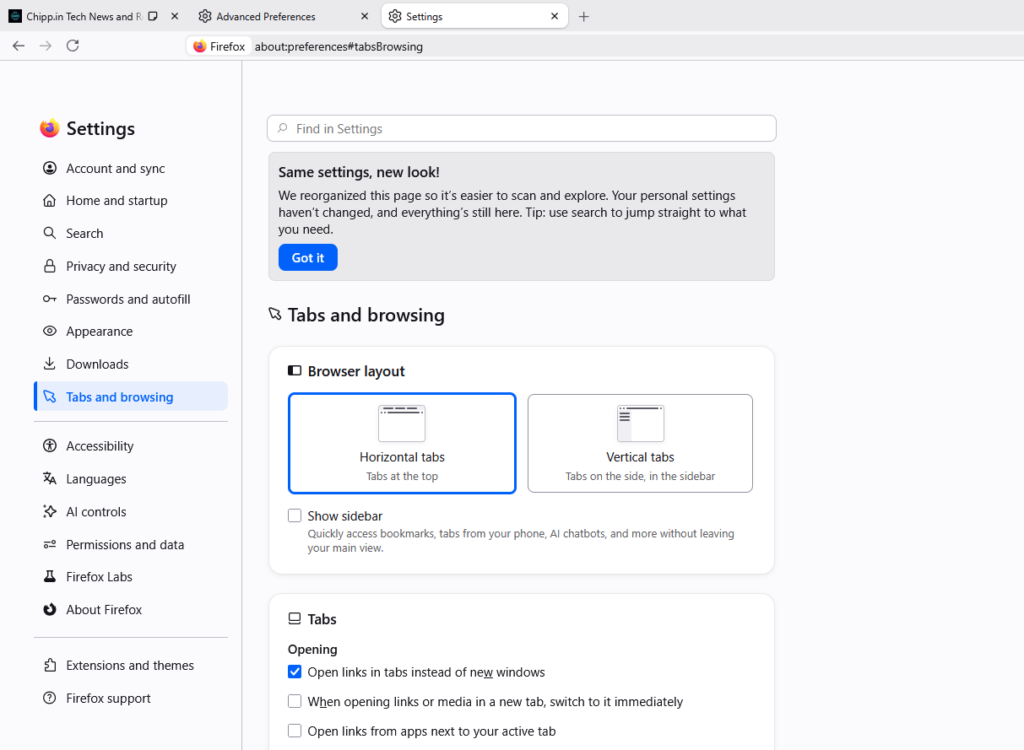
Beyond its structural changes, the Nova redesign introduces a fresh splash of personality through customizable pastel gradients and vibrant color accents on the new tab page and menus. As the major successor to the “Proton” UI introduced in 2021, Nova also brings functional layout updates, including improved integration for vertical tabs, a built-in compact mode to decrease UI spacing, and a revamped settings page.

How to enable Nova in Firefox

Make sure that you have installed the latest version of Firefox Nightly. Nova will come to Beta and Stable Firefox eventually, but this may take some time. If you want to give Nova a try right now, you need the development version.

  1. Load about:config in the Firefox address bar.
  2. Search for browser.nova.enabled.
  3. Use the toggle at the end of the line to set the preference to True.
  4. Restart Firefox.

If all worked out, you should see first bits of the new design in action.

It is not the biggest of re-designs at the moment. In fact, depending on the theme and website, you may not even notice that much has changed to begin with.

Firefox

Firefox 150.0.1 is out with a Facebook fix and security patches

Posted on April 29, 2026April 29, 2026 by Martin Brinkmann

Mozilla released point updates for its open source Firefox web browser yesterday evening. The updates are available for all three supported stable versions of the browser:

  • Firefox 150.0.1
  • Firefox 140.10.1 ESR
  • Firefox 115.35.1 ESR

However, only the main stable release, Firefox 150.0.1 is getting bug fixes and security patches. The two extended support release versions do get the security fixes only.

Here are the fixed security issues:

  • CVE-2026-7320: Information disclosure due to incorrect boundary conditions in the Audio/Video component
  • CVE-2026-7322: Memory safety bugs fixed in Firefox ESR 115.35.1, Firefox ESR 140.10.1 and Firefox 150.0.1
  • CVE-2026-7323: Memory safety bugs fixed in Firefox ESR 140.10.1 and Firefox 150.0.1
  • CVE-2026-7324: Memory safety bugs fixed in Firefox 150.0.1

The changes in Firefox 150.0.1

Mozilla lists five non-security fixes and a change in the official release notes:

  • Fixed issues accessing Facebook and other unnamed websites on systems with Bitdefender security software installed.
  • Fixed an issue where a geolocation permission prompt would be shown again on a second attempt.
  • Fixed an issue that prevented tabs to be added to older saved tab groups.
  • Fixed a drop-down menu display issue that had them show all list items at once.
  • Fixed a zooming issue on macOS and Windows that caused some borders and outlines on some page elements to disappear.

The change affects Firefox indirectly only. Mozilla increased the email masks limit of its Relay service to 50 for free users. The previous limit was five.

The new versions are available already. Most non-managed systems should get the updates automatically, but you can speed up the installation by selecting Menu > Help > About Firefox.

Firefox

How to enable Firefox’s secret ad-blocker

Posted on April 24, 2026April 26, 2026 by Martin Brinkmann

For years, I asked myself why Mozilla did not add a good content blocker to Firefox. It would be a great fit. An organization that values privacy, an open source browser that blocks most tracking out of the box.

However, for Mozilla, integrating a content blocker would also mean torpedoing its main revenue stream coming from Google.

Mozilla never made the step and others, including Brave, led by Mozilla’s ex-CEO, stepped in to fill that gap.

This changed recently

Mozilla did integrate Brave’s Rust-based adblock engine into its Firefox browser. More precisely, it is part of Firefox 149 and Mozilla describes it as a prototype rich content blocking feature.

It is not yet available as an option in the user-facing interface, let alone as something similar to the Shield feature of Brave. Still, users who run Firefox 149 can enable the content blocker and make use of it right away for testing.

Here is how that works:

  1. Load about:config in the Firefox address bar.
  2. Search for privacy.trackingprotection.content.protection.enabled
  3. Set the value to True with a click on the toggle on its right.
  4. Search for privacy.trackingprotection.content.protection.test_list_urls.
  5. Paste https://easylist.to/easylist/easylist.txt|https://easylist.to/easylist/easyprivacy.txt as the value.
  6. Restart Firefox

This enables two EasyLists, but you can add any other list that uses the same format. Separate lists with the character |.

Clearly, this is done for testing purposes. Mozilla would very likely add controls to the preferences or another user facing interface to make this easier to configure and use.

For now, it is a work in progress implementation, but one that shows that Mozilla could finally integrate what many users of its browser have wanted (or did not know they wanted) for a long time.

Mozilla fixed 271 vulnerabilities in Firefox 150 thanks to AI

Posted on April 23, 2026April 23, 2026 by Martin Brinkmann

When Mozilla released Firefox 150 earlier this week, it revealed that it had fixed what looked like the usual number of security issues in the browser. However, what Mozilla did not tell at the time was that it had fixed a significant number of vulnerabilities.

A post on the official Mozilla blog reveals that engineers fixed 271 vulnerabilities in total, a significant number. However, this time, Mozilla’s engineers did not hunt for vulnerabilities using traditional means. Instead, the company used Anthropic’s Mythos AI to do so.

Mozilla writes:

As part of our continued collaboration with Anthropic, we had the opportunity to apply an early version of Claude Mythos Preview to Firefox. This week’s release of Firefox 150 includes fixes for 271 vulnerabilities identified during this initial evaluation.

So, what is Claude Mythos?

Claude Mythos is a powerful, unreleased frontier AI model developed by Anthropic. Announced in April 2026, it is famous—and highly controversial—for its unprecedented capabilities in cybersecurity, specifically its ability to autonomously hunt down and exploit software vulnerabilities.

This is not the first time that Mozilla used an AI from Anthropic for that purpose. Back in February 2026, it used Claude and discovered 22 “security-sensitive bugs”.

Mozilla says that this is great news for software developers and what it calls defenders, legitimate developers who need to secure their applications against a constant barrage of threats.

While the use of AI continues to be controversial, it is usually ethical and privacy concerns that are raised. Good uses for AI, like using it to discover vulnerabilities before the bad guys find them, is probably something that most might not find nearly as problematic.

I would not go as far and say that the days of the 0-day threats are numbered, as Mozilla does, but it looks as if it can help. Still, threat actors could also leverage AI tools for finding vulnerabilities.

What you need to know about Firefox’s new built-in VPN feature

Posted on March 25, 2026 by Martin Brinkmann

Mozilla published Firefox 149 to the stable channel this week and it comes with a bunch of new features and changes. Besides split-view, which allows users to display two webpages side-by-side in a single browser tab, Mozilla advertises a free built-in VPN as one of the main new features.

Mozilla describes the feature in the following way:

Firefox now offers a free built-in VPN. Whether you’re using public Wi-Fi while traveling, searching for sensitive health information, or shopping for something personal, this feature gives you a simple way to stay protected. Once you sign in and turn it on, you can hide your location and IP address by routing it through a secure proxy while you browse in Firefox. You will get 50 GB of protection every month, with the option to turn it on or off for specific websites. This feature is progressively rolling out in the US, UK, Germany and France starting today.

The paragraph is different when you check out the linked support page:

VPN is a built-in Firefox feature that adds privacy by routing your browser traffic through a secure proxy server and masking your IP address. The feature includes a monthly data limit of 50 GB. Firefox will notify you when you are approaching this limit with a prompt in the browser. It is available to a limited set of users during the initial rollout, starting with Firefox version 149.

The latter is accurate, as it confirms that the solution is actually a secure proxy and not a VPN. Mozilla has likely picked VPN as it is more popular. Microsoft, actually, did the same when it introduced the Secure Network feature in Edge.

The main difference between a secure proxy and a VPN solution is that the integrated proxy only protects data from a single application, in this case Firefox.

Once activated, Firefox will route all traffic through the proxy. This protects the device IP of the user and improves privacy and security.

Mozilla says that Firefox users get 50 gigabytes of free traffic per month. This is ten times the amount that Microsoft gives Edge Secure Network users for free each month.

Another difference between the two solutions is that Mozilla relies on its own partner network for the feature, whereas Microsoft partnered up with Cloudflare.

Mozilla says that it does not log visited websites or “the content of your communications”. It does “collect technical data”, which it says is “needed to provide, maintan, and ensure the performance and stability of the service”. It also collects interaction data to “understand usage of the feature and help guide improvements”.

The feature is rolling out to users in the US, UK, Germany, and France only at the moment. You see a VPN icon in the address bar once it is available. A click displays the option to start using it.

Note: You do need to sign in to a Mozilla account to use the proxy. Once that is out of the way, you can complete the onboarding process. Users who do not want to use it can right-click on the icon to remove it from the toolbar.

Toggle browser.ipprotection.enabled to TRUE on about:config to enable it immediately, or set it to FALSE to disable the feature.

Now You: do you use a proxy or VPN when you are on the Internet?

Mozilla changes plans, extends Firefox support on Windows 7 and 8 once more

Posted on March 11, 2026March 11, 2026 by Martin Brinkmann

No one has seen that development coming. After announcing the end of support for its Firefox web browser for Windows 7, 8 and 8.1 starting in February 2026, Mozilla seems to have had a change of heart.

Now, the organization says that it is extending support once again. The information has been published on its What Train Is It Now website, which lists the latest and upcoming Firefox releases.

There, Mozilla writes:

We have decided to extend support to ESR 115 only on Windows 7-8.1 and macOS 10.12-10.14 up to August 2026. We will re-evaluate this decision in July 2026 and announce any updates on ESR 115’s end-of-life then.

Support for Firefox on Windows 7, 8, 8.1 and the macOS versions 10.12, 10.13, and 10.14, is guaranteed until at least August 2026. At least? Yes, as Mozilla may extend support again. In either way, the organization will make an announcement in July 2026 regarding the web browser’s support on the older operating systems.

Firefox 115.x users on these operating systems should receive browser updates, only security fixes and critical bug fixes, as usually via the integrated updating system.

The extension gives users on these old systems access to one of the major browsers, as the other major browser makers, including Google and Microsoft, have stopped supporting the older operating systems for a long time already.

Security updates are guaranteed for another six months at the very least. Good move by Mozilla.

Mozilla is working on a Firefox redesign – a fan favorite feature could make an official return

Posted on March 6, 2026March 6, 2026 by Martin Brinkmann

Mozilla is working on a redesign of its open source Firefox web browser according to leaked mockups of the project. Previous attempts to redesign the browser split the community. While some heralded the changes as a move to modernize the browser, others pointed out that these redesigns were removing or changing features.

Here is an overview of the main changes according to the leak:

  • Strongly Rounded Elements: The most characteristic feature of the Nova design is its prominent use of rounded corners. The tabs, address bar, sidebar launcher, website content area, and elements on the start page are all significantly more rounded. The top section (tab bar and navigation bar) now forms a single rounded unit.
  • Subtle Color Gradients: Unlike the previous design, which relied on solid, single-color surfaces, Mozilla is introducing subtle color gradients across parts of the interface.
  • New Color Accents: The mockups show a noticeable tendency toward violet tones. However, these colors appear to adapt to the chosen theme, as another screenshot demonstrates a mint-green start page with matching UI colors.
  • Improved Vertical Tabs Integration: The redesign prominently features built-in support for vertical tabs as an alternative to the traditional horizontal tab bar.
  • Return of “Compact Mode”: While Firefox currently hides its space-saving “compact mode” behind advanced settings, the Nova mockups explicitly show a visible toggle for it. This suggests Mozilla might officially support and promote a compact UI layout again.
  • Split-Screen Tabs: The dark theme mockups showcase a layout with two tabs open side-by-side, hinting at a native split-screen or tiling feature currently in development.

Mozilla is not reinventing the wheel with this new design. Most web browsers look very similar in this day and age. In fact, compared to the current version of Firefox, it is focusing heavily on colors and rounded elements as the main distinguishing visual changes.

The one thing that excites me the most is the (supposed) return of the compact mode. This mode, which is still supported unofficially by Firefox, is my favorite display mode, as it reduces the size of the UI to give websites more room. Its existence in the mockups suggests strongly that Mozilla might return it officially to Firefox, a change that I would welcome with open arms. It would be another feature that Mozilla is returning or adding to Firefox in the past two or so years.

The mockups show a work in progress. This means that it is not really clear if a redesigned Firefox will look exactly like that.

Now You: What is your take on the proposed redesign of the web browser?

Firefox 148.0 is out with its AI kill switch and support for Windows 7 and 8.1 comes to an end

Posted on February 24, 2026February 24, 2026 by Martin Brinkmann

Mozilla has released several updates for its web browser Firefox, including version 148.0 Stable and also updates for the extended support release (ESR) versions. It is a special day, as Mozilla is ending support for older versions of Windows and macOS with the release of Firefox 115.33.0 ESR.

Firefox 148.0: The release highlights

  • The AI kill switch and AI controls make their debut, allowing users to control AI in Firefox.
  • Important security fixes.
  • Improved PDF screen reader support for math formulas.
  • Translation improvements.
  • Telemetry adjustments.

How to download and install Firefox 148

Most unmanaged Firefox installations will be updated automatically to the latest release once it has been released officially. This may take minutes, hours and sometimes even days. You can speed this up by selecting Menu > Settings > Help > About Firefox.

The new AI controls

The new AI controls of the Firefox browser.

Probably the main feature of Firefox 148.0 is the new AI controls that Mozilla added to the browser. Load about:preferences#ai in the browser’s address bar or go to Menu > Settings > AI Controls to display all options.

The options are divided into two main sections: first a toggle to block all AI enhancements in Firefox with a single click or tap, and then individual controls for users who want to enable some but not other AI features.

So, if you want to block all AI, toggle “Block AI enhancements” and confirm the decision. This should take care of all current and future AI features in Firefox.

The second section is divided into two parts: On-device AI and AI chatbot providers in sidebar. Here you can enable or block the following features individually:

  • Translations.
  • Image alt text in Firefox PDF Viewer.
  • Tab group suggestions.
  • Key points in link previews.
  • Chatbot in sidebar.

When you see available, it means that the feature is not active. Blocked means that it is disabled and enabled means that it is active.

A word or two about Remote Improvements

Remote Improvements are small changes to Firefox that are delivered remotely. Previously, this required for Firefox to share “technical and interaction data”, short Telemetry, with Mozilla. Starting in Firefox 148, this is no longer the case.

In other words, you can receive the fixes without sharing the data or participating in experimental studies.

Opting-out

Uncheck the highlighted option to opt-out of remote updates.

The feature is on by default in Firefox 148, unless you have opted out of studies in the Settings prior to the release of Firefox 148.

To make sure that you are opted-out, do the following:

  • Load about:preferences#privacy in the address bar.
  • Scroll down to the Firefox Data Collection and Use section near the bottom.
  • Uncheck “Allow Firefox to improve features, performance, and stability between updates”.

Smaller changes in Firefox 148

  • Firefox now has improved support for screen readers accessing mathematical formulas embedded in PDFs.
  • Firefox Backup is now also available to Windows 10 users who set “Clear history when Firefox closes” to enabled. Backups will only include data that is not set to be cleared on exit in that case.
  • Translation into Vietnamese, and translation into and from Traditional Chinese is now supported.
  • New Tab wallpapers will show up on new container tabs also now.

The security updates

Firefox 148 fixes several security issues in previous versions. The severity is high and a massive 51 issues or potential issues are patched when the updated is installed.

The end of the road for old Windows and macOS versions

Mozilla is ending support for older operating systems with the release of Firefox 115.33.0 ESR. It is the last official release for systems that are no longer supported by their makers. Mozilla was the last major browser maker to support these operating systems, but this is coming to an end.

Firefox 115.33.0 continues to work on these systems, but updates won’t be released anymore. This means that security issues won’t get fixed anymore, which can be problematic as time passes by. Similarly, new web technology support is absent, which means that some sites or apps may not work correctly or at all.

  • 1
  • 2
  • 3
  • 4
  • …
  • 8
  • Next

Support This Site

If you like what I do please support me!

Any tip is appreciated. Thanks!
  • June 1, 2026 by Martin Brinkmann The Nvidia RTX Spark promises a new Windows PC era, but the price tag may stings
  • May 29, 2026 by Martin Brinkmann Meta is rolling out subscriptions for all of its products, including Facebook, Instagram and WhatsApp
  • May 27, 2026 by Martin Brinkmann Using 7-Zip? Time to update, as your version may be vulnerable
  • May 26, 2026 by Martin Brinkmann MultiDrive: Free Software to Clone, Back Up, Erase and Restore Drives on Windows
  • May 24, 2026 by Martin Brinkmann Vivaldi 8.0 is out with new layout presets and theme improvements

About

We talk, write and dream about Technology 24/7 here at Chipp.in. The site, created by Martin Brinkmann in 2023, focuses on well-researched tech news, reviews, guides, help and more.

Legal Notice

Our commitment

Many websites write about tech, but chipp.in is special in several ways. All of our guides are unique, and we will never just rehash news that you find elsewhere.

Read the About page for additional information on the site and its founder and author.

Support Us

We don't run advertisement on this site that tracks users. If you see ads, they are static links. Ads, including affiliate links, never affect our writing on this site.

Here is a link to our privacy policy

©2026 Chipp.in Tech News and Reviews