When I was young, I studied German, History and English at Essen University in Germany. I worked in computer support for several years at the time to help other computer users when they ran into issues.
Writing started out as a passion project, as I wanted to help more users and not just the ones that I handled in support.
This lead to the founding of Ghacks Technology News in 2005. First, as a side-project, but shortly thereafter as a full-time project as the site's popularity exploded.
I sold Ghacks to Softonic some years ago, but stayed on as Editor. You can still read my articles on the site. I do publish on Betanews as well. In recent years, I started to write and publish technology books, including my latest book "Windows 11 From Beginner to Advanced", which is available on Amazon.
I'm also a freelance writer for the German publisher Gamestar.
Chipp.in is my newest project. I want to use it to talk about my book projects, sell my books directly, and write about technology, as this is what interests me.
When Windows 11 launched in 2021, it was defined as much by what was missing as by what was new, with a redesign that inexplicably stripped away the deep customization options power users had relied on for decades.
Microsoft locked and limited the taskbar in Windows 11 to the bottom of the screen. A big downgrade to how things were on the predecessor Windows 10.
Now, nearly five years after that controversial debut, Microsoft is finally preparing to right that wrong. According to new internal reports, the company is actively developing a fully movable and resizable taskbar that will allow users to dock their start menu to the top, left, or right of the screen once again, with the feature slated to arrive in a major update later in 2026.
Windows Central reports that Microsoft is working on bringing the functionality back, citing sources familiar with Microsoft’s plans.
If that sounds familiar, you may think of Mozilla. The Firefox maker started to bring back features and introduce features that Firefox enthusiasts wanted for years recently.
It could reflect how serious the situation is for Microsoft. Mozilla faces a declining user base, as it tries to juggle a user-first approach with the necessity of having the world’s largest advertising company finance operations.
Microsoft’s situation is different. Windows is still the dominating desktop operating system. Yes, there is Apple with macOS, but it does not really seem to be a focus of the company. Linux is gaining, but recent gains come down to a large degree on Valve’s Steam Deck, which runs Linux.
Still, Microsoft’s bet on AI and the first rush of integrating AI into everything seems to have backfired somewhat. It did not help that features such as Recall were not designed properly and seen as threats by many users instead of useful tools to help them in their day-to-day activities when using Windows.
Whether it is able to regain the trust of Windows users remains to be seen. A very good start would be to deal with the looming Windows 10 end of support situation for home users. Come October 2026, millions of Windows 10 devices that can’t be upgraded to Windows 11 officially won’t get any updates anymore.
Extending this to the three years that corporate customers get would show plenty of good will and would certainly help paint Microsoft’s image in a better light.
Internet users have plenty of options to make their connections more private. Popular choices include content blocking, using VPNs, or disabling services or features that may reveal information about them.
However, in rare circumstances, it is the very tools designed to protect users that may reveal information about them.
Enter Adbleed
Adbleed is a proof-of-concept designed to highlight a specific privacy risk associated with the use of regional adblocking rules.
The tool functions by detecting which country-specific filter lists—such as EasyList Germany or Liste FR—are currently active within a user’s browser. By probing for the blocking of domains unique to these specific lists, Adbleed creates a “filter fingerprint” that can reveal a user’s likely country of origin or language preference.
This technique demonstrates that users can be partially de-anonymized based solely on their adblocking configuration, even when employing VPNs or proxies to mask their physical location.
The detection process follows three simple steps:
Domains: The tool uses a curated list of domains that are blocked exclusively by certain filter lists, such as EasyList Germany.
Probing: Adbleed attempts to load resources from these specific domains. It then looks at what is returned. Blocked requests, which happen near instantly, are what the tool is after. It measures the time it takes to get a response to distinguish blocked requests from other errors, e.g., network failures.
Fingerprinting: When a specific number of domains are blocked from a regional listing, Adbleed concludes that the list is active.
What does it mean? It means that a site can detect if certain regional content blocking lists are likely enabled. This adds another factor to fingerprinting attempts.
Mitigation & Protection
Here are a few suggestions to mitigate Adbleed or limit its use for fingerprinting:
Stick to the defaults. If you do not enable any regional lists, Adbleed won’t detect any, which in turn makes your configuration less unique.
Enable anti-fingerprinting: If the browser supports anti-fingerprinting techniques, make sure they are enabled.
Disable JavaScript or enable hard-mode blocking: This may not be practicable, especially the JavaScript part, but this should protect against this particular type of attack.
Use different browsers: If you use different browsers, you torpedo tracking attempts, as the trackers can’t link your activities between different apps or browsers (unless there is a common factor that is unique).
Adbleed demonstrates that the tools designed to protect users on the Internet can sometimes be used against them. It reveals how regional content blocking preferences may allow sites to fingerprint and track users. It is not an argument against content blocking, but rather a wake-up call that things are never as straightforward as they look like on first glance.
If January was the warm-up, February is the sprint.
Microsoft’s second Patch Tuesday of 2026 has arrived with significant urgency, addressing 59 vulnerabilities in total. While the total count is manageable, the severity is high, as it contains six zero-day vulnerabilities that are currently being exploited in the wild.
Here is the breakdown of what you need to know, what to patch first, and what might break.
Key Action Item: Administrators must prioritize workstation patching immediately due to three “one-click” security bypasses (Shell, MSHTML, Word) that allow code execution without user confirmation. Simultaneously, restrict and patch RDP servers to prevent the active SYSTEM-level escalation exploit (CVE-2026-21533).
Important Patches
CVE-2026-21510 — Windows Shell Security Feature Bypass Vulnerability
Security updates and non-security changes. Adds “Cross-Device resume” and MIDI 2.0 support.
Deep Dive: The Critical Vulnerabilities
Microsoft confirmed that six already exploited zero-day vulnerabilities are fixed after installing the cumulative updates. Attackers may exploit the issues on unpatched systems to bypass protections and gain system-level access.
Allows attackers to craft malicious links or shortcut files to bypass Mark of the Web (MotW) and Windows SmartScreen prompts. As a result, malicious payloads may execute on unpatched systems without the usual “Are you sure” security warnings of SmartScreen.
Allows attackers to bypass security prompts using malicious HTML files, if the Internet Explorer engine (MSHTML) is used for rendering. The threat is similar to the Windows Shell issue described above, as it may be used to skip security screens to run malicious code on target systems.
CVE-2026-21514 (Microsoft Word Security Feature Bypass)
The third of the feature bypasses, this exploits an issue in Object Linking & Embedding (OLE) in Microsoft Office. Attackers may use it to run malicious Word documents and sidestep certain protections designed to block the execution of risky external content.
CVE-2026-21519 (Desktop Window Manager Elevation of Privilege)
The vulnerability is a type confusion flaw in the Desktop Windows Manager (DWM). Attackers need basic access for exploitation, but if they have, they may use the flaw to elevate their privileges to SYSTEM level, which allows them to take control of the system.
CVE-2026-21533 (Windows Remote Desktop Services Elevation of Privilege)
Describes an improper privilege management flaw in Remote Desktop Protocol. Exploitation opens another route to SYSTEM privileges on unpatched system. Especially problematic in Enterprise environments, which usually use RDP a lot.
CVE-2026-21525 (Windows Remote Access Connection Manager Denial of Service)
A null pointer dereference issue in the VPN / Dial-up manager. A local attacker, even with low privileges, may use the issue to crash the service repeatedly.
Significant Changes in the February 2026 updates
The Virtual Secure Mode (VSM) restart loop bug is fixed.
Cross-Device resume arrives in Windows 11. When a phone is paired with the Windows system, its recent activities are now displayed in Start. You can continue those. Requires the latest Link to Windows app.
Native MIDI 2.0 support. The new protocol is now supported, which creators and audio engineers may take advantage of.
The Secure Boot change is entering the targeting phase. In this phase, Windows can determine whether the device’s UEFI is compatible with the upcoming certificate rotation. If it is, it will be queued to receive the actual update in the coming months. No user action required.
First Steps: Your Patch Tuesday Strategy
Patch the six zero-day vulnerabilities immediately. Start with user workstations.
If you paused updates in January because of the VSM restart loop bug, deploy this month’s cumulative update to get it fixed.
Microsoft revealed recently that it plans to regain the trust of its users and focus in areas such as Windows stability and security. Yesterday, the company announced two new initiatives that it says will strengthen “Windows trust and security through user transparency and consent”.
The two features, Windows Baseline Security Mode and User Transparency and Consent, will make Windows more resilient according to Microsoft.
Baseline Security Mode is a new architectural safeguard designed to ensure that every application, regardless of its origin, operates within a set of “safe” boundaries by default. Only “properly signed apps, services and drivers” are allowed to run by default, but users and administrators may override the defaults to run apps, services or drivers that do not meet the new requirements.
User Transparency and Consent shifts the Windows experience toward a mobile-centric privacy model, giving users granular control over what their apps can access. This includes new real-time prompts by apps when they try to access sensitive data, such as the location, camera, or personal files, or install unintended software.
Microsoft plans to roll out the changes “through a phased approach”. It says that it is already working with partners and that the work has begun already. Next step is — probably — the integration in Insider builds for a first round of extended tests before the features will land eventually on stable machines.
It remains to be seen how these features are integrated. Run-time permission prompts sound useful, as they introduce much needed transparency to Windows for users. Baseline security mode could go either way. It might help protect machines, especially in corporate environments, but it could also become a nightmare for users who need to run something that is not signed or meeting Microsoft’s requirements. Especially, if there is no easy option to whitelist apps, drivers, or services.
It does not look as if this is coming soon, as Microsoft seems to have taken a cautious approach to introducing major new features to Windows. Slow, steady and stable could be the mantra of the year for Microsoft, especially after a rather frustrating first patch day in January 2026.
Ask any PC enthusiast what the most critical component for gaming is, and they will almost certainly say “the graphics card” — but Microsoft begs to differ.
In a controversial update to its official Windows Learning Center, the tech giant is now aggressively positioning its AI-centricCopilot+ PCs as the ‘ideal’ hardware for gamers, recommending a staggering 32GB of RAM and a neural processing unit (NPU) as the new standard for high performance.
Is this advice actually about achieving higher frame rates, or is Microsoft simply trying to upsell AI capabilities that most modern games don’t even use yet?
Microsoft’s Offload-Theory
Microsoft argues that the neural processing unit (NPU) is a game-changer. The logic goes something like this: Windows can delegate background AI tasks to the NPU, so that the processor and the graphics card have more resources available for rendering games.
This, according to Microsoft, results in smoother gameplay and higher frame rates compared to traditional Windows PCs without an NPU.
To support this claim, Microsoft has updated the specifications for gaming on Windows.
RAM: While 16 GB remains the minimum, Microsoft now strongly recommends 32 GB of RAM as the “sweet spot” for high-performance gaming.
Storage: A fast NVMe SSD with at least 512 GB to 1 TB of space to handle modern game file sizes and ensure fast load times.
Processor: A CPU with an NPU-chip (like the Snapdragon X series, AMD Ryzen AI 300, or Intel Core Ultra).
The company leans heavily on Auto Super Resolution (Auto SR) to hammer home its argument. It is an upscaling technology that is exclusive to Copilot+ PCs. Like other technologies of its kind, it is promising higher frame rates and thus a smoother gameplay experience.
This technology allows Copilot+ PCs, which are mostly light laptops without dedicated graphics cards, to run demanding games at acceptable frame rates, according to Microsoft.
Here is a critical breakdown of the arguments
Microsoft’s recommendation for 32 GB sounds good on paper, until you realize that Copilot+ PCs usually do not include a dedicated graphics card.
Traditional PCs have system RAM and dedicated video RAM (if they have a dedicated graphics adapter). Most Copilot+ PCs do not have the latter, which means that all components share the system memory.
If a modern game requires 8 GB of video memory, Copilot+ PCs have to use system RAM for that. Selling 32 GB as high performance is misleading therefore.
While offloading some tasks to the NPU may reduce CPU usage somewhat, it is highly doubtful that this is making big impacts on the performance of games.
Finally, Auto SR is a necessary feature as it boosts game resolutions and frames on laptops that would otherwise be too weak for higher resolutions or frame rates.
The feature competes directly against Nvidia DLSS and AMD FSR, two mature technologies that improve systems with dedicated graphics cards. Even mid-range dedicated video cards should provide better and smoother game plays than Auto SR on systems with NPU but no dedicated cards.
Closing Words
Most gamers won’t buy a Copilot+ PC at this time, unless it comes with a dedicated graphics card. Traditional systems with video cards will outperform Copilot+ PCs without one in gaming, there is little doubt about that. This may change once Copilot+ PCs and laptops with dedicated video cards become available on scale. For now, Microsoft is making a recommendation that is not in the best interest of most Windows gamers.
While many games do run on ARM already, there are still holdouts, including many popular multiplayer games that run anti-cheat software on the system.
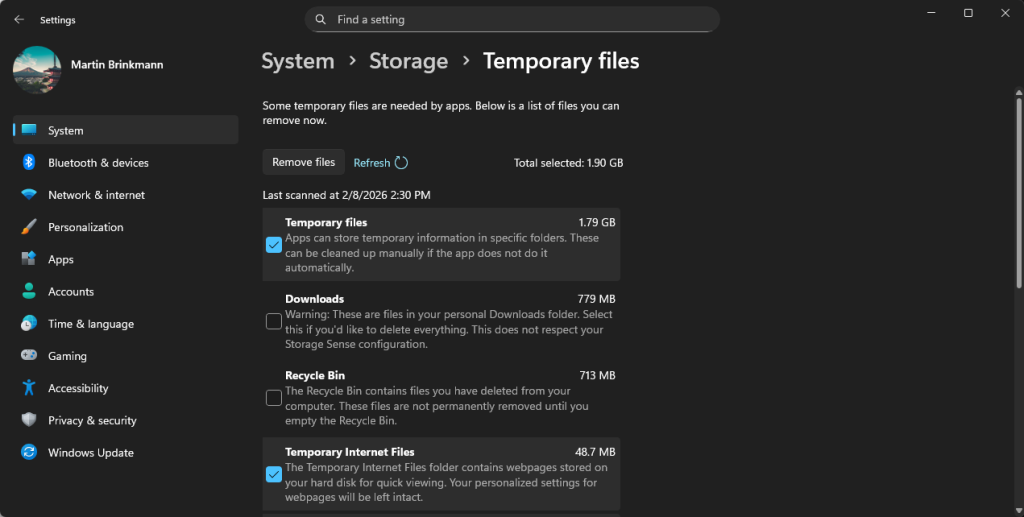
If you have installed the preview update (KB5074105) for Windows 11’s February update, you may have noticed that something is amiss. Opening the Storage part in the Settings app fires an UAC prompt now and some options seem to have been removed.
Microsoft says the security prompt is introduced to “ensure that only authorized Windows users can access system files”. An unelevated process scans and displays only the folders that the current user account has permission to see.
The move has four objectivesfor Microsoft:
Preventing the unauthorized enumeration of system files.
Reducing accidental system damage, for instance when a user deletes the previous Windows installation, as Windows can’t be rolled back anymore in that case.
Reducing local attack vectors.
Alignment with the least privilege security model.
Some cleanup options are AWOL
The Temporary files cleaner in Settings / Storage has fewer options after installing the Windows update.
Is it a bug or a feature? While the newly introduced UAC prompt for the Storage part of the Settings app seems to work just fine, users noted that some cleanup options were missing.
Options such as Windows Update Cleanup or Device Driver Packages do not appear anymore when you select the Temporary files option on the Storage page.
Microsoft has not confirmed this as an issue and at this moment, it is unclear whether this is intentional or a bug that will get fixed eventually.
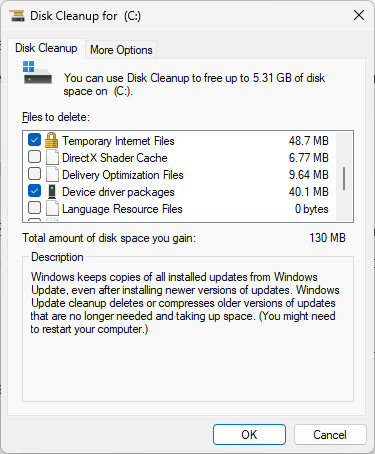
The Disk Cleanup tool has the missing options.
The solution: While Storage in Settings fails to provide users with elevated rights with the proper cleanup options, the legacy Disk Cleanup tool continues to show these options.
Just open the run box with the shortcut Windows-R, type cleanmgr.exe, and press the Enter-key to get started. Make sure you select “clean up system files” after the initial scan to see all options.
Summary: The update didn’t just add a security prompt; it seemingly broke the logic that populates the list in the modern Settings app, forcing users to go back to the old Windows 98-era “Disk Cleanup” tool to do a proper system scrub.
It remains to be seen whether the cumulative updates for Windows 11, which Microsoft will release on February 10, 2026, will correct the issue.
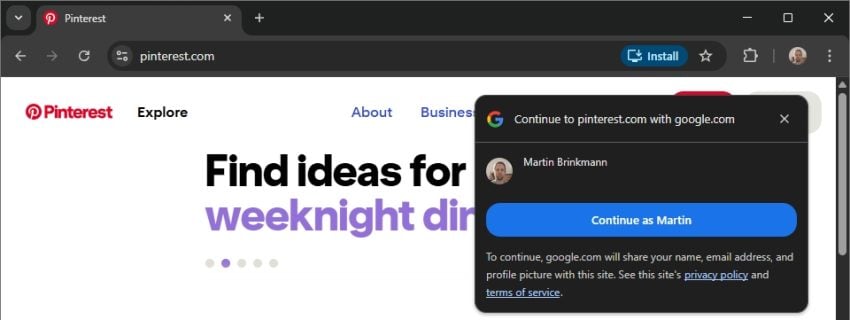
If you are using Chrome and are signed-in to a Google account, you may have received a fair share of requests to sign-in with your account on third-party websites, provided that you do not have an account there already.
The main idea is to make sign ups on third-party sites easier and more secure by using the Google account. Google provides the site with information to set up the account and you decide much of what you want to share and what not. The user password is never provided by Google, which is an advantage.
There are disadvantages: using one account for multiple sites and Google knowing which sites you create accounts on.
The prompts appear on site load and at least some users find them highly annoying. Not everyone wants to (or can) use Chrome without being signed in or switch to another browser. There is another option, but it is hidden deep in the Chrome settings.
How to stop Chrome from showing “Continue As” prompts
Here are the required steps for desktop Chrome:
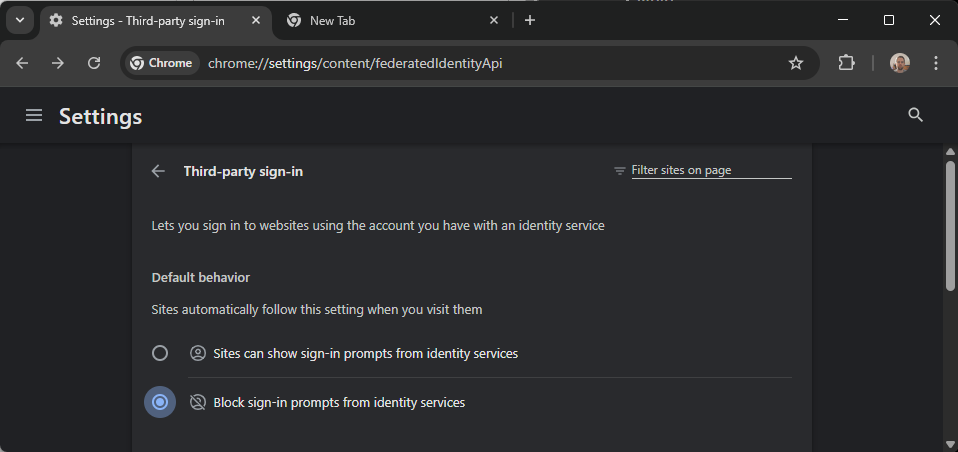
Enable the block option in the Settings to prevent continue-as-prompts in the future.
Load chrome://settings/content/federatedIdentityApi in the browser’s address bar.
Enable “Block sign-in prompts from identity services” under Default Behavior.
This takes care of the prompts. You can add sites to the allow-list, but this is only useful if you want to create an account on the website using your Google information.
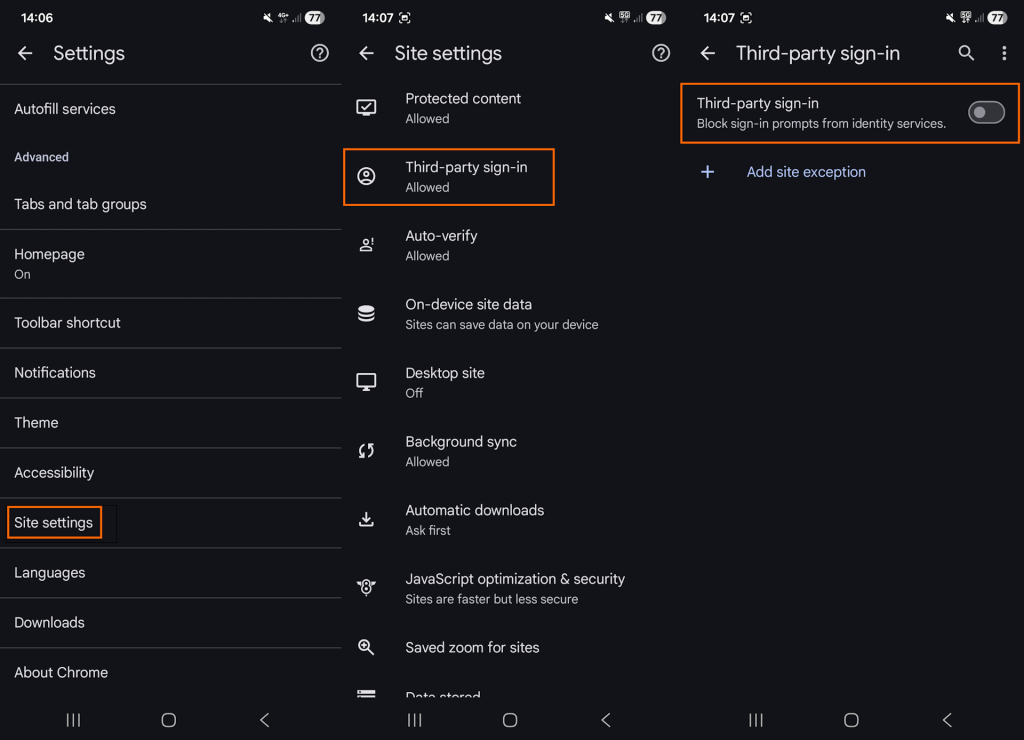
Here are the required steps for mobile Chrome:
In mobile Chrome, you need to open the setting manually.
Open the Settings.
Go to Site Settings.
Tap on Third-party sign-in.
Toggle “Third-party sign-in” so that it is off.
This blocks all future attempts in mobile versions of the Chrome web browser.
Manage existing connections
Google’s support page provides information on managing existing connections. You can review all connections on the third-party connections page on Google’s website.
Switch to the “Sign-In with Google” tab first. Google lists all connections and you may click on the “>” icon to display details. There you may remove it by selecting “Stop using Sign in with Google ” and confirm the decision.
Note that this severs the connection only, but it does not affect the data that the third-party site has accumulated.
What you may do instead
While the option to use your Google account on third-party sites may be convenient, most users may benefit from separating accounts.
Apart from providing Google and the third-party site with additional information, any successful account breach gives the attacker access to not only Google but all other sites with connections.
My suggestion: stick to the one site, one unique account rule, and turn off the prompts, if you do use Chrome and want to stay signed in. (source: Caschys Blog)
In a few years, hard drives could cross the 100 TB barrier, but at what cost?
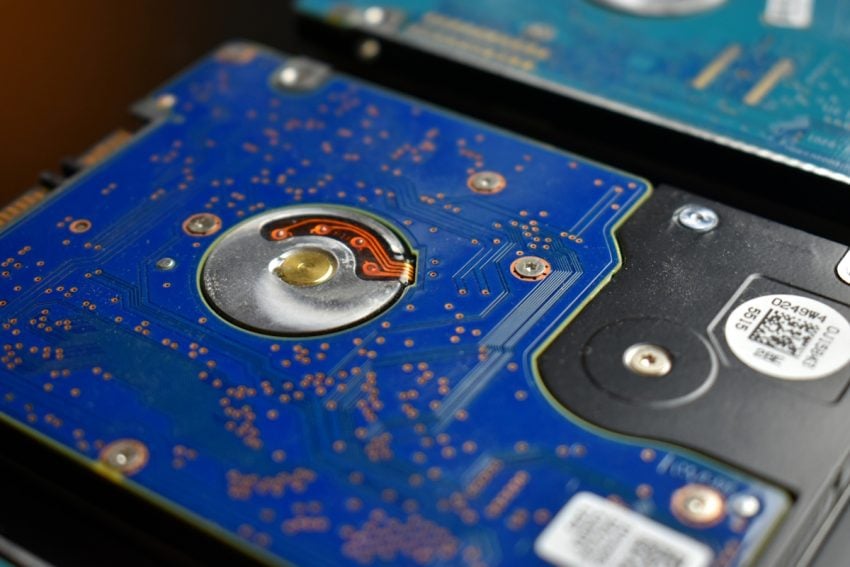
Western Digital, now rebranded as WD, lifted the veil on a roadmap that it hopes will shatter the 100 terabyte storage barrier by 2029. Announced at its Innovation Day 2026, the strategy leverages a dual-path approach using both Heat-Assisted Magnetic Recording (HAMR) and Enhanced Perpendicular Magnetic Recording (ePMR) to meet the growing demands of AI.
With 40TB UltraSMR drives already entering customer qualification and a clear engineering path to 100TB+, the industry is finally moving past the incremental gains of the last decade toward a future where massive, high-performance capacity is no longer the bottleneck of innovation.
The next step, 40 TB UltraSMR hard drives, are actually already being tested by two customers according to WD. The company plans to mass produce the hard drives in the second half of 2026.
Engineers run test on the Heat-Assisted Magnetic Recording (HAMR) drive technology, which could see first hard drives on the market in 2027.
WD plans to extend Energy-assisted Perpendicular Magnetic Recording (ePMR) drives to 60 TB and scale HAMR to 100 TB by 2029. Both types of drives are built on common architecture according to WD, which enables “greater manufacturing efficiencies, yields, and a smoother customer product transition”.
The real kicker is that WD says that two new technologies that improve HDD performance significantly and support “workloads previously considered flash-only”.
The company writes:
High Bandwidth Drive Technology enables simultaneous reading and writing from multiple heads on multiple tracks delivering up to 2x the bandwidth of conventional HDDs without power penalties. The technology has a clear path to scale up to 8x bandwidth gains and is already in customer hands for validation.
Dual Pivot Technology adds a second set of independently operating actuators on a separate pivot and will deliver up to 2x sequential IO gain within a 3.5-inch drive. This differs from previous dual actuator designs that sacrificed capacity and required extensive customer software changes. Dual Pivot enables reduced spacing between disks, allowing for more platters per drive and higher overall capacity.
WD says that the technologies combined increase sequential IO to 4x overall. The company expects that HDDs with Dual Pivot Technology will become available in 2028.
Closing Words
These drives are largely built for use in data centers and not at home. However, it is likely that consumers will also benefit from an increase in storage. WD did not reveal pricing information but it is clear that these drives won’t be cheap and probably too expensive for the majority of home users out there.
It usually happens in the first five seconds: you click on a video expecting the familiar, expressive voice of your favorite creator, only to be greeted by the flat, sterile drone of a synthetic narrator. That Japanese video game trailer? Has a voice over that sounds like a bored car salesmen from the Midwest.
If you watch YouTube content in different languages, there is a good chance that you encountered the video hosting site’s auto-dubbing feature before.
The idea is simple: To make content available to a wider audience, YouTube is giving creators access to tools that translate speech into other languages. This, according to YouTube, makes videos more accessible.
However, if you speak multiple languages or prefer to watch videos in the original language, you may have run into the problem that YouTube picked an AI-powered translation for you regardless.
YouTube announced an extension of AI dubbing on the platform recently. The feature is now available to creators worldwide and in eight languages. Expect this to increase further in the coming years.
What you can do about it
Google has implemented two options for YouTube users. One works for individual videos and requires no account, the other for all videos, but requires an account.
Third-party solutions, in the form of extensions, are also available.
The Quick Fix (Per Video)
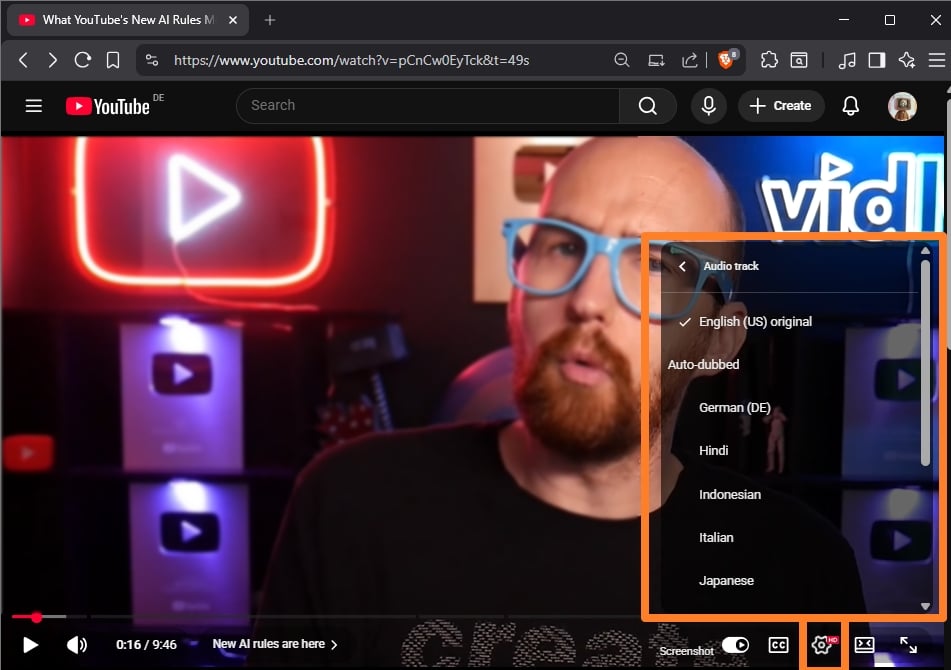
YouTube shows the original language and all dubbed languages when you open the Audio Track setting. (Image Source: vidlQ / YouTube)
If you are watching a video and hear an AI voice, you can switch back to the original voice immediately.
Pro: Works without account.
Con: Needs to be done for each video, preferences are not saved.
Here are the steps:
Click/Tap the Gear Icon (Settings) on the video player.
Select Audio Track.
Choose the option labeled Original (e.g., “English (Original)” or “Japanese (Original)”).
The Permanent Fix (Account Settings)
If you are signed in, add languages that you never want YouTube to dub using AI.
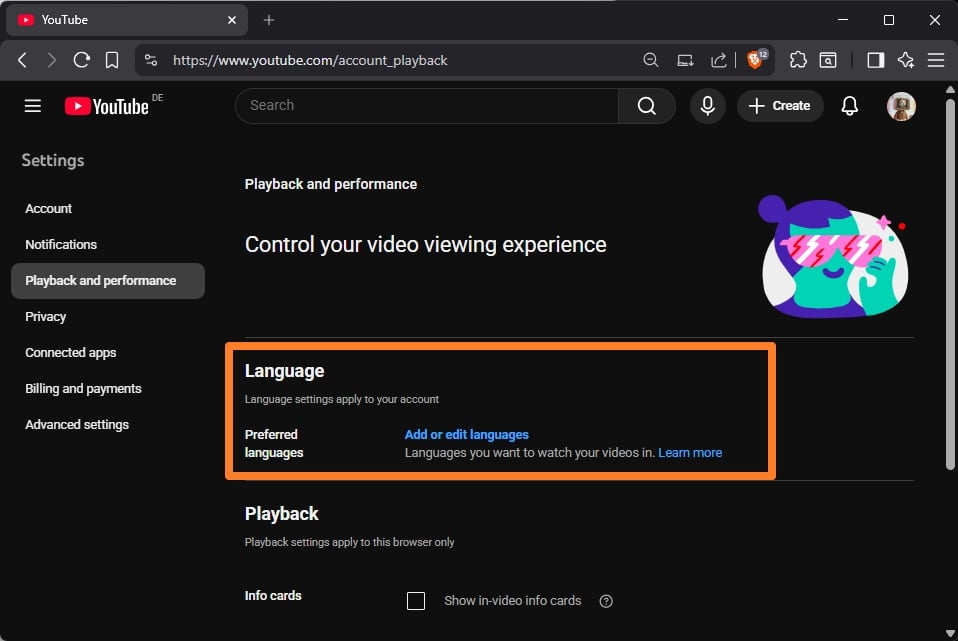
A new YouTube setting enables you to set all languages that you understand (or do not want dubbed).
Pros: Works for all videos.
Cons: Not a true “never” option. Requires a YouTube account and using it all the time.
Here are the steps:
Go to the YouTube Settings.
Select Playback and performance.
Look for “Preferred languages“ or “Add or edit languages“.
Select all the languages you speak/understand/don’t want dubbed.
The browser extensions
Extensions offer best of both worlds: they do not require an account and they work for any video that you encounter. Set once and forget.
Here is a short selection of extensions that you may want to try:
YouTube Anti Translate (Chrome / Firefox) – The extension disables the automatic translation of YouTube titles, audio, or descriptions using AI. Works automatically, open source extension.
YouTube Audio Selector (Chrome) — Set preferred languages for YouTube to make sure that they are never AI-translated.
What about you? Did you encounter AI dubbed videos on YouTube before?
The eBay marketplace offers a treasure trove of sales data, readily available for everyone. It is a great option to find out if your first-press record is worth next to nothing or a fortune.
Most Internet users know that they can search on eBay for items and they get a list of sellers that sell that item. While that search is not always accurate, as you may get items listed that are not exactly what you are looking for, it reveals the minimum and maximum price that sellers are asking for the item at the time.
That is useful information, but it is not based on actual data, not a reflection of real-world value. Anyone can sell a pencil for a million bucks on eBay, but the chance that someone will buy it for the price is slim.
However, eBay includes tools to look up past sales off that item. Good news is that this information is publicly available. You do not need an account or a subscription for that. It is free and available on all eBay sites.
Note: Sellers on ebay may access the company’s Terapeak that offers several advantages, including a 3-year price history instead of the 90-days that anyone gets and average sold price data.
Checking prices on eBay
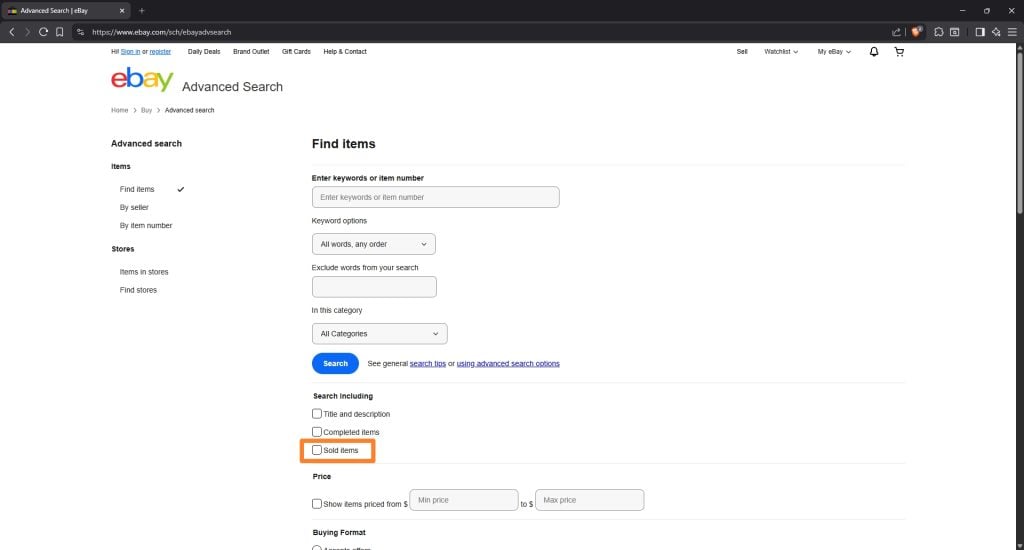
Do not forget to check the “sold” box to look up past sales on eBay.
Lets say you want to find out how much your Samsung Galaxy A55 5G 128GB mobile phone is worth.
Open the eBay website on a desktop system.
Type the name of the product in the search field and click on search to get active offers.
Click on the Advanced link at the top.
Check “sold items”
Click on search on the page.
The eBay mobile apps offer this as well. Run the search, activate the filter option at the top of the search results page, expand “show more” and toggle “sold items” there. Hit the results button afterwards to get the list of sold items.
Now you get matching mobile phones that were actually sold on eBay. The list is sorted chronologically, with the most recent sales at the top.
You can use the filters to narrow it down further. If your device is used, check it under condition. You can also sort by lowest price ever, but this is often not recommended, as the price may change over time. For mobile phones, it usually goes down with time, but for other items, like many Lego sets, it may actually go up.
Here is a pros and cons list of using eBay to determine prices.
The Pros: Why It’s the Gold Standard
Actual Sales vs. Asking Price: Active listings only show what people want. Sold listings show what people are actually willing to pay, which is the only true metric of market value.
High Volume Data: For common items (like electronics or popular toys), the sheer volume of sales provides a very accurate “average” price point.
Supply and Demand Insights: By looking at “Completed” vs. “Sold” listings, you can calculate the sell-through rate. If 100 items ended but only 5 sold, you know the item is a “slow mover,” regardless of the price.
Niche Precision: eBay is often the only place with enough data to value obscure collectibles or vintage parts that don’t appear in traditional price guides.
Keyword & Photo Research: You can see which specific keywords (e.g., “MCM,” “Rare,” “Tested”) or photo styles led to the highest sale prices.
The Cons: Where it Can Mislead You
The “Best Offer” Trap: In a standard search, if an item sold via “Best Offer,” eBay often displays the original asking price with a strikethrough. You don’t actually see the final negotiated price (which could be 50% lower).
The 90-Day Cliff: Standard searches only show the last 90 days of data. For rare items that only sell once or twice a year, 90 days of history might show “zero results,” leading you to think the item is worthless when it’s actually just rare.
Condition Discrepancies: A “Mint” version of an item might sell for $100, while a “Good” version sells for $20. If you aren’t careful to match the condition of the sold items to yours, your estimate will be way off.
Shipping & Fees: The “Sold” price doesn’t account for the fees the seller might have paid or the shipping costs they might have eaten.
Outlier/Fake Sales: Occasionally, “Sold” listings are the result of non-paying bidders or shill bidding (fake accounts bidding to drive up perceived value). One massive price spike among dozens of lower sales is usually an outlier to be ignored.
Why not just sell for $1 in an auction?
Selling items for $1 works well in some cases, especially if a category has a lot of traffic. Many Games or popular mobile phones will almost always reach the average sales price, provided that you do not let the auction run out in the middle of the night or on a public holiday.
However, items that are not that sought after, including rare items, may be sold for a lower price.
I’m currently selling part of my vast CD collection on eBay. I first thought of selling each item for $1 in an auction, or in bulk packages, say 50 CDs for $50. That is less time consuming than researching prices.
The problem here is that you will make less money, guaranteed. Some rarer CDs will sell for less. That is why I decided to research each CD, beat the competition by a few cents to be the lowest seller on eBay at the time, and include shipping costs in the price as well.
Yes, takes an awful long time, but it is well worth it once you realize that some rarer CDs sell for $10 or more.