For forty years, you launched apps by clicking and typing—but Nvidia wants your next computer to simply do the work for you and behave more like R2-D2 and C3PO.
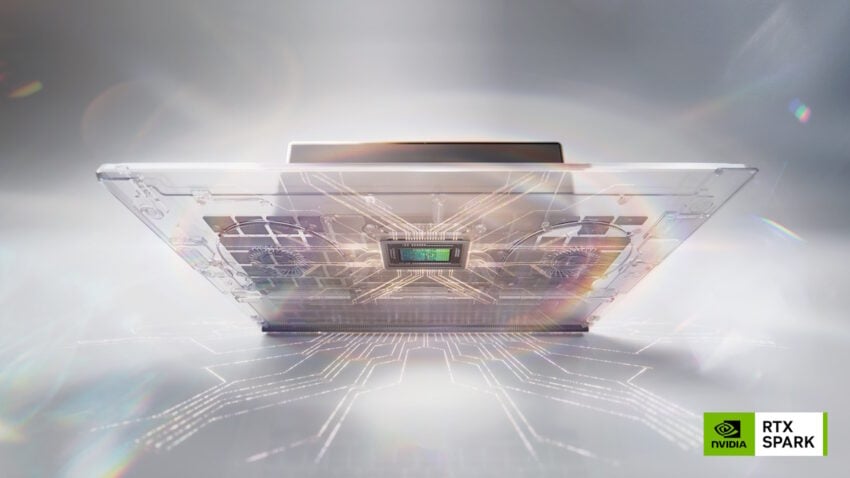
Kicking off Computex 2026 with a high-octane keynote at GTC Taipei, Nvidia CEO Jensen Huang officially unveiled the RTX Spark, a novel 1-petaflop system-on-a-chip designed to completely reinvent the Windows PC for the era of personal AI agents.
Up until now, Nvidia delivered graphics cards to PC users but kept out of the ongoing CPU-battles between AMD and Intel. This changes with the new chip, which is a custom 20-core ARM CPU infused with Nvidia’s Blackwell GPU-architecture and a huge 128 GB of unified memory.
This, according to Nvidia, allows PCs to run massive local AI models and the most taxing tasks. Yet, while Nvidia claims that this will move PCs from basic tools to active teammates, a staggering price tag may limit the audience to the ultra-premium tier.
Under the Hood
The RTX Spark represents a complete architectural split from the traditional x86 platform that Intel and AMD have dominated for years.
By designing a SoC (System on a Chip), Nvidia is bringing ultra-tight hardware integration similar to Apple’s M-series of chips to high-performance Windows PCs, but with the added benefit of a strong graphic processing part.
Based on the technical data revealed during the keynote, here is what is known about the silicon powering the RTX Spark:
- The Custom ARM CPU: The 20-core processor utilizes a custom architecture optimized specifically for Windows on ARM. It splits workloads efficiently between high-performance cores for demanding tasks and high-efficiency cores to keep background OS processes from draining resources.
- Blackwell Graphics Pipeline: Rather than relying on a separate graphics card connected via PCIe, desktop-class Blackwell GPU cores are baked directly onto the same die. This eliminates the latency bottleneck between the processor and the graphics card, allowing for instantaneous asset loading and ray-tracing calculations.
- Next-Gen Unified Memory: The headline-grabbing 128GB of unified memory operates on a massive bus width, allowing both the CPU and GPU to pull from the same pool of lightning-fast RAM.
- The 1-Petaflop AI Engine: By fusing traditional Tensor cores with a dedicated, next-generation Neural Processing Unit (NPU), the chip delivers unprecedented local AI throughput. This isn’t just for blurring webcam backgrounds; it provides the raw muscle required to generate complex code, render real-time AI upscaling, and drive persistent local operating system agents simultaneously.
Innovation on this scale doesn’t come without structural trade-offs. While ARM architectures are fundamentally praised for their power efficiency, pushing a petaflop of local compute requires advanced cooling solutions.
While Nvidia has kept exact MSRPs under wraps until its hardware partners (such as ASUS, MSI, and Razer) open pre-orders closer to the fall launch, the pricing strategy is premium.
WinFuture notes that the price of the very first N1X-powered device, the Lenovo Yoga Pro 7, starts at around $3000 and goes all the way up to $4600 for the premium version. Cheaper models are planned, but it looks as if these devices will push premium computing on Windows to a whole new level.
“The Lenovo Yoga Pro 7, starts at around $3000” which is relatively inexpensive when considering the capabilities.
The MSI Raider 18 HX AI is running $3800; I doubt the chip is anywhere close in raw computing capability.
As mentioned before, those who want the best can have it for free–one invested in NVDA a few months ago was just handed a new Windows PC with the new Nvidia chip. Market dynamics–take the $3,000 and invest in NVDA months ago when it was on sale; wait for the Taiwan conference and news in early summer; be ready to purchase a new computer in the fall.
LLM’s eat ram which is why nand prices have tripled recently.
128GB isn’t “massive” by any measurement when it comes to AI but it’s enough to squeeze a decent little LLM on.
The most important bits of info are missing here, which LMM and can I change it and, most important, context size, how many tokens? What good is an “AI OS” that can’t remember what I said yesterday?
The title says “Windows”, this would be a privacy nightmare. I can see it now, the AI deleting my firewall rules, removing software somebody put on a list or just refusing to install it, “I’m sorry, M$ hasn’t approved that!”, undoing all my tweaks to the OS.
I’m not against AI, I use them daily now, one has some limited access to my local files but baked into my PC, um… nope… not happening.
@Tachy–“I’m not against AI, I use them daily now, one has some limited access to my local files.” So great to hear someone using AI on a daily basis; AI is truly revolutionary in so many fields–landscaping, remodels, medicine, financial consultants, etc. But, my doctor despises AI for well-known reasons; the contractors I’ve worked with despise it because it provides “real time” labor/material costs for this area which gives me a good indication how much “mark up” they charge; landscapers are ridiculed by it because it offers much better alternatives to their “cookie cutter” imaginations. And journalists who fail to realize AI as a research tool, not a writing tool, are baffled by the endless possibilities of producing extraordinary investigative articles. And financial consultants/tax pros loathe it because it offers better advice than they do–simply because of its ability to harvest vast amounts of information. It’s truly a new era!
Hardware complying to AI requirements and not the other way around definitely means AI is the leader, the reference around which all is thought, planned and decided. Reading the article and discovering the power (and the price) of this “RTX Spark, a novel 1-petaflop system-on-a-chip” makes me feel tiny with the 13 year old duo-core PC running old Firefox ESR on old Windows 7 🙂 Need to say a majority of users are in-between the ground (as myself) and the heavens (top-notch) in terms of digital environment. Who cares if you get what you need? Moreover, power if dedicated to built-in AI systems does not, at this time, get me frustrated given I feel no excitement for an LLM driven machine. But if I live long enough to reach an era where they’d be no choice, guess I’d have to comply. Burt we aren’t there yet. Let them take their time to impose AI everywhere, no hurry!