Chipp.in Tech News and Reviews

Windows, Security & Privacy, Open Source and more

Menu
  • Home
  • Windows
  • Security & Privacy
  • Gaming
  • Guides
  • Windows 11 Book
  • Contact
  • RSS Feed
Menu

Tag: brave

Brave is getting Container support and the feature has made a big jump recently

Posted on April 14, 2026April 14, 2026 by Martin Brinkmann

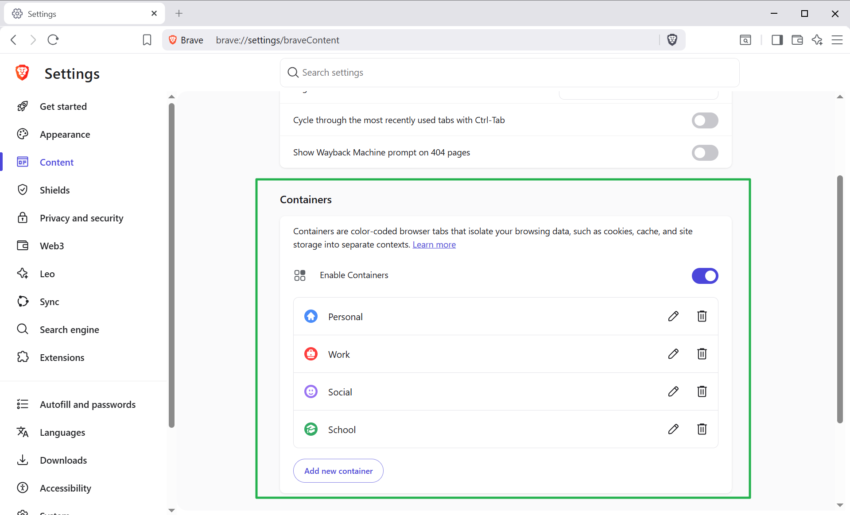
Firefox fans have long heralded the browser’s Multi-Account Containers feature as an exclusive that users of Chromium-based browsers did not have. Soon, Brave Brower users may also make use of a Containers feature, ending Firefox’s exclusivity.

Brave has begun rolling out native Container support as an experimental flag in its desktop browser as of April 2026. It allows users of the browser to isolate web sessions better and even get options to open multiple accounts of the same site in a single browser window without using clunky workarounds or third-party extensions.

The Core Concept: Session Isolation

At its core, the Containers feature creates isolated islands within a single browser window. Each container acts as a separate, sandboxed environment. Data, including cookies, local storage, or cached files, can’t be seen or accessed by tabs in another container or by the default container-less environment.

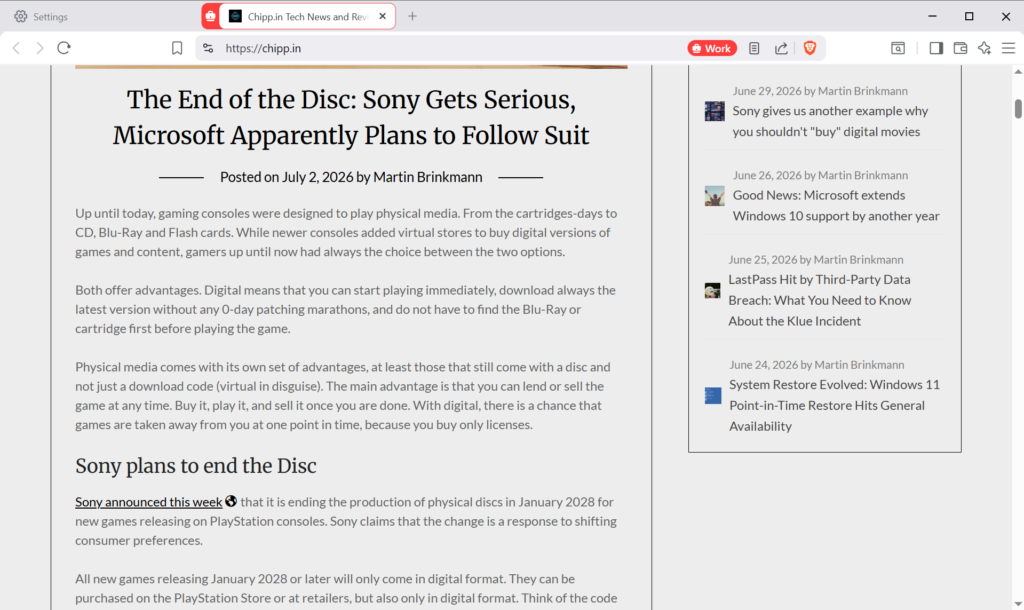
Since data is sandboxed, it is possible to sign-in to the same site in different containers in the same browser window using a single profile, or to open a site with an account and without one at the same time. Furthermore, since data is separate, tracking becomes less effective as the trackers can only see what is going on in a single container and not the entire browser.

Containers works with tab groups and all core features of the browser, including browser extensions.

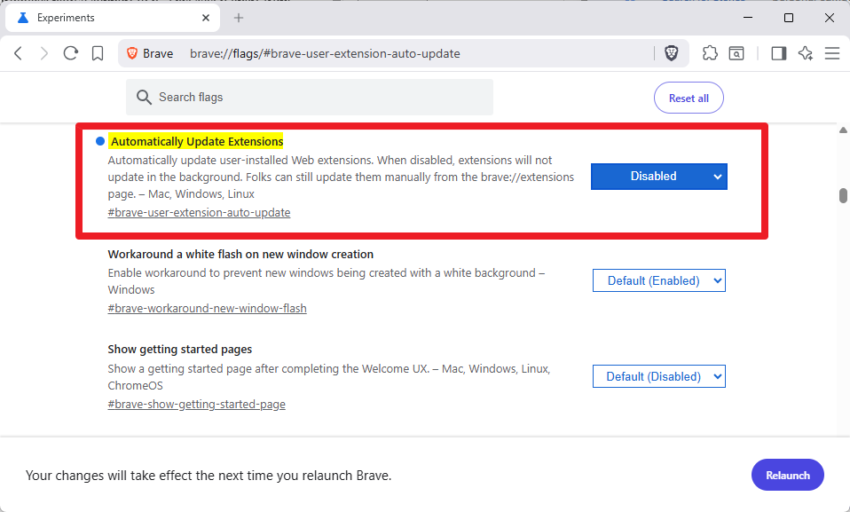
The feature is available in Brave Nightly only at the time. You need to load brave://flags, search for Enable Containers, and toggle the feature to Enabled to start using it. A restart of the browser is required as usual before it becomes available.

Since this feature is in Nightly, it may have bugs and may not be as polished as the stable version that Brave Software plans to ship in a later version of the browser.

Brave slashes memory use of its ad-blocker by at least 45 megabytes on all platforms

Posted on January 6, 2026January 6, 2026 by Martin Brinkmann

Brave Browser is one of the few major web browsers that supports native content blocking on all supported platforms that is enabled by default. It should not come as a surprise that the browser is on an upwards trajectory when it comes to users and popularity.

While Brave is not without controversy, it is clear that Brave Software has made several meaningful strategic decisions in the past that has benefitted the business immensely.

Quick Tip: do this, if websites do not react anymore in Brave on first load.

Content blocker improvements

Brave announced today that it has improved the memory usage of its internal content blocker significantly. The company claims that it has reduce memory usage by about 75 percent, which equates to a reduction of about 45 megabytes on all supported platforms.

Brave says that users who have enabled additional filters will see an even larger reduction in memory usage going forward.

How it managed to do that? Brave explains:

..we achieved this major memory milestone by iteratively refactoring the adblock-rust engine to use FlatBuffers, a compact and efficient storage format. This architectural transition allowed us to move the roughly 100,000 adblock filters shipped by default from standard, heap-allocated Rust data structures (such as Vecs, HashMaps, and structs) into a specialized, zero-copy binary format.

Brave notes that it has implemented several optimizations in addition). These are:

  • Memory management: Used stack-allocated vectors to reduce memory allocations by 19% and improved building time by ~15%.
  • Matching speed: Improved filter matching performance by 13% by tokenizing common regex patterns.
  • Sharing resources: Resources are shared between instantiations of adblock engines, saving ~2 MB of memory on desktop.
  • Storage efficiency: Optimized internal resource storage memory by 30%.

The main memory reduction and optimizations landed in Brave 1.85 while additional optimizations will be included in the next release of the browser.

It will be interesting to see how users who have enabled additional filters in Brave benefit from the change.

Adding extra filters in Brave

It is quite easy to add more filters to Brave to extend the content blocking functionality.

Note: Each list that Brave supports natively offers a short description of what it does. Fanboy’s Anti-Newsletter list, for instance, blocks newsletter popups on websites.

  1. Select Menu > Settings, or load brave://settings/ directly in the address bar.
  2. Go to Shields > Content filtering.
  3. Click on “show full list” to display all included filter lists.
  4. Check the lists that you want to enable in Brave.

Note that adding lists will increase the memory usage of the content blocker and thus Brave. It is recommended to keep the list as short as possible.

As for recommendations, it depends largely on your Internet browsing and which annoyances you encounter regularly. YouTuber regulars, for instance, could enable filters for mobile distractions and recommendations, if they use Brave on their mobile devices.

There are also language-specific block lists, which are useful if you visit websites regularly in a specific language.

Cookies

Brave: Quick Tip if websites do not react to input when you load them

Posted on December 26, 2025December 26, 2025 by Martin Brinkmann

Brave Browser includes several convenience features, mostly linked to the built-in content blocker. One of the features deals with cookie prompts automatically.

This works well most of the time. Whenever a cookie prompt appears, it is handled immediately by the browser in the most privacy-respecting manner.

Announced in 2022, it has been a feature of the browser ever since and is enabled for all users since mid-2023.

Here is how Brave describes the feature:

One approach (which Brave uses) is to block cookie banners, and to hide and to modify pages to remove any additional annoyance such systems include (such as overlays, preventing scrolling, etc.). Other Web-privacy tools (such as uBlock Origin) can be configured to use this same approach. This approach provides the strongest privacy guarantees: it doesn’t require trusting that the cookie consent systems will respect your choice, and prevents your browser from needing to communicate with consent-tracking systems at all.

Brave blocks cookie banners and deals with any nuisances related to them, including overlays.

However, while that works well most of the time, you may come upon websites that do not seem to work at all. You do not see a cookie prompt, but you can’t interact with the site. No scrolling, clicking on links, copying text. Nothing works.

This may be related to the script that deals with the cookie banners. It is possible that the site changed its code or that Brave does not support the specific cookie prompt the site uses. Brave’s solution relies on EasyList, a community managed list, which means that it works only when sites use one of the identifiers of the list.

Reloading does not resolve the issue, as the site will get stuck again. In fact, the only option that is working is to allow the cookie banner script to display and deal with it manually.

Sidenote: You could dig in the code and find the references to block them manually. May be worth a short, if you visit the site regularly.

The quick solution: Reject everything, deal with the cookie banner manually, and enable the script-blocking of the browser again for the site.

Granted, this is not ideal, as you allow the site to run all of its scripts and such. You could try and allow certain scripts to run only, which is the better approach, if you have the time to adjust this manually, as you will limit scripts this way.

If you are in a hurry though, you may use the method described above to quickly gain access to the site.

Once you have dealt with the cookie banner script, you should be able to use the site in question normally.

YouTube Shorts

Brave: it takes a few clicks to get rid of YouTube Shorts once and for all

Posted on May 30, 2025May 30, 2025 by Martin Brinkmann

The rise of TikTok has saw established sites and apps like YouTube or Instagram scrambling. On YouTube, one response was the introduction and promotion of Shorts, a short video format that resembles TikTok’s own.

YouTube Shorts seem to split the user base. Some like it, others dislike it with a passion. If you fall into the second group, you may like the idea of removing Shorts from YouTube altogether.

If you use Brave Browser, that is handled with just a few clicks. Note that you can also do that in other browsers, which I explain later as well briefly.

Brave Browser's Anti-Shorts video to block YouTube Shorts

So, if you do use Brave Browser, do the following to get rid of YouTube Shorts:

  1. Load brave://settings/shields/filters in the browser’s address bar.
  2. Click on “show full list” underneath the Filter lists section near the top.
  3. Check “YouTube Anti-Shorts”.

Tip: you can also add more, e.g., YouTube Mobile Distractions or YouTube Mobile Recommendations, or any of the other filter lists displayed on the page.

When you reload YouTube now or open the site, you will notice that Shorts are gone. No more Shorts content when you search for videos on YouTube. Shorts is gone from the sidebar, and when you browse recommendations and suggestions, it is also gone.

Now, if you use a different content blocker, like uBlock Origin, then you may add the instructions that Brave uses to it as well. You find Brave’s list here on GitHub. All you need to do is add the instructions as custom filters in uBlock Origin. Any other ad-blocker that supports this filter syntax will work as well.

Now You: What is your take on Shorts on YouTube? Great entertainment and value, or so mundane that you’d rather watch grass grow? Feel free to leave a comment down below.

Brave Browser gets support for injecting scripts into websites

Posted on February 7, 2025February 7, 2025 by Martin Brinkmann

Remember userscripts? These little scripts are a useful alternative to browser extensions. They can be used for lots of things, most often for changing something on websites, like removing elements.

Brave Software announced support for scriplets in the company’s Brave Browser today. These work similarly to userscripts. Users of the browser may add scriptlets to Brave so that they run on selected sites automatically.

The new feature has landed in Brave 1.75, the current stable version of the browser.

Good to known: the process is fiddly right now. You need to enable developer mode, add the scriptlets yourself, and assign websites to these scriplets using custom filters.

Here is how it works in detail:

  1. Load the Content Filters section of the settings. The easiest option is to load this URL: brave://settings/shields/filters
  2. Toggle Developer Mode to turn it on.
  3. Activate the “add new scriplet” button on the same page after enabling developer mode.
  4. Type a name for the scriptlet. You may want to avoid spaces.
  5. Type or paste the code of the script.
  6. Select the Save button.
  7. Now use the following syntax to assign the scriptlet to specific websites: example.com##+js(name-of-your-scriptlet.js)
  8. Select the save changes button.

Notes:

  • Replace example.com with the hostname of the website, e.g., chipp.in.
  • Replace name-of-your-scriptlet.js with the name that you have specified during creation.

Brave will execute the script whenever the matching domain is visited.

You can check out the technical documentation of the feature here.

Userscripts or Scriptlets?

Userscript extensions offer some advantages. They may load userscripts easily from various sources, and they may also update them. They also work in all browsers, which is great if you use multiple browsers.

Brave’s solution supports pasting scripts, but it is still fiddly to link them to specific sites and maintain them.

With that said, it may be interesting to advanced users who prefer to avoid extensions whenever possible.

I cannot really say how Brave’s integrated solution compares to userscripts. It is more powerful, equally powerful, or less?

What is your take on the integration? Good move by Brave?

Brave Shields Down

Brave: if a loaded webpage does not react to your input, try this

Posted on October 2, 2024October 2, 2024 by Martin Brinkmann

When I use Brave Browser, I sometimes encounter websites that do not react at all after load. Scrolling does not work, clicking on links does nothing, and you cannot even copy text.

The site appears crashed, but the rest of the browser works fine.

Here is one reason for the issue: Brave reacts to cookie and privacy prompts automatically. This works well most of the time, but sometimes, it does not.

Sites stop responding in those cases. You can reload them, but the issue persists. There is a solution though.

  1. Click on the Shield-icon in Brave’s address bar.
  2. Toggle the Shields functionality to Off. Brave reloads the webpage.
  3. You should get a privacy prompt now.
  4. Select Reject all or whichever option you want.
  5. Re-enable Shields. The site reloads.

The webpage works normally from that moment on. It is not locked anymore and you may interact with the site again.

I do not experience the behavior often. Maybe once every 250 or so sites I open and visit.

What about you? Did you notice the odd behavior? Feel free to leave a comment down below.

Brave

Brave Browser may support some Manifest V2 extensions even after Google’s shutdown

Posted on June 30, 2024June 30, 2024 by Martin Brinkmann

There has been a lot of talk about Google replacing the extensions system of the Chromium web browser with an updated version. Chromium is the source for many browsers, including Google Chrome, Brave Browser, Opera, Microsoft Edge, and many more.

While open source, it is Google that controls Chromium to a large degree.

Brave Software, maker of the Brave Browser, has now announced its stance on existing extensions support and the upcoming changes.

Here are the highlights:

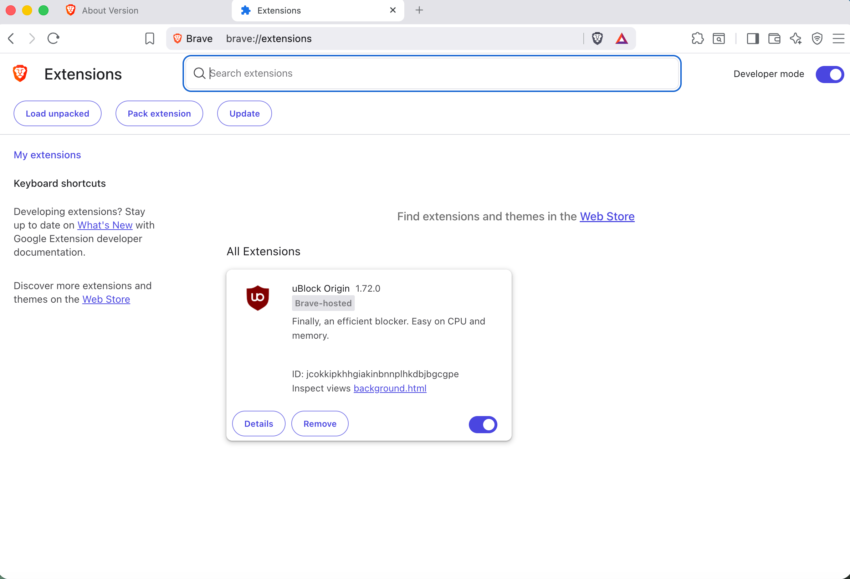
  • Classic extensions continue to work until at least June 2025. Brave activated an Enterprise-feature to extend support.
  • Brave Software plans to support a small number of extensions beyond June 2025: AdGuard, NoScript, uBlock Origin, and uMatrix
  • Brave Shields is unaffected.

Brave Software’s plan

Brave Software Manifest V2 Extensions page

All classic extensions will continue to work in Brave Browser until at least June 2025. Brave Software uses an official setting in Chromium to extend support.

Google plans to end support this year, but allows Enterprise customers to extend support by a year.

Come June 2025, Brave Software hopes that it can continue to offer support for four major content blocking extensions.

  • AdGuard
  • NoScript
  • uBlock Origin
  • uMatrix

This requires modification of Chromium code and the developers of the extensions according to Brave Software.

The company notes:

While Brave has no extension store, we have a robust process for customizing (or “patching”) atop the open-source Chromium engine. This will allow us to offer limited MV2 support even after it’s fully removed from the upstream Chromium codebase.

Extensions that become “stale or obsolete” may be removed. One example is the creation of a Manifest V3 extension that offers the same or similar functionality.

Brave users may control the four mentioned extensions, and any that may be added along the way, on the new Extensions page in the Settings.

Just load brave://settings/extensions/v2 to access it. Here users may enable or disable support for the Manifest V2 extensions. Note that this happens automatically, if one of the extensions gets installed in the web browser.

Closing Words

Manifest V2 extensions will eventually go away. While it is commendable that Brave Software plans to extend support for some beyond June 2025, it is clear that this is only a temporary measure.

Content blocking remains possible, even in Chromium-based browsers. The adblockers may not be as effective or feature-rich anymore, but it is likely that most blocking operations continue as before for the majority of users.

Those who want full control may switch to Firefox, as the Mozilla browser will continue to support Manifest V2 next to Manifest V3.

What about you? Do you use a Chromium-based browser and Manifest V2 extensions currently? What will you do when support ends?

Brave signing you out all the time? Here is a fix for that

Posted on June 24, 2024June 24, 2024 by Martin Brinkmann

For several months, I have noticed a rather strange behavior of Brave Browser. Whenever I use it to write articles on WordPress sites, it is logging me out on start or shortly thereafter.

This happens very frequently to the point that it is quite annoying. The following guide may help you resolve the issue. It fixes the issue on my end.

The basics: checking settings

Brave Delete Cookies and site data on exit setting

Brave supports several features that may interfere with accounts you are signed in.

Here is what you want to check first:

  • Click on the Shield icon, expand Advanced Controls, and check that “Forget me when I close that site” is not checked.
  • In the same menu, check that “Block all cookies” is not selected.
  • Load brave://settings/clearBrowserData and verify that “cookies and other site data” is not cleared on exit.
Brave Shields

If these options are set correctly, which they were on my end, then you may proceed to the next section.

Finding the actual culprit

Brave Secure DNS setting

Making a change to the following option resolved the issue on my end. There is a bonus tip at the end, if making the change does not work for you.

  1. Open the Privacy and Security settings page by loading this URL in the address bar: brave://settings/security
  2. Check whether “Use secure DNS is activated”.
    • If it is, disable the feature.

Use Brave as you would normally. If you do not encounter the issue anymore after several days of usage, you have likely fixed it.

I do not know if the problem is caused by specific Secure DNS providers, or if it does not matter which provider you select. Disabling Secure DNS in Brave fixed the issue on my end.

Bonus tip: you may also want to consider disabling Brave’s fingerprinting protection on affected sites, just to see if it resolves the issue. I read user reports on the Internet that claimed that disabling it helped them.

What about you? Have you run into similar problems in the past?

Brave

Brave 1.64 browser update brings more AI and blocks VPN services from installing by default

Posted on March 21, 2024March 21, 2024 by Martin Brinkmann

Brave Software released a new stable version of the company’s Brave browser today. Brave 1.64 continues the AI push in the browser, but it also privacy improvements as well as new features.

Existing installations of the browser should receive it automatically via the integrated updating functionality. Desktop users may speed up the installation of the new version by loading brave://settings/help in the address bar. An alternative to that is to click on Menu > Help > About Brave.

Brave displays the current version when the page opens. It runs a check for updates and will download and install new updates automatically at this point. Note that it is necessary to restart Brave once to complete the installation.

One big change of Brave 1.64 deserves special mention. Brave notes in the changelog that it is no longer installing VPN services automatically. This is only done when users purchase a VPN subscription or enable it.

Tip: check out six Brave features that you may like.

Brave 1.64

Brave 1.64 Browser update

Like Google and Microsoft, Brave Software is also integrating AI into its browser. Called Leo, it is different from Microsoft’s Copilot and Google’s Gemini. A core difference is that Leo gives you access to different large language models. Not all of them are free, but the core service is.

Brave 1.64 introduces a Leo AI Tools right-click context menu entry. Right-click on any text element on the webpage and you may select a diverse range of AI tools. The two main options are to ask the AI to provide context and for help with your creative efforts.

Leo AI Tools

For instance, you could select a few paragraphs of text and ask Leo to summarize or explain it. When you are writing, you could ask Leo to rewrite the entire text, improve it, or change its tone or length.

How well this works depends on the text itself but also on other variables, including the large language model. Selecting the last sentence and asking Brave Leo to extend it resulted in the following three paragraphs of text:

The effectiveness of this method relies heavily on two main factors: the text being analyzed and the specific large language model being utilized. The text itself plays a crucial role, as the more nuanced and well-crafted it is, the better the language model can understand and generate appropriate responses. This, in turn, improves the overall outcome of the process.

However, the text is not the only determinant of success. The large language model chosen for the task also significantly influences the results. Different models have varying strengths and weaknesses, making some more suitable than others for specific tasks. For instance, a language model trained on scientific literature may not perform as well when dealing with colloquial language.

In conclusion, the combination of a well-structured text and a carefully selected language model is essential for achieving optimal results. By focusing on these two aspects, users can expect a more accurate and contextually appropriate response from the language model.

Other changes

The full changelog is long and you may want to check it out on Brave’s website to go through all the changes. Here is a quick overview of changes that are noteworthy:

  • There is a new “Bring all tabs to this window” option in the right-click tab context menu. It moves all tabs of other windows into the active one.
  • There is a new “show scrollbar” option when vertical tabs are enabled. This adds the option to use it for scrolling.
  • Chromium’s storage partitioning is now compatible with Brave’s ephemeral storage implementation.
  • Implemented stream isolation for third-party subresources in Private Windows with Tor to bring it up to par with Tor Browser’s implementation.

Now You: anything that you find interesting? Anything that I missed? Let me know in the comments.

6 Brave Browser features that you may like

Posted on October 6, 2023October 6, 2023 by Martin Brinkmann

Brave Browser is a Chromium-based web browser by Brave Software Inc. It is available for desktop PCs and mobile devices.

While it shares its core with Google Chrome, Microsoft Edge and other Chromium-based browsers, Brave Browser comes with several useful and even unique features.

The following paragraphs list some of these features.

Tor Integration

Brave with Tor integration

Tor promises to anonymize the browsing session. It is started with a click on Menu > New private window with Tor. You may also use the keyboard shortcut Alt-Shift-N instead.

Once Brave establishes the link, it routes the connection through a series of servers. This means, essentially, that the IP address of the user’s device is never revealed to the target website.

This mode includes all the benefits of Incognito Mode, which erases local data accumulated during the browsing session once the mode is terminated.

Performance may be slower than direct browser connections to websites; this is explained by the number of extra servers used while connected to the Tor Network.

Note that there is still a chance that personal data leaks during that browsing mode. You may want to check out this support article for additional information. Use of Tor Browser is recommended if anonymity is of utmost importance.

Force Paste in disabled forms

Force Paste into Forms

Some web forms may prohibit the pasting of data, which is a nuisance. Common examples include preventing the pasting into password fields, email fields or other fields that accept sensitive data.

Brave Browser includes an option to force paste content into forms. The feature bypasses the restriction imposed by the website to allow the pasting of any data into the blocked form field.

To use it, simply right-click on the protected form field and select the Force paste option from the context menu. Note that content needs to be in the Clipboard for the paste option to display.

Speedreader: improve readability

Brave's Speedreader

Speedreader is a readability feature that turns any article in Brave into a readable copy. This conversion puts the focus on the content by removing everything else, e.g., menus, advertisement, comments and other noise.

You may need to enable Speedreader in the Brave Settings (brave://settings/appearance). The option is located near the bottom of the page.

Brave displays the Speedreader icon in the address bar from that moment on. A click displays the active website in the mode.

Note that this feature may not detect all sites correctly. It does not work on this site, for example.

Speedreader supports two options, which you may configure while in the mode:

  • Change font and appearance related settings, e.g., make the font size larger or change the background color.
  • Configure Speedreader to always load articles of the active site or all compatible articles in the mode.

Vertical Tabs

Vertical Tabs in Brave

Browser tabs are displayed in a horizontal bar by default. Only a few browsers support vertical tabs, and Brave Browser is one of them.

Open the Appearance settings in Brave (brave://settings/appearance) and toggle “Use vertical tabs” there to switch to the display mode.

Two additional options, “show title bar” and “expland vertical tabs panel on mouseover when collapsed”, are enabled by default. You can turn these off individually, if you like.

Vertical Tabs may display more open tabs at the same time and free up horizontal space for websites. It is an excellent option on widescreen displays.

Integrated Content Blocker

Brave Browser includes an integrated content blocker. It works well out of the box, but it contains options to add more filter lists to it.

A click on the Shield icon displays information about the active webpage. Brave lists the number of ads, trackers and other contents that it blocked.

A click on Advanced Controls displays additional information and the settings that the browser applied to the site. Here you may make changes right away, such as blocking scripts.

Filter lists are linked here as well, which leads to this page, brave://settings/shields/filters, in the Settings.

New filters from a preset list of filters may be enabled there with a single click. Options to add custom filters are also available.

Delete data automatically when closing a site

Another useful feature of Brave’s Shield feature, which powers the content blocker, is that you may configure the browser to delete site data once you leave a website.

Activate the Shield icon on the site that you want to configure this way and toggle “Forget me when I close this site” to enable the feature.

Brave deletes site data automatically once the site is closed.

Support This Site

If you like what I do please support me!

Any tip is appreciated. Thanks!
  • April 16, 2026 by Martin Brinkmann Windows 11 Context Menu Manager: remove items with a click
  • April 15, 2026 by Martin Brinkmann One Exploited Zero-Day and Record Numbers: The April 2026 Windows Patch Tuesday Breakdown
  • April 14, 2026 by Martin Brinkmann Brave is getting Container support and the feature has made a big jump recently
  • April 13, 2026 by Martin Brinkmann A More User-Friendly Way to Pause Windows 11 Updates is Coming
  • April 11, 2026 by Martin Brinkmann Microsoft is Radically Changing the Windows Insider Program

About

We talk, write and dream about Technology 24/7 here at Chipp.in. The site, created by Martin Brinkmann in 2023, focuses on well-researched tech news, reviews, guides, help and more.

Legal Notice

Our commitment

Many websites write about tech, but chipp.in is special in several ways. All of our guides are unique, and we will never just rehash news that you find elsewhere.

Read the About page for additional information on the site and its founder and author.

Support Us

We don't run advertisement on this site that tracks users. If you see ads, they are static links. Ads, including affiliate links, never affect our writing on this site.

Here is a link to our privacy policy

©2026 Chipp.in Tech News and Reviews