Chipp.in Tech News and Reviews

Windows, Security & Privacy, Open Source and more

Menu
  • Home
  • Windows
  • Security & Privacy
  • Gaming
  • Guides
  • Windows 11 Book
  • Contact
  • RSS Feed
Menu

Author: Martin Brinkmann

When I was young, I studied German, History and English at Essen University in Germany. I worked in computer support for several years at the time to help other computer users when they ran into issues. Writing started out as a passion project, as I wanted to help more users and not just the ones that I handled in support. This lead to the founding of Ghacks Technology News in 2005. First, as a side-project, but shortly thereafter as a full-time project as the site's popularity exploded. I sold Ghacks to Softonic some years ago, but stayed on as Editor. You can still read my articles on the site. I do publish on Betanews as well. In recent years, I started to write and publish technology books, including my latest book "Windows 11 From Beginner to Advanced", which is available on Amazon. I'm also a freelance writer for the German publisher Gamestar. Chipp.in is my newest project. I want to use it to talk about my book projects, sell my books directly, and write about technology, as this is what interests me.

Full-size Amiga 1200 Remake in the works with great games

Posted on October 24, 2025October 24, 2025 by Martin Brinkmann

If I had to pick my favorite home computer of all time, it would probably be the Commodore Amiga. It had awesome games, lots of innovative features, and for the time excellent visuals and sound.

While my interest in remakes of other classic computers, such as the C-64, was not high enough to warrant buying a modernized machine for a few hundred Euro or so, the announcement of THEA1200 could change that.

It comes from the company that created TheA500 Mini and TheC64 Maxi, among other systems. As the name suggests, this time it has set its development eyes on one of the crown jewels of Commodore’s Amiga portfolio, the Amiga 1200.

Here is what the package is said to include:

  • A full-sized Amiga 1200 remake.
  • Integrated Workbench desktop.
  • USB and HDMI connectivity.
  • Working keyboard, mouse and retro-style gamepad.
  • A list of 25 all-time classics, including the Turrican trilogy, The Settlers II, Defender of the Crown, and Beneath a Steel Sky among others.

Now, the only thing the machine is missing is a disk drive. It is somewhat of a let down, considering that you can’t play your old Amiga floppy discs on the machine. However, you can play games from USB according to the announcement, which should work similarly to using the classic Amiga 1200’s hard drive.

As for “when”: Preorders start on November 10, 2025 and the company hopes to ship the devices by June 2026.

There is an announcement video with renders, which you can check out below.

Heise Online says that the device will retail for 190 Euro, which is about 220 Dollar.

I’d probably use it to replay classic games, including Moonstone, It came from the desert, Wings, Dungeon Master, or Rainbow Islands.

Here is a video with 100 great Amiga games (according to the creator):

Did you know that Amazon sells Smart Beds? They did not work during the AWS outage

Posted on October 22, 2025October 22, 2025 by Martin Brinkmann

Companies plaster “smart” on everything these days. While that is a generalization, it is clearly a trend that is getting more traction as the years go by only to be overshadowed by the use of AI. From smart hairbrushes to AI-powered toasters, companies come up with incredible ideas to justify premium pricing for their products. Not always do the products benefit from smart functionality.

Amazon offers a range of smart devices. You probably think of Alexa-powered devices, like the Amazon Echo, first. Did you know that Amazon sells Smart Beds as well?

At $2000 and more, beds of Amazon’s Eight Sleep brand are not exactly cheap, but they can control the temperature of different regions individually, support elevation, and come with sound-functionality.

However, to function properly, Amazon’s Smart Beds require cloud connectivity. Without it, they apparently become non-functional, as in, dead weight. With no manual overrides available, users are up for a hellish-experience when connectivity breaks.

The AWS outage exemplified this, according to a post by Dextero. When AWS went down, owners of the bed lost connectivity and could not use the app anymore to control their bed. This left them stuck with the last setting that was active, according to the report.

Even worse, some beds overheated apparently while the cooling stopped in others entirely. One user reported that his bed locked itself at a temperature level that was nine degrees above room temperature, stating that it felt like “sleeping in a sauna”. Others claimed that the bed was stuck in a position that they could not change anymore.

No offline mode

Amazon’s Smart Beds have no offline mode at the moment, which is more than puzzling. Even if the company thought that an AWS outage was very unlikely, it must have considered the possibility of local Internet outages that would then also impact a user’s control?

Should not something like this, a manual override for core features, be at the forefront of one’s thoughts when designing a smart product?

Now You: do you own smart devices? If so, which and for what purpose?

Who is going to talk to their PC, once Microsoft launches Copilot Voice for Windows?

Posted on October 21, 2025October 21, 2025 by Martin Brinkmann

The main future of PC that Microsoft envisions is giving Windows users more flexibility when it comes to interacting with the PC. Instead of using mouse and keyboard, Microsoft is betting big on AI and the recently announced Copilot Voice feature.

In simple terms, it allows anyone, Microsoft says even users with no-Copilot+ PCs, to talk to the AI using a connected microphone. This allows Windows users to use their voice for searching, getting help, or automating tasks, according to Microsoft.

Many news outlet made it appear that Microsoft wants Windows users to use their voice exclusively when they use the PC. This is not the case, but Microsoft believes that voice will play a much larger role in the future.

There are several uncertainties here, largely because Microsoft did not provide many details on the functionality. Tests have to show how well, or not, the voice feature works and what you can do with it.

  • Is it just for communicating with the AI via voice?
  • Can you use it for other purposes, e.g., dictation?
  • What are the privacy implications? Where is the voice data processed? Is it stored? If so, for how long? Who has access to the data?

Who is going to talk to their PC?

Assuming that the feature works well, the question about who is going to use it needs to be answered as well.

Voice interactions can be beneficial in some contexts, for instance if you need to use your hands for something else, or use a fullscreen app and do not want to switch to the text-based prompt.

However, voice does not work well in some contexts. Imagine talking to your Windows PC during your commute, or in an office with other workers sitting nearby.

The idea of a Star Trek-like communication with a computer system works well, if there is only one person talking to it. Now imagine the whole Enterprise-crew talking to the computer at the same time in the command room. That is utter chaos.

So, this voice feature will be used in private for the most part, which excludes some business use. Still, Microsoft says it is another option that Windows users have, and that is fine, provided that you want to communicate with the AI.

What is your take on this? Do you see yourself talking to an AI in the coming years?

Windows 11 lock screen widgets

Microsoft confirms Windows 11 bug that affects the Windows Recovery Environment (WinRE)

Posted on October 20, 2025October 20, 2025 by Martin Brinkmann

It did not take long for Microsoft to confirm the first few issues after the official release of this year’s feature update, Windows 11 version 25H2.

The latest issue affects the Windows Recovery Environment. It is an essential recovery option of Windows that includes features such as repairing startup, resetting the PC, or uninstalling updates.

The confirmed bug renders USB mice and keyboards inoperable. Means, if the input devices are connected via USB, they won’t function in the Windows Recovery Environment.

For some, it can mean that no selection can be made, unless a non-USB mouse or keyboard is connected to the PC.

The issue affects the following platforms:

  • Windows 11, version 25H2
  • Windows 11, version 24H2
  • Windows Server 2025

Microsoft writes:

After installing the Windows security update released on October 14, 2025 (KB5066835), USB devices, such as keyboards and mice, do not function in the Windows Recovery Environment (WinRE). This issue prevents navigation of any of the recovery options within WinRE.

Microsoft notes that the issue does not impact normal operations. In Windows itself, USB mice and keyboards continue to work.

The company revealed that it plans to release a fix for the issue in the coming days. This was on October 17th, which suggests that a fix should be released very soon.

Until then, you better cross fingers that you won’t need the Recovery Environment or have a non-USB keyboard or mouse ready for accessing it even with the bug present.

The second issue that Microsoft confirmed affected IIS websites. They would fail to load if affected. Microsoft admitted that it fixed the issue using a Known Issues Rollback. This rollback restores previous functionality to resolve bugs.

Note that it is necessary on managed PCs to configure special policies to allow the rollback to take place, as explained here.

Phishing: Don’t let your eyes deceive you

Posted on October 19, 2025October 19, 2025 by Martin Brinkmann

Phishing is a constant battle and problem on today’s Internet. While it is easy to spot most phishing attacks, if you are experienced, many Internet users fall for these attacks.

The use of AI in attacks helps attackers, even though AI is also used by the developers of security solutions. It is an arms race that has been going on for a long time.

I stumbled upon a new phishing post on LinkedIN recently. It showed a phishing email that looked like it came from noreply@microsoft.com. Upon closer inspection, it came from noreply@rnicrosoft.com.

You may spot the difference easily, but depending on the mail client that you are using, it may not be as easy to figure out that the phishing email does not come from the microsoft.com domain, as the m has been replaced by the two letters r and n.

It is simple, but very effective, especially in an age where everyone seems to be in a hurry.

This goes to show that threat actors do not always have to come up with new sophisticated schemes for their attacks. Sometimes, it is enough to register lookalike-domains by replacing just one or two characters in a domain name.

This goes hand in hand with registering domain names that look like the real deal, but are not, like microsoft-support.com.

What is the best line of defense in those cases? Never, ever, click on links in emails. Also, do not call, text, or interact with anything else in emails. Instead, verify, if you are unsure.

For instance, if you do get a password reset email, but did not request a password reset, it is very likely that this is fake. You could visit the website directly and sign-in to your account to find out, or contact support, if there is any.

Have another tip regarding the threat of phishing? Feel free to leave a comment down below.

Firefox

Mozilla will continue to support Firefox on Windows 10

Posted on October 17, 2025October 17, 2025 by Martin Brinkmann

Now that support for Windows 10 has ended, software developers will make announcements regarding support of their products on the operating system.

Mozilla has just announced that it will continue to support Firefox on Windows 10 devices for “the foreseeable future”. While the organization did not provide a specific, at least “at the minimum until” would be nice, it guarantees that Firefox users on Windows 10 continue to receive updates for the browser.

Mozilla is also one of the few browser makers that supports Windows 7, as it extended support for the operating system several times. Considering that Windows 10 is more widely used, it is likely that support for Firefox on Windows 10 will go on for a long time.

If you remain on Windows 10, you will continue to get the same updates to Firefox you do today, with all of our latest feature improvements and bug fixes. This includes our commitment to resolve security vulnerabilities as rapidly as we can, sometimes in less than 24 hours, with special security updates. Windows 10 remains a primary platform for Firefox users. Unlike older versions of Windows like Windows 7 and 8, where Mozilla is only offering security updates to Firefox, Windows 10 will get the latest and greatest features and bug fixes just like users on Windows 11.

Mozilla recommends that Windows 10 users upgrade to Windows 11, if the PC supports it, or subscribe to Extended Security Updates for Windows 10. The latter would extend support by a year on consumer PCs and for up to three years on business PCs.

Other browser makers, including Google, have not made announcements regarding end of support of their browsers. The official Chrome Support Timelines website lists Chrome’s deprecation release and date for Windows 10 as “not yet scheduled”.

With Windows 10 used on hundreds of million of devices worldwide, even Google can’t afford to lose a sizeable chunk of users overnight, should the company decide to end support as early as it did when Windows 7 support ended.

Firefox

Firefox: how to delete files download in private browsing automatically

Posted on October 16, 2025October 16, 2025 by Martin Brinkmann

The private browsing mode of web browsers is quite useful, albeit not for the task that developers like Google or Mozilla advertise it for. While the companies make it sound like a good way to improve privacy, it is just that in one very specific use case: if someone else has access to the device, your user account and browser.

If that is not the case, it won’t really help you much, as most of the tracking happens online.

Still, it is great for accessing sites without having to worry about deleting it manually from history, accessing sites without being signed in to an account, or avoiding some tracking, as the private browsing data is separate from the regular browsing data.

Mozilla added a new option recently that deals with downloaded files. When you download files in private browsing modes, they land in the same download folder as regular downloads.

While that is wanted at times, some users might prefer the traces of downloads being deleted automatically. It is that option that is now available in the Firefox browser.

Here is how you configure it:

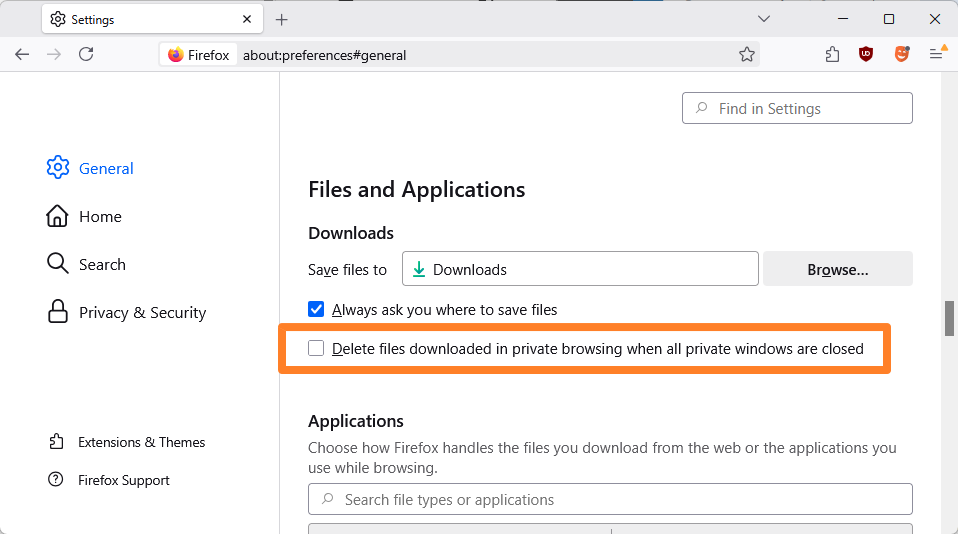
  1. Load about:preferences#general in the browser’s address bar.
  2. Scroll down to the Files and Applications section on the page.
  3. Check “Delete files downloaded in private browsing when all private windows are closed”.

This deletes downloaded files automatically once you close the last private browsing window.

Is it a useful feature? I do not know. It may help users who share accounts, as it removes any trace of a download from the system. Whether that makes sense depends on the use case. I’d say, it can also lead to confusion, as files get deleted automatically when the feature is enabled. That is probably the main reason why Mozilla decided to make it opt-in.

YouTube Row Fixer

How to change the number of videos YouTube shows per row

Posted on October 15, 2025October 15, 2025 by Martin Brinkmann

When you open the YouTube homepage or a channel, you may see videos neatly listed as thumbnails in rows. If you feel like the number of videos is too small or large, you might consider adjusting the video-per-row count on YouTube.

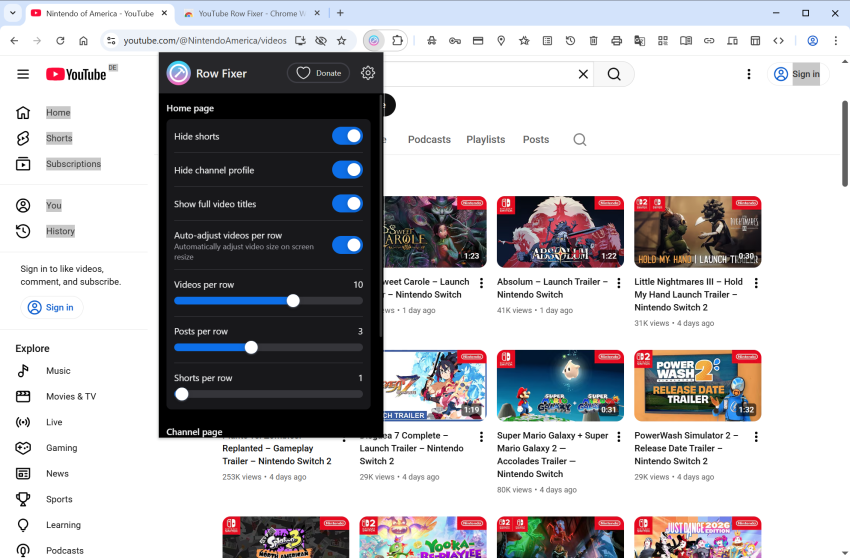
Enter YouTube Row Fixer, a browser extension for Chromium-based and Firefox-based browsers, that lets you do just that. The main idea is to give you customization options. Once installed, activate the icon of the extension to display the configuration options.

You can select the number of videos, posts, and shorts per row on YouTube for the homepage and for channels. Additionally, if you dislike Shorts, you can turn them off entirely to hide them.

Other options include showing full video titles for each video, which YouTube does not, if the video title is too long. It gets cut off, but when you enable the option, you get the full video title for all videos.

Last but not least, you may also enable an auto-adjust option. This changes the number of videos per row based on the size of the browser window. The maximum is always the number that you get in the configuration though. In other words, if you make the window of the browser smaller, you may get fewer videos per row than you set in the settings.

The changes happen automatically. You do not need to restart the browser or even refresh the page. Just exit the settings page by clicking on another interface element, and you should notice that the changes get applied to the page.

YouTube Row Fixer is an open source extension. You can download and install it from the Chrome Web Store, the Mozilla Add-ons Store for Firefox, or directly from the project’s GitHub repository. The Firefox version has the advantage that it also runs in mobile Firefox.

I ran tests in several browsers, including Chrome and Firefox, and it worked as advertised. Extensions like it have a tendency to break when the developer of the website they manipulate makes changes. This could happen with YouTube Row Fixer as well, but an update should fix any issue that may arise.

Now it is your turn. Do you use YouTube in your browser? If so, have you installed any extensions or scripts to tweak the video site?

Amazon seems to turn Echo Show devices into personal advertisement billboards for your home

Posted on October 13, 2025 by Martin Brinkmann

I try to avoid ad-powered devices or services as much as possible. Besides privacy implications, there is wasted time and bandwidth to consider among other things. On some systems, ads are often used in malware campaigns as well.

I do not really mind when companys sell products and make it very clear that they are ad-powered. It is your decision to buy it or skip it. I’d prefer an ad-free world, but that seems highly improbable. What I mind is if a company adds advertisement after you bought a device and did not make it clear back then that it could use the device to show you ads frequently or even all the time.

Amazon did this with Prime Video, which it turned from an ad-free streaming service into an ad-powered one for all users. You have to buy an add-on to get rid of ads, and even that does not get rid of all the ads, apparently.

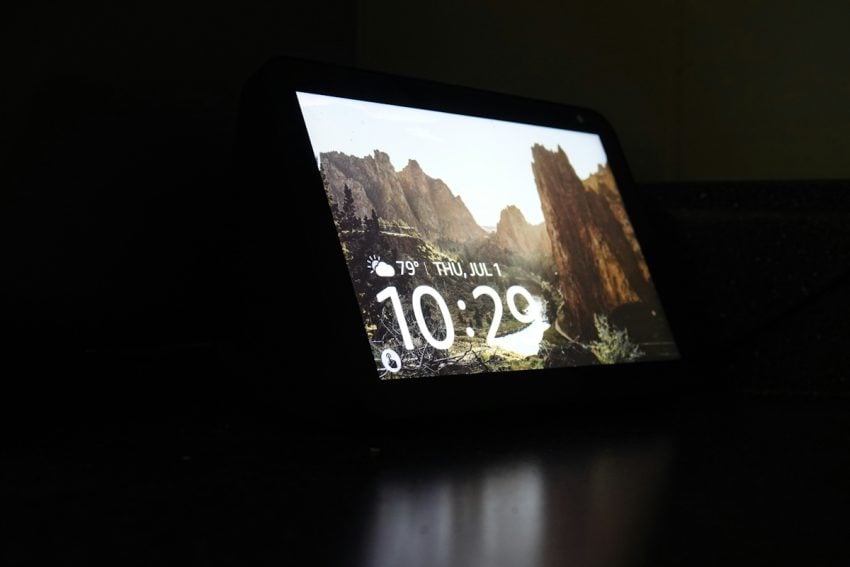
Now, reports are coming in that Echo Show devices are being turned into full-screen advertisement billboards.

Echo Show devices fall into the smart home category. You can communicate with them using your voice and they may be used to control and monitor smart home devices, display photos, play media, help you with cooking, and more.

Some Echo Show devices are quite expensive. The Echo Show 21, Amazon’s latest device, costs $350 right now. Add some much needed peripheral, like an adjustable stand, and you end up paying $440 for the device with stand.

Some customers reported that they noticed full-screen display ads on their Echo Show devices for months, while others have not noticed them at all. It could be that Amazon is rolling this out slowly to go into damage-control-mode if things get out of hand regarding publicity, or that it is testing the waters.

Owners of said devices started to notice the ads, which may appear between photos, when you have set the device to show a photo slideshow. They may also show up when the device is set to show different categories.

The ads appear to be quite intrusive and most users who mentioned them on sites like Reddit do not appear to be pleased. That is understandable, considering that Amazon does not really mention ads at all on the product page on its website. You find mention of ads in the customer reviews though.

Furthermore, as the Verge is reporting, Alexa Plus, Amazon’s next-generation AI-powered voice assistant, is reportedly also showing full screen ads for its own services.

In closing, it appears that Amazon is pushing ads even more than Netflix or Disney do. It is quite problematic for customers who purchased a device that cost several hundred Dollars. They expected a device that would show them a photo slideshow, and only photos of that slideshow, and not an ad between every second or third photo.

Whether Amazon’s strategy regarding advertisement is going to hurt the company in the long run remains to be seen. After all, Netflix, Disney and Co. are also not bleeding users after they introduced ad-supported plans.

Now You: What is your take on this? Would you buy a device with ads? Feel free to leave a comment down below.

Windows 11 is removing an option to bypass Microsoft account and internet during setup

Windows 11, Version 23H2 Home and Pro will stop getting updates starting next month

Posted on October 12, 2025October 12, 2025 by Martin Brinkmann

If you still run a device with the Home or Pro editions of Windows 11, version 23H2, then you may want to consider upgrading it to a newer version of Windows 11. Microsoft published a reminder that the particular version of the operating system is reaching end of life in November 2025 for consumer devices.

The details:

  • Affects Windows 11, version 23H2 Home and Pro editions.
  • Support ends after November 11, 2025.

Microsoft writes on its website:

Windows 11 Home and Pro, version 23H2 will reach the end of updates on November 11, 2025. This version was released in October of 2023.

This edition will no longer receive security updates after November 11, 2025. Customers who contact Microsoft Support after this date will be directed to update their device to the latest version of Windows 11 to remain supported.

Microsoft released the operating system in 2023. It is supporting specific consumer versions of its Windows 11 operating system for 24 months. Business customers get an additional 12 months worth of support for specific versions of the operating system.

Tip: use the two keys Windows-key and R to open the runbox. Type winver and hit the Enter-key. This displays the version that is installed on a device currently.

The solution

Most home devices should support Windows 11, version 24H2 or this month’s Windows 11, version 25H2. Both upgrades won’t install too quickly, unlike the upgrade from 24H2 to 25H2. Expect multiple reboots during the upgrade process.

Should you upgrade to 24H2 or 25H2? New Windows versions are better to be avoided in the first months after release. While 25H2 is a smallish release, it should not be a problem to upgrade to Windows 11, version 24H2 first. The upgrade to 25H2 should not take long once you feel ready to install it.

Most devices should upgrade fine via Windows Update in the Settings app. Just open it, maybe hit the check for updates button, and you should see a new version offered to you.

This may not be the case if you bypassed system requirement checks during installation of Windows 11, or if a safeguard hold is in place. You can check out my guide on upgrading Windows 11 on systems that do not meet all requirements.

  • Previous
  • 1
  • …
  • 8
  • 9
  • 10
  • 11
  • 12
  • 13
  • 14
  • …
  • 69
  • Next

Support This Site

If you like what I do please support me!

Any tip is appreciated. Thanks!
  • March 2, 2026 by Martin Brinkmann Don't Bother with Windows 11's new Speedtest feature
  • February 27, 2026 by Martin Brinkmann Warning! That laptop on Amazon? It comes with temporary storage
  • February 26, 2026 by Martin Brinkmann "If your printer works today, it will continue to work": Microsoft corrects previous announcement
  • February 25, 2026 by Martin Brinkmann YouTube Premium Lite subscribers get background playback and downloads with a big "but"
  • February 24, 2026 by Martin Brinkmann Firefox 148.0 is out with its AI kill switch and support for Windows 7 and 8.1 comes to an end

About

We talk, write and dream about Technology 24/7 here at Chipp.in. The site, created by Martin Brinkmann in 2023, focuses on well-researched tech news, reviews, guides, help and more.

Legal Notice

Our commitment

Many websites write about tech, but chipp.in is special in several ways. All of our guides are unique, and we will never just rehash news that you find elsewhere.

Read the About page for additional information on the site and its founder and author.

Support Us

We don't run advertisement on this site that tracks users. If you see ads, they are static links. Ads, including affiliate links, never affect our writing on this site.

Here is a link to our privacy policy

©2026 Chipp.in Tech News and Reviews