The eBay marketplace offers a treasure trove of sales data, readily available for everyone. It is a great option to find out if your first-press record is worth next to nothing or a fortune.
Most Internet users know that they can search on eBay for items and they get a list of sellers that sell that item. While that search is not always accurate, as you may get items listed that are not exactly what you are looking for, it reveals the minimum and maximum price that sellers are asking for the item at the time.
That is useful information, but it is not based on actual data, not a reflection of real-world value. Anyone can sell a pencil for a million bucks on eBay, but the chance that someone will buy it for the price is slim.
However, eBay includes tools to look up past sales off that item. Good news is that this information is publicly available. You do not need an account or a subscription for that. It is free and available on all eBay sites.
Note: Sellers on ebay may access the company’s Terapeak that offers several advantages, including a 3-year price history instead of the 90-days that anyone gets and average sold price data.
Checking prices on eBay
Lets say you want to find out how much your Samsung Galaxy A55 5G 128GB mobile phone is worth.
- Open the eBay website on a desktop system.
- Type the name of the product in the search field and click on search to get active offers.
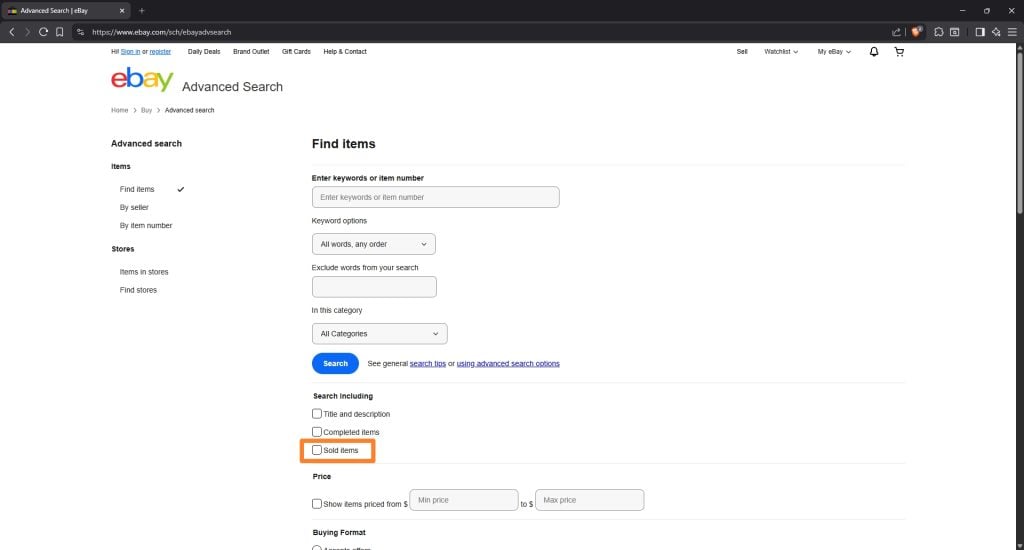
- Click on the Advanced link at the top.
- Check “sold items”
- Click on search on the page.
The eBay mobile apps offer this as well. Run the search, activate the filter option at the top of the search results page, expand “show more” and toggle “sold items” there. Hit the results button afterwards to get the list of sold items.
Now you get matching mobile phones that were actually sold on eBay. The list is sorted chronologically, with the most recent sales at the top.
You can use the filters to narrow it down further. If your device is used, check it under condition. You can also sort by lowest price ever, but this is often not recommended, as the price may change over time. For mobile phones, it usually goes down with time, but for other items, like many Lego sets, it may actually go up.
Tip: you can open the Advanced Search directly as well, if you prefer that.
Here is a pros and cons list of using eBay to determine prices.
The Pros: Why It’s the Gold Standard
- Actual Sales vs. Asking Price: Active listings only show what people want. Sold listings show what people are actually willing to pay, which is the only true metric of market value.
- High Volume Data: For common items (like electronics or popular toys), the sheer volume of sales provides a very accurate “average” price point.
- Supply and Demand Insights: By looking at “Completed” vs. “Sold” listings, you can calculate the sell-through rate. If 100 items ended but only 5 sold, you know the item is a “slow mover,” regardless of the price.
- Niche Precision: eBay is often the only place with enough data to value obscure collectibles or vintage parts that don’t appear in traditional price guides.
- Keyword & Photo Research: You can see which specific keywords (e.g., “MCM,” “Rare,” “Tested”) or photo styles led to the highest sale prices.
The Cons: Where it Can Mislead You
- The “Best Offer” Trap: In a standard search, if an item sold via “Best Offer,” eBay often displays the original asking price with a strikethrough. You don’t actually see the final negotiated price (which could be 50% lower).
- The 90-Day Cliff: Standard searches only show the last 90 days of data. For rare items that only sell once or twice a year, 90 days of history might show “zero results,” leading you to think the item is worthless when it’s actually just rare.
- Condition Discrepancies: A “Mint” version of an item might sell for $100, while a “Good” version sells for $20. If you aren’t careful to match the condition of the sold items to yours, your estimate will be way off.
- Shipping & Fees: The “Sold” price doesn’t account for the fees the seller might have paid or the shipping costs they might have eaten.
- Outlier/Fake Sales: Occasionally, “Sold” listings are the result of non-paying bidders or shill bidding (fake accounts bidding to drive up perceived value). One massive price spike among dozens of lower sales is usually an outlier to be ignored.
Why not just sell for $1 in an auction?
Selling items for $1 works well in some cases, especially if a category has a lot of traffic. Many Games or popular mobile phones will almost always reach the average sales price, provided that you do not let the auction run out in the middle of the night or on a public holiday.
However, items that are not that sought after, including rare items, may be sold for a lower price.
I’m currently selling part of my vast CD collection on eBay. I first thought of selling each item for $1 in an auction, or in bulk packages, say 50 CDs for $50. That is less time consuming than researching prices.
The problem here is that you will make less money, guaranteed. Some rarer CDs will sell for less. That is why I decided to research each CD, beat the competition by a few cents to be the lowest seller on eBay at the time, and include shipping costs in the price as well.
Yes, takes an awful long time, but it is well worth it once you realize that some rarer CDs sell for $10 or more.
“The problem here is that you will make less money, guaranteed. Some rarer CDs will sell for less. That is why I decided to research each CD, beat the competition by a few cents to be the lowest seller on eBay at the time, and include shipping costs in the price as well. Yes, takes an awful long time, but it is well worth it once you realize that some rarer CDs sell for $10 or more.”
I went through this “trap’ two summers ago when I finally tired of paying a storage unit fee of $150/month. I gave loads and loads of the non-valuable items to a local thrift store and wrote it off in taxes; there were other items such as Depression Glass, green and pink, antique furniture, special Hispanic paintings, etc. I had two antique dealers who looked through the shed and said, “There are some nice things in here; however, by the time you list and MAYBE sell the items for a fair price, you will have paid more in storage fees–it will take that long!” Both of them “cherry picked” items and took what they could sell in their stores–WWII army clothes and badges were super hot items. Old land claims–Silver Certificates were gold mines. But they were right. I chose to sell the entire lot for $400. I completely trashed a huge collection of vinyl opera records that do have a market in Europe, but zero in the US. Heartbreaker! Anyway, almost two summers later, I am sitting on $3,000 cash which is about what I may have made through sales. I didn’t have to clean out the shed; I didn’t have to list any items and wait for emails asking questions and then respond and then ship; it was done in a flash! Thankful.
All those CDs–don’t kid yourself. If you don’t have someone to give them to, give them to a library or sell them dirt cheap–one big box and free yourself from the idea that “I am going to make $10 on 20 CDs–$200? It’s not worth it–better things to do with one’s time than declutter for money–individually.
If one is a professional and setup for business it could be different. But both antique dealers told me the reason they pay such a pittance is because they have to store the items until someone comes by, maybe two years later, and purchases the item.
The whole “what do I do with all of this stuff?” is a real mind game because one thinks he/she MAY make a fortune. Doesn’t happen, or not very often.