Chipp.in Tech News and Reviews

Windows, Security & Privacy, Open Source and more

Menu
  • Home
  • Windows
  • Security & Privacy
  • Gaming
  • Guides
  • Windows 11 Book
  • Contact
  • RSS Feed
Menu

Category: Software

Mozilla extends Firefox for Windows 7 support again and it may not be the last time either

Posted on September 6, 2025September 6, 2025 by Martin Brinkmann

Mozilla’s Firefox web browser continues to be supported on Windows 7 and older versions of Apple’s macOS operating systems, according to an update that Mozilla published on its website.

According to the update, Firefox ESR 115 support is extended until at least March 2026. Mozilla plans to evaluate the end of support again in March 2026 to determine whether it will extend support again.

Firefox is one of the few web browsers that continue to support Windows 7 and older macOS versions. Most browsers have ended support for the discontinued versions of Windows and macOS some time ago already.

Firefox ESR 115.33 will be released in February 2026. It could be the last version of that ESR branch, if Mozilla decides to end support then and there.

More than six percent of Firefox users use Windows 7. That is a large number, even with Firefox’s declining userbase.

Firefox 115 was released in 2023 initially. The Extended Support Release version of the browser is only supported with security and bug fix updates. New features are not introduced in the same ESR branch usually. The next major ESR release introduces the features that Mozilla released in stable Firefox in the meantime.

Since there is no upgrade for Firefox ESR 115 users, their version of the browser remains on the 2023 feature set. Means, features such as tab groups, vertical tabs and others are not available.

The consumer editions of Windows 7 are no longer supported by Microsoft. This means that the operating systems do not receive security updates anymore. Micro-patching service 0Patch continues to support the operating system, however.
0Patch promises to keep Microsoft Office 2016 and 2019 secure after official end of support

Posted on August 27, 2025August 27, 2025 by Martin Brinkmann

Windows 10 is not the only Microsoft product that is reaching end of support in October 2025. Microsoft Office 2016 and 2019 will also reach end of support in that month. The two Office products do not get an option for extended security updates, unlike Windows 10.

Windows 10 home users may extend support by a year only, through one of three options, but it is better than nothing. The best option is to run a free open source script, which makes the entire process effortless.

With Office 2016 and Office 2019, Microsoft made it clear that it won’t offer the same option. In other words: Come October 2025, both products will not receive future updates, at least not from Microsoft.

Microsoft suggests that customers either buy the latest Office 2024 application or subscribe to Microsoft 365 instead. This can be expensive. A standard edition license costs about $150, and it will run out of support in five years since its release. A Microsoft 365 subscription costs about $100 per year currently, but discounts are available from time to time. Businesses and Enterprises pay considerably more.

While both Office products will continue to work, they will be affected by security issues that Microsoft will only fix in newer versions of Office.

However, not all is lost. Micro-patching service 0Patch announced that it will add both Office products to the list of supported applications.

The company promises to deliver critical security updates for both Office versions for at least three years. Means, the worst critical issues will be fixed until at least October 2028.

An 0Patch subscription for consumers costs about $30 per year. Good news is that a subscription includes other Microsoft products, including Windows 10, version 22H2, as well.

So, if you run Windows 10 and either Office version, you get security updates for both products for the price of one.

Granted, there is also the option to switch to a free Office suite, such as LibreOffice, instead. It is free, but it may take a bit of adjusting and there is no 100% compatibility.

Resume Android app on Windows 11

Windows 11: Resuming apps from Android is coming, again

Posted on August 24, 2025 by Martin Brinkmann

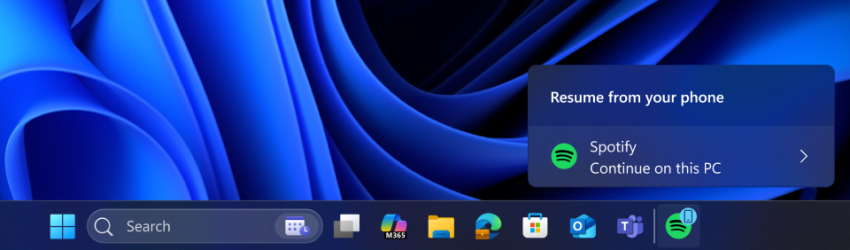
Microsoft released a new Windows 11 test build this week that is bringing the Dev channel version to 26200.5761. With it comes a new option to “seamlessly resume apps from Android phone on PC”, at least for some users, as Microsoft has the habit of split testing features even in developer builds.

Microsoft admits that this initial version of the feature works only with the Spotify app. If you have Spotify installed on your Android device and on your Windows 11 PC, you may resume listening on PC to whatever you listened to on your phone.

Still requires you to click on the resume notification that Windows 11 displays and have the Android phone and the Windows 11 PC linked as well.

Microsoft reveals that the notification will also display if Spotify is not installed on the PC. In that case, a 1-click installation of the app from the Microsoft Store will be started and the installed application will be launched. However, you are still required to sign in to the same Spotify account before you can resume the playback.

Microsoft encourages other app developers to integrate resume functionality into their apps. Media streaming apps seem the main target for this at this point, but it could also include apps to call or maybe even some games. However, this requires that an app is available for Windows and Android, which limits the reach.

Closing Words

How useful is that feature? I have to admit that I do not have any use for it, but then, I’m probably not the target demographic for this anyway. I can see some use for users who commute to work and work on a PC there, but is it really more comfortable than just launching the app manually or even automatically on PC to continue using it? Considering that you need to go through some hoops to set up the link between the Android device and the PC in first place, it is probably going to stay pretty niche.

Now You: what is your take on this? Would you use it, if it would be launched by Microsoft? Which apps or games would you like to see supported? Feel free to leave a comment down below.

Windows 11 is removing an option to bypass Microsoft account and internet during setup

Microsoft confirms reset and recovery issue in Windows 10 and 11

Posted on August 19, 2025August 19, 2025 by Martin Brinkmann

When Microsoft released the August 2025 security updates for Windows, it listed not a single known issue for any of the supported operating systems. Now, a week later, Microsoft had to confirm several issues already.

The latest to be added to the growing list is that reset and recovery operations may fail on some older versions of Windows.

Microsoft confirmed the issue for the latest version of Windows 10, which is version 22H2, and for Windows 11, version 23H2 and earlier. Only client operating systems are affected, according to Microsoft.

​Client: Windows 11, version 23H2; Windows 11, version 22H2; Windows 10, version 22H2; Windows 10 Enterprise LTSC 2021 and Windows 10 IoT Enterprise LTSC 2021; Windows 10 Enterprise LTSC 2019 and Windows 10 IoT Enterprise LTSC 2019

If you still run one of these and have the latest security updates installed for the operating systems, you may run into issues when you try to reset or recover the PC.

Microsoft says that three processes are affected by the issue:

  • System >Recovery > Reset my PC
  • System > Recovery > Fix problems using Windows Update
  • RemoteWipe CSP

Run any of those, and the reset or recovery operation may fail, provided that the most recent update is installed. To get around this, you could uninstall the security update before running reset or recovery actions on the Windows PC.

Microsoft confirmed that it is working on a resolution and that it plans to release an out-of-band patch for affected versions of Windows to address the issue. The company plans to release the update “in the coming days” according to the confirmation on the Release Health website for affected Windows editions.

Windows updates

Windows 10: script to join ESU (Extended Security Updates) without Microsoft account

Posted on August 18, 2025August 18, 2025 by Martin Brinkmann

If you still run Windows 10 on one or multiple of your PCs, you may be aware that Microsoft is ending support for the operating system in about two months.

Come October 2025, Microsoft won’t release updates for the consumer editions of Windows 10 anymore. Windows 10 users may join the Extended Security Updates program to receive another year of support, but this requires becoming active.

If you do not do anything, you won’t receive any updates anymore for the operating system after October 2025.

Joining ESU is a simple process, but you still need to pick one of the available “payment” options: pay with Microsoft Rewards points, enable cloud backups, or pay with money.

Consumer ESU Enrollment is a new script for Windows that simplifies the process. It does require an administrative account and Internet connectivity, but that is about it.

When you run it without parameters, it will enroll using the free backup option and use a Microsoft account or a local account for that, depending on which you used to sign in to the operating system.

Here is what the developer Abbodi says about the order on GitHub (via Deskmodder):

By default, the script will run in the following order, if a step failed, the next is executed:

  • Enroll using Microsoft account currently logged-in as Windows user.
  • Enroll using Microsoft account currently logged-in with Microsoft Store.
  • Enroll using current Local account.
  • Acquire Consumer ESU license manually as last resort.

You may run the script using optional parameters to force one of the available options. If you use a local account, you can run .\Consumer_ESU_Enrollment.ps1 -Local to make sure that you are enrolled using the local account and not a Microsoft account.

Note that you may need to run Set-ExecutionPolicy Bypass -Scope Process -Force prior to that to allow the execution of unsigned scripts temporarily.

While you may enroll manually as well, using the script may speed up things significantly, especially if you use a local account to sign in to Windows.

Now You: do you still run Windows 10 on a device that you use regularly? Did you join ESU? Feel free to leave a comment down below.

Microsoft changes popular option to block Microsoft Store application updates, makes it worse

Posted on August 17, 2025August 17, 2025 by Martin Brinkmann

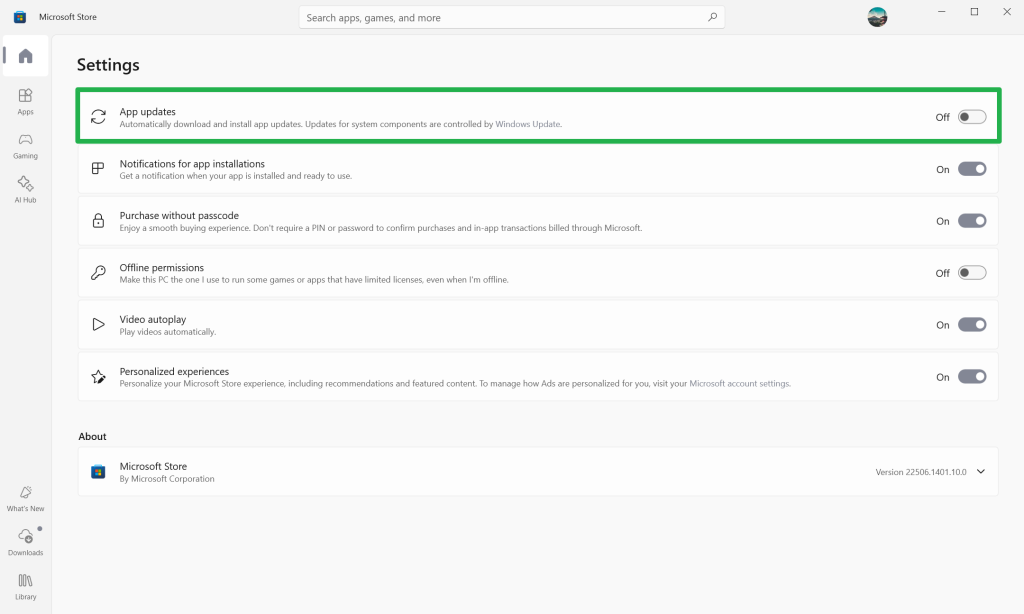
Up until now, if you did not want Microsoft to update the installed default apps of the Windows operating system via the Microsoft Store, you had to disable the “App Updates” option of the store. Once set, it would prevent the automatic updating of Microsoft Store applications on the system.

This option is being removed, according to tests conducted by Deskmodder. While the option is still there, flipping it to off displays a new prompt now that gives you the choice to block app updates for one to five weeks only.

Afterwards, application updates will get enabled again automatically. This option may remind you of the pause Windows updates functionality that Microsoft introduced a long time ago. It too does not let you disable updates indefinitely, but only for a certain period.

Here is how the screen looks like on Windows 10 currently.

To make matters worse, the corresponding Registry entry will also be temporary in nature according to Deskmodder.

This leaves the Group Policy option as the only one left for blocking automatic Microsoft Store updates.

Here is how it works:

  1. Open the Start menu.
  2. Type gpedit.msc and press the Enter-key.
  3. Navigate to Computer Configuration > Administrative Templates > Windows Components > Store
  4. Double-click on “Turn off Automatic Download and Install of updates”.
  5. Set the status to Enabled.
  6. Click on the ok-button.
  7. Restart the computer.

Now, if you do not have access to the Group Policy Editor, which means that you are running a Windows Home edition, then you may make the changes in the Registry directly.

  1. Open the Start menu.
  2. Type regedit.exe and press the Enter-key.
  3. Navigate to HKEY_LOCAL_MACHINE\SOFTWARE\Policies\Microsoft\WindowsStore
    • Note: If one of the keys do not exist, right-click on the previous one that still exists and select New > Key. Name it accordingly to create the structure.
  4. Right-click on WindowsStore and select New > Dword (32-bit) value.
  5. Name it AutoDownload.
  6. Double-click on AutoDownload and set its value to 2.
  7. Close the Registry Editor.
  8. Restart the PC.

Closing Words

Microsoft has not documented the change anywhere to my knowledge. It is unclear, therefore, why it is being made. Maybe Microsoft wants that most Windows users run the latest versions of the integrated applications on their devices.

However, considering that this is the default, Microsoft is taking away an option that Windows customers have set deliberately. Those who have set automatic updates to off have done so for a specific reason though.

Now You: What is your take on this? Good thing that the majority of users will run the latest version of the pre-installed apps on Windows soon? Feel free to leave a comment down below.

Google Search

Google Messages is checking any image for nudity to potentially blur it

Posted on August 16, 2025August 16, 2025 by Martin Brinkmann

Google Messages is a dominant messaging app on Android devices. Installed and enabled on many devices by default, it is used to send messages. It supports several message formats, including SMS, MMS and Rich Communication Services (RCS), with RCS being the default protocol.

Google is rolling out a new protective feature in Google Messages that is designed to detect and blur images of nudity. It is enabled by default for non-adult accounts, but can be enabled for adult accounts as well.

When you receive an image in Google Messages, it may be blurred if the processing determines that it contains nudity and if the feature is enabled on the device.

You have multiple options in that case:

  • Block the sender’s number.
  • Open the image and confirm that you want to view the image.
  • Open a resource page that offers information on “why nude images can be harmful”.
  • Go back.

Google says that the entire processing of images happens on the local device and that no personal or identifiable information is submitted to Google servers as part of the processing.

Here is how you control the feature on an unmanaged device:

  1. Open Google Messages.
  2. Click on the profile icon.
  3. Select Messages settings.
  4. Tap on Protection & Safety.
  5. Activate Manage sensitive content warnings.
  6. Toggle “Warning in Google Messages” to on or off.

If you set it to on, incoming photos with nudity are blurred. Furthermore, sending a photo with nudity requires an extra step as well.

Is it a useful protective feature? It may blur images with nudity and includes an option to block the sender from sending more. There is a chance for false positives, but it is easy enough to turn off the feature if that is the case.

What is your take on this? Should services like Google, Meta, or Microsoft scan user images to blur, block or report them? Feel free to leave a comment down below.

Firefox

Mozilla plans to drop support for very-old Android versions

Posted on August 11, 2025August 11, 2025 by Martin Brinkmann

Mozilla plans to drop support for Android versions older than Android 8. Android 8 was released in 2017, which means that the move will affect users who use Firefox on mobile phones that are nearly a decade old or older.

Current mobile versions of Firefox require at least Android 5.0, which was released in 2014.

Mozilla announced the intention to raise the system requirements for Firefox on Android on the organization’s bug tracking website. And the organization has good reasons for wanting to drop support.

It allows Mozilla to “implement newer technologies” and prevents engineers from “being burdened by fixing bugs that only emerge on a small population of people using old devices”.

Also worth noting is that libraries that Mozilla is using are dropping support for Android 5, which causes additional problems for Mozilla.

With Android 15 (API 35) official release last Oct 15, 2024 (for Pixel devices), we should be considering bumping up the min Android OS version of the Firefox Mobile Browser up to Android 8 (API 26). Doing so allows us to implement newer technologies, and prevents us from being burdened by fixing bugs that only emerge on a small population of people using old devices. By bumping the min Android OS version, users on those devices will no longer receive app updates.

Additionally, we are increasingly finding that libraries we use are dropping support for obsolete versions like Android 5. This causes us big problems for ongoing maintenance of our apps.

Mozilla is not the only browser maker that bumped Android version requirements recently. Google dropped support for Android 7 and 8 recently with the launch of Chrome 139 for Android. Most Chromium-based browsers for Android are likely affected by the change going forward.

So, if you are still using an Android device that is no longer supported, and has not been for a few years at least, you may find yourself without a supported browser as well.

Will there be browsers that continue to support Android 8 or earlier? That remains to be seen. For now, both Vivaldi and Opera support Android 8, as will Firefox going forward.

Windows 11

Windows 11 finally overtakes Windows 10 as the most popular desktop operating system

Posted on August 4, 2025August 4, 2025 by Martin Brinkmann

Microsoft’s newest — if you consider four years new – has finally done it. It has passed Windows 10 as the most popular desktop operating system last month.

The consumer versions of Windows 10 have less than three months of support left. While you can extend that by a year, the end is inevitable at this point.

Statcounter reports that Windows 11 made a big jump to more than 53 percent usage share while Windows 10 dropped to a still respectable 43 percent share.

It appears that users are finally moving from Windows 10 to 11, either by upgrading compatible devices to the new version of Windows or by buying new PCs with Windows 11. There is also a third possibility. Since Statcounter does not reveal totals, Windows 10 devices could just have been taken offline by their respective owners or users.

Is the change in leadership the big win that Microsoft hoped Windows 11 would become? Or just born out of necessity, considering that Microsoft will end support for Windows 10 in a short while?

It seems likely that the trend will continue in the following months. Windows 10 will drop, Windows 11 will rise as a consequence.

It is interesting to note that Windows 10 managed to keep the lead until last month. Almost half of all desktop devices ran the operating system and users have started to migrate mere weeks before the official end of support.

In related news, Windows 7 still holds about 2 percent of the desktop market, more than two years after Microsoft ended the ESU program and more than five years since support ended officially.

Windows 8 and 8.1 are also listed, with a combined share of about 1 percent of the desktop market. May not sound like much, but if you assume more than 1 billion desktop PCs, you end up with 10 million Windows 8 and 8.1 devices still in use.

As far as desktop operating systems are concerned, Windows continues to have a commanding lead of more than 71 percent of the market. Unknown, meaning device with unidentifiable operating systems, macOS and Linux follow behind, each with less than 10 percent of the usage share.

Now You: do you run Windows on your devices or another operating system? Let me know in the comments below.

Windows 11 is removing an option to bypass Microsoft account and internet during setup

Windows 11, version 23H2: Support ends this year as well

Posted on July 28, 2025July 28, 2025 by Martin Brinkmann

While Windows 10’s official end of support later this year is the big Windows-topic of 2025, an earlier version of Windows 11 is also put to rest by Microsoft on the same day.

Windows 11, version 23H2, released almost two years ago, will reach end of support in November 2025 shortly after Windows 10 reaches its end of support.

To be clear, the end of support affects the Home and Pro editions of the operating systems only. Microsoft supports Home and Pro editions of Windows 11 for two years (24 months), while Enterprise and Education editions get an extra year of support.

So, if you have not upgraded a Windows 11, version 23H2 Home or Pro device to version 24H2 yet, you may want to consider doing so to keep it supported.

Systems that meet the official system requirements should get the upgrade offer in Settings > Windows Update > Check for updates. Potential upgrade blockers could prevent the upgrade offer via Windows Update, but only a few confirmed issues remain.

If the upgrade to version 24H2 is not offered, you could try Microsoft’s official Installation Assistant. It can start the upgrade, even if it is not offered via Windows Update.

If that fails as well, your best bet is to use third-party tools like Rufus or FlyOobe (formerly known as Flyby11), which can also be used to bypass most of the system requirements of Windows 11.

Here is the list of Windows versions and editions, and their upcoming end of support later this year.

  • Windows 10, version 22H2 (latest) — Home and Pro : October 14, 2025.
  • Windows 11, version 22H2 — Enterprise and Education: October 14, 2025
  • Windows 11, version 23H3 — Home and Pro: November 11, 2025

Now You: do you run any of these? Let us know in the comments below.

  • Previous
  • 1
  • …
  • 3
  • 4
  • 5
  • 6
  • 7
  • 8
  • 9
  • …
  • 31
  • Next

Support This Site

If you like what I do please support me!

Any tip is appreciated. Thanks!
  • March 2, 2026 by Martin Brinkmann Don't Bother with Windows 11's new Speedtest feature
  • February 27, 2026 by Martin Brinkmann Warning! That laptop on Amazon? It comes with temporary storage
  • February 26, 2026 by Martin Brinkmann "If your printer works today, it will continue to work": Microsoft corrects previous announcement
  • February 25, 2026 by Martin Brinkmann YouTube Premium Lite subscribers get background playback and downloads with a big "but"
  • February 24, 2026 by Martin Brinkmann Firefox 148.0 is out with its AI kill switch and support for Windows 7 and 8.1 comes to an end

About

We talk, write and dream about Technology 24/7 here at Chipp.in. The site, created by Martin Brinkmann in 2023, focuses on well-researched tech news, reviews, guides, help and more.

Legal Notice

Our commitment

Many websites write about tech, but chipp.in is special in several ways. All of our guides are unique, and we will never just rehash news that you find elsewhere.

Read the About page for additional information on the site and its founder and author.

Support Us

We don't run advertisement on this site that tracks users. If you see ads, they are static links. Ads, including affiliate links, never affect our writing on this site.

Here is a link to our privacy policy

©2026 Chipp.in Tech News and Reviews