Chipp.in Tech News and Reviews

Windows, Security & Privacy, Open Source and more

Menu
  • Home
  • Windows
  • Security & Privacy
  • Gaming
  • Guides
  • Windows 11 Book
  • Contact
  • RSS Feed
Menu

Category: Software

Greenshot: open source screen capturing app is now also available as a portable version

Posted on November 1, 2025November 1, 2025 by Martin Brinkmann

There is certainly no shortage of options when it comes to capturing screenshots or videos on computer systems. From built-in solutions like Microsoft’s Snipping Tool to excellent third-party apps like my favorite PicPick.

Greenshot is another household name. The open source application has been around for a long time and it is well maintained. It supports various types of screenshot captures, from full screen over windowed to region captures.

While it does lack some of the advanced options, like capturing video or scrolling windows in most programs, it does support a few extras like excellent support for integrating third-party services like Flickr or Dropbox. Other features that it supports include adding annotations and highlights, obfuscating parts of the screenshot, and more.

Greenshot interface

The developer of Greenshot Christian Schulz released a new version of the application just a few days ago. It includes a single fix for file associations not working when the app is running already and a new feature: a portable version.

Good news is that you can run Greenshot now from any location using the portable version. You can put it on a USB flash drive or stick and carry it with you around to use it on any Windows machine you plug the USB device in.

So, if you are using Greenshot already you might switch to the portable version, if you prefer it. You can download the portable version, or the setup version, of Greenshot from its GitHub repository.

Now You: which screenshot tool or tools do you use and why? Feel free to leave your recommendation in the comment section below.

Microsoft announces plan to simplify Windows Update titles

Posted on October 30, 2025October 31, 2025 by Martin Brinkmann

Microsoft announced an upcoming change regarding the titles of Windows Update. Going forward, Microsoft wants to simplify the name of updates so that they are “more intuitive, consistent, and informative”.

The company hopes that this change will make it easier for regular users to understand what an update does that is installing or was installed on the Windows device. Original equipment manufacturers and partners should benefit from this as well, according to Microsoft.

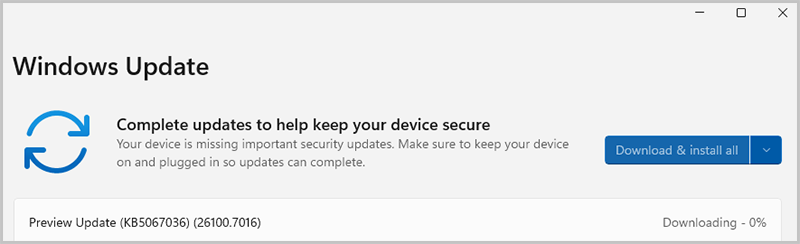
The updated titles follow a simple structure and will focus on the name of the update. Most updates, the exception is a driver update, include the KB ID as before. Windows Updates include the build number furthermore, while drivers the version of the driver.

An example of an update with a new title. Source: Microsoft

Microsoft posted several examples of how driver updates will be named in the future:

  • Monthly or out-of-band security updates: Security Update (KB5034123) (26100.4747)
  • Monthly preview non-security updates: Preview Update (KB5062660) (26100.4770)
  • .NET Framework security updates: .NET Framework Security Update (KB5056579)
  • .NET Framework non-security updates: .NET Framework Preview Update (KB5056579)
  • Driver updates: Logitech Driver Update (123.331.1.0)
  • AI component updates: Phi Silica AI Component Update (KB5064650) (1.2507.793.0)

Generally speaking, the new titles apply to Windows operating system updates, such as monthly cumulative updates, .NET Framework updates, driver updates, AI component updates, and Visual Studio updates.

Windows users will find the new titles under Settings > Windows Update and also in the update history, which can be accessed from the Windows Update page of the Settings. Lastly, it is also shown on the Windows release health website.

Microsoft says that updates that do get deployed via WSUS (Windows Server Update Services) or the Microsoft Update Catalog, won’t reflect the changed titles for the most part. Windows feature update titles will also keep the traditional title.

The new titles may omit the version of Windows the update is for. While that may not affect regular users who install the update on their devices, it could affect users who want a quick overview of the released updates on Microsoft’s website or elsewhere.

Now You: What is your take on this change? Is it for the better?

Who is going to talk to their PC, once Microsoft launches Copilot Voice for Windows?

Posted on October 21, 2025October 21, 2025 by Martin Brinkmann

The main future of PC that Microsoft envisions is giving Windows users more flexibility when it comes to interacting with the PC. Instead of using mouse and keyboard, Microsoft is betting big on AI and the recently announced Copilot Voice feature.

In simple terms, it allows anyone, Microsoft says even users with no-Copilot+ PCs, to talk to the AI using a connected microphone. This allows Windows users to use their voice for searching, getting help, or automating tasks, according to Microsoft.

Many news outlet made it appear that Microsoft wants Windows users to use their voice exclusively when they use the PC. This is not the case, but Microsoft believes that voice will play a much larger role in the future.

There are several uncertainties here, largely because Microsoft did not provide many details on the functionality. Tests have to show how well, or not, the voice feature works and what you can do with it.

  • Is it just for communicating with the AI via voice?
  • Can you use it for other purposes, e.g., dictation?
  • What are the privacy implications? Where is the voice data processed? Is it stored? If so, for how long? Who has access to the data?

Who is going to talk to their PC?

Assuming that the feature works well, the question about who is going to use it needs to be answered as well.

Voice interactions can be beneficial in some contexts, for instance if you need to use your hands for something else, or use a fullscreen app and do not want to switch to the text-based prompt.

However, voice does not work well in some contexts. Imagine talking to your Windows PC during your commute, or in an office with other workers sitting nearby.

The idea of a Star Trek-like communication with a computer system works well, if there is only one person talking to it. Now imagine the whole Enterprise-crew talking to the computer at the same time in the command room. That is utter chaos.

So, this voice feature will be used in private for the most part, which excludes some business use. Still, Microsoft says it is another option that Windows users have, and that is fine, provided that you want to communicate with the AI.

What is your take on this? Do you see yourself talking to an AI in the coming years?

Windows 11 lock screen widgets

Microsoft confirms Windows 11 bug that affects the Windows Recovery Environment (WinRE)

Posted on October 20, 2025October 20, 2025 by Martin Brinkmann

It did not take long for Microsoft to confirm the first few issues after the official release of this year’s feature update, Windows 11 version 25H2.

The latest issue affects the Windows Recovery Environment. It is an essential recovery option of Windows that includes features such as repairing startup, resetting the PC, or uninstalling updates.

The confirmed bug renders USB mice and keyboards inoperable. Means, if the input devices are connected via USB, they won’t function in the Windows Recovery Environment.

For some, it can mean that no selection can be made, unless a non-USB mouse or keyboard is connected to the PC.

The issue affects the following platforms:

  • Windows 11, version 25H2
  • Windows 11, version 24H2
  • Windows Server 2025

Microsoft writes:

After installing the Windows security update released on October 14, 2025 (KB5066835), USB devices, such as keyboards and mice, do not function in the Windows Recovery Environment (WinRE). This issue prevents navigation of any of the recovery options within WinRE.

Microsoft notes that the issue does not impact normal operations. In Windows itself, USB mice and keyboards continue to work.

The company revealed that it plans to release a fix for the issue in the coming days. This was on October 17th, which suggests that a fix should be released very soon.

Until then, you better cross fingers that you won’t need the Recovery Environment or have a non-USB keyboard or mouse ready for accessing it even with the bug present.

The second issue that Microsoft confirmed affected IIS websites. They would fail to load if affected. Microsoft admitted that it fixed the issue using a Known Issues Rollback. This rollback restores previous functionality to resolve bugs.

Note that it is necessary on managed PCs to configure special policies to allow the rollback to take place, as explained here.

Firefox

Mozilla will continue to support Firefox on Windows 10

Posted on October 17, 2025October 17, 2025 by Martin Brinkmann

Now that support for Windows 10 has ended, software developers will make announcements regarding support of their products on the operating system.

Mozilla has just announced that it will continue to support Firefox on Windows 10 devices for “the foreseeable future”. While the organization did not provide a specific, at least “at the minimum until” would be nice, it guarantees that Firefox users on Windows 10 continue to receive updates for the browser.

Mozilla is also one of the few browser makers that supports Windows 7, as it extended support for the operating system several times. Considering that Windows 10 is more widely used, it is likely that support for Firefox on Windows 10 will go on for a long time.

If you remain on Windows 10, you will continue to get the same updates to Firefox you do today, with all of our latest feature improvements and bug fixes. This includes our commitment to resolve security vulnerabilities as rapidly as we can, sometimes in less than 24 hours, with special security updates. Windows 10 remains a primary platform for Firefox users. Unlike older versions of Windows like Windows 7 and 8, where Mozilla is only offering security updates to Firefox, Windows 10 will get the latest and greatest features and bug fixes just like users on Windows 11.

Mozilla recommends that Windows 10 users upgrade to Windows 11, if the PC supports it, or subscribe to Extended Security Updates for Windows 10. The latter would extend support by a year on consumer PCs and for up to three years on business PCs.

Other browser makers, including Google, have not made announcements regarding end of support of their browsers. The official Chrome Support Timelines website lists Chrome’s deprecation release and date for Windows 10 as “not yet scheduled”.

With Windows 10 used on hundreds of million of devices worldwide, even Google can’t afford to lose a sizeable chunk of users overnight, should the company decide to end support as early as it did when Windows 7 support ended.

Windows 11 is removing an option to bypass Microsoft account and internet during setup

Windows 11, Version 23H2 Home and Pro will stop getting updates starting next month

Posted on October 12, 2025October 12, 2025 by Martin Brinkmann

If you still run a device with the Home or Pro editions of Windows 11, version 23H2, then you may want to consider upgrading it to a newer version of Windows 11. Microsoft published a reminder that the particular version of the operating system is reaching end of life in November 2025 for consumer devices.

The details:

  • Affects Windows 11, version 23H2 Home and Pro editions.
  • Support ends after November 11, 2025.

Microsoft writes on its website:

Windows 11 Home and Pro, version 23H2 will reach the end of updates on November 11, 2025. This version was released in October of 2023.

This edition will no longer receive security updates after November 11, 2025. Customers who contact Microsoft Support after this date will be directed to update their device to the latest version of Windows 11 to remain supported.

Microsoft released the operating system in 2023. It is supporting specific consumer versions of its Windows 11 operating system for 24 months. Business customers get an additional 12 months worth of support for specific versions of the operating system.

Tip: use the two keys Windows-key and R to open the runbox. Type winver and hit the Enter-key. This displays the version that is installed on a device currently.

The solution

Most home devices should support Windows 11, version 24H2 or this month’s Windows 11, version 25H2. Both upgrades won’t install too quickly, unlike the upgrade from 24H2 to 25H2. Expect multiple reboots during the upgrade process.

Should you upgrade to 24H2 or 25H2? New Windows versions are better to be avoided in the first months after release. While 25H2 is a smallish release, it should not be a problem to upgrade to Windows 11, version 24H2 first. The upgrade to 25H2 should not take long once you feel ready to install it.

Most devices should upgrade fine via Windows Update in the Settings app. Just open it, maybe hit the check for updates button, and you should see a new version offered to you.

This may not be the case if you bypassed system requirement checks during installation of Windows 11, or if a safeguard hold is in place. You can check out my guide on upgrading Windows 11 on systems that do not meet all requirements.

Why Not Win 11 App

Test your PC’s Windows 11 compatibility with free WhyNotWin11

Posted on October 10, 2025October 10, 2025 by Martin Brinkmann

While Microsoft has its own tool for checking if a PC meets the system requirements of its Windows 11 operating system, it is generally considered rather heavy and not overly useful.

If you have come to the same conclusion, you may prefer an open source alternative that is both free and lightweight.

WhyNotWin11 is developed by serial developer Roby C. Mahel, whom you may know for his work on MSEdgeRedirect and other open source apps already.

The main purpose of WhyNotWin11 is simple: check, if your PC meets the system requirements to find out if you can upgrade without hassles.

All you need to do is download the app and run it. No installation, no ads, nothing that is considered bloat.

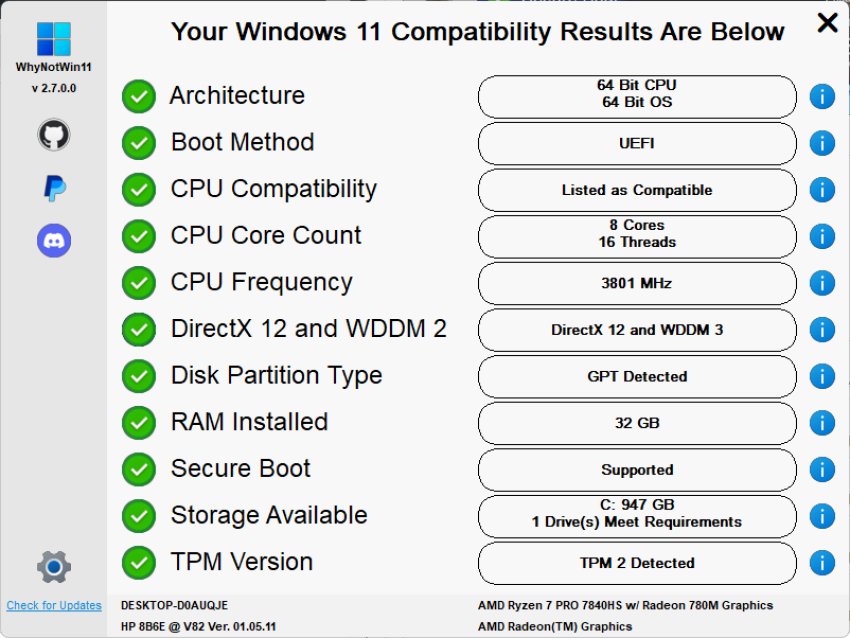
The app runs its checks on start automatically and presents its findings to you in its interface after a short moment.

Note that you can run the app on Windows 11 as well. Handy, if you installed the operating system and used bypasses for certain requirements.

The program color codes results. Green checkmark tell you that everything is fine, but you will also known if a component does not meet Windows 11’s minimum requirements.

WhyNotWin11 does not prioritize certain components over others, which could improve usability. Arguably, some checks are more important than others. For instance, the CPU or TPM version checks, while others, like CPU frequency, may not be as important, at least not for making upgrade decisions.

Still, it is easy enough and you see at a glance if your system fails to meet requirements. You can hover over the i-icon next to an entry to find out more about it.

WhyNotWin11 does not provide suggestions or tips to resolve compatibility issues. You find a few help guides in settings though. These explain how to enable secure boot or the TPM. There is also a link to the official Windows 11 requirements and to skipping some of the checks.

All guides open websites though.

Closing Words

WhyNotWin11 is a handy open source tool to quickly check the Windows 11 compatibility of a PC. It is a portable app, which means that you can run it without installation. Ideal for placing it on a USB tools collection and carrying it around whenever you do some troubleshooting work.

Now You: do you use lightweight open source tools like WhyNotWin11 regularly? Feel free to highlight apps that you recommend in the comments below.

Microsoft breaks more Windows 11 local account creation options

Posted on October 7, 2025October 7, 2025 by Martin Brinkmann

It is clear that Microsoft is pushing Windows 11 users towards using a Microsoft account. While using one has advantages, part of the user base prefers local accounts because they are not tied to a Microsoft account, offer more privacy, and there is no risk of accounts being banned by Microsoft.

Up until now, workarounds existed to create local accounts in Windows 11. These required a bit of magic during setup, but they let users create a local account immediately.

Going forward, it appears that Microsoft is tinkering with Windows setup to make these bypasses go away.

In a recent Insider build, it posted the following announcement:

We are removing known mechanisms for creating a local account in the Windows Setup experience (OOBE). While these mechanisms were often used to bypass Microsoft account setup, they also inadvertently skip critical setup screens, potentially causing users to exit OOBE with a device that is not fully configured for use. 

The consequence, according to Microsoft? “Users will need to complete OOBE with internet and a Microsoft account, to ensure device is setup correctly.”

In other words, Microsoft is forcing users to go through the process of setting up their device and system with a Microsoft account. Even users who have no interest in using one are required to use one during setup.

They can still create a local account after setup ended and remove the Microsoft account, but this requires even more work on their part to set up the operating system.

Microsoft says that it is doing so because setting up using local accounts bypasses “critical setup screens”. The company does not reveal which, but if your first thought is upsells, you are probably not too far off the mark here.

Using a Microsoft account is the first step towards signing up for Microsoft 365 — you need Office and more online space right — or a Game Pass — you play games, right — or towards using Copilot, Edge or other company products.

Bypasses continue to exist, but they require tweaking Windows installation media, something that most users may not be willing to do. It may also lead to more downloads of installation media from third-party sources, which is also increasing the risk of malware infections.

Another option, at least for now, is to set up Windows 11 using an older image. This should work but may require extended upgrades to make sure the system is supported.

Now You: what is your take on this? Should Microsoft give users clear options to use local accounts or a Microsoft account? Feel free to leave a comment down below.

PSA: If you use Windows 11 and Microsoft 365, new apps will be installed automatically starting next month

Posted on September 29, 2025September 29, 2025 by Martin Brinkmann

Nothing is more exciting than new apps that do get installed automatically on your devices, right? That’s probably Microsoft’s official argument for starting to force-install new Microsoft 365 companion apps on Windows 11 devices from next month onward.

Microsoft confirmed the decision to Microsoft 365 administrators, but it has not informed regular customers of its Microsoft 365 service about it to my knowledge.

Here is what is going to happen: Starting in “early October 2025”, Microsoft will install the Companion apps People, Files, and Calendar on any Windows 11 device, provided that Microsoft 365 desktop client apps are installed.

Wonder what those do?

  • People app: Extends search functionality for contacts, option to send messages and start chats, use Copilot, view profile cards and availability.
  • File app: Find cloud and local files, preview file content, share with colleagues, filter using new filters, e.g., by activity, and use Copilot.
  • Calendar app: view agendas or days, open meeting details, find events, edit meetings, use Copilot.

These apps will appear in the Start menu by default. What they have in common is that they introduce even more Copilot AI functionality on the Windows system. The integration focuses on app-specific tasks, for instance to find out what a specific user is working on at the time or drafting a new message to catch up.

Microsoft gives system administrators options to disable the rollout. Means, the apps won’t get installed automatically on managed devices, if the administrator does not allow it.

Home users, on the other hand, are once again kept in the dark by Microsoft. Users may uninstall the apps after they have been installed, according to Microsoft.

While there is a chance that Microsoft is making last-minute changes to its plans, for instance by making the apps install manually only, nothing of the kind has been confirmed officially at this point.

Now You: what is your stance on auto-installing apps on your devices? Feel free to leave a comment down below.

Free Windows 10 ESU has a catch: it auto-expires every 60 days

Posted on September 26, 2025September 26, 2025 by Martin Brinkmann

Many Windows 10 users are eying the Extended Security Updates program for the operating system to extend support by a year. Microsoft announced the program for home users for the first time, and while it decided to limit it to a single year, it may be enough to buy users some time or help them keep on using their trusted PCs.

Microsoft revealed that users had three options to join the ESU program on Windows 10:

  • Pay about $30 to receive updates for another year.
  • Pay with Microsoft Rewards points.
  • Enable the cloud backup functionality of Windows Backup.

While two of the three options do not require any money to change hand, you’d still have to either pay with accumulated points or allow Microsoft to transfer some files to the cloud.

Microsoft announced a new option this week. This one only for users from the EEA region, which includes all EU member states, Norway, Liechtenstein, and Iceland. Microsoft said that users from these countries could join ESU for Windows 10 without completing any of the three options that users from any other region in the world had at their disposal.

This sounded like a great deal on paper for users from the region. However, Microsoft has added another requirement. Users need to sign in with a Microsoft account regularly to stay subscribed.

Here are the details:

  • You need to sign in with a Microsoft account for an opportunity to join ESU and start receiving security updates after October 2025.
  • You need to do this every 60 days. Microsoft stops delivering ESU-updates to a machine, if no Microsoft account sign-in was recorded in that period.
  • Windows 10 users may rejoin ESU by signing in with a Microsoft account again.

This affects Windows 10 users who sign in with local accounts. They need to make sure that they sign in with a Microsoft account every other month to keep on getting the extended security updates.

Microsoft plans to end the program for home users on October 13, 2026. There is a slim possibility that Microsoft might get pressured into extending the program, at least in some regions, but I would not hold my breath.

Now You: Are you using PCs with Windows 10? What is your plan going forward?

  • Previous
  • 1
  • 2
  • 3
  • 4
  • 5
  • 6
  • 7
  • 8
  • …
  • 31
  • Next

Support This Site

If you like what I do please support me!

Any tip is appreciated. Thanks!
  • March 2, 2026 by Martin Brinkmann Don't Bother with Windows 11's new Speedtest feature
  • February 27, 2026 by Martin Brinkmann Warning! That laptop on Amazon? It comes with temporary storage
  • February 26, 2026 by Martin Brinkmann "If your printer works today, it will continue to work": Microsoft corrects previous announcement
  • February 25, 2026 by Martin Brinkmann YouTube Premium Lite subscribers get background playback and downloads with a big "but"
  • February 24, 2026 by Martin Brinkmann Firefox 148.0 is out with its AI kill switch and support for Windows 7 and 8.1 comes to an end

About

We talk, write and dream about Technology 24/7 here at Chipp.in. The site, created by Martin Brinkmann in 2023, focuses on well-researched tech news, reviews, guides, help and more.

Legal Notice

Our commitment

Many websites write about tech, but chipp.in is special in several ways. All of our guides are unique, and we will never just rehash news that you find elsewhere.

Read the About page for additional information on the site and its founder and author.

Support Us

We don't run advertisement on this site that tracks users. If you see ads, they are static links. Ads, including affiliate links, never affect our writing on this site.

Here is a link to our privacy policy

©2026 Chipp.in Tech News and Reviews