Chipp.in Tech News and Reviews

Windows, Security & Privacy, Open Source and more

Menu
  • Home
  • Windows
  • Security & Privacy
  • Gaming
  • Guides
  • Windows 11 Book
  • Contact
  • RSS Feed
Menu

Category: Software

New Year, New Zero-Day: The January 2026 Windows Patch Tuesday Breakdown

Posted on January 14, 2026January 15, 2026 by Martin Brinkmann

If you were hoping for a quiet start to the new year, Microsoft has other plans.

The January 2026 Patch Tuesday is here, and it marks a heavy start to the year for system administrators. Microsoft has addressed a massive 114 vulnerabilities across its ecosystem, including eight critical flaws and a zero-day that require immediate attention.

While Microsoft released a large number of patches for its operating systems and services, it is CVE-2026-20805 that requires immediate attention. It is an actively exploited zero-day vulnerability in the Desktop Windows Manager (DWM) that is being used by threat actors to bypass security controls.

Add to that a “no-click” remote code execution flaw in Microsoft Office that is triggered by using the preview pane, it is clear that administrators have their hands full in the coming days to address these and others.

Beyond the security fixes, this month also brings some significant housekeeping: Microsoft is officially purging legacy Agere modem drivers from Windows images, marking the end of the road for decades-old hardware dependencies.

The January 2026 Patch Day overview

Executive Summary

  • Release Date: January 13, 2026
  • Total Vulnerabilities: 114
  • Critical Vulnerabilities: 8
  • Zero-Days (Actively Exploited): 1 (Desktop Window Manager)
  • Key Action Item: Administrators should prioritize patching CVE-2026-20805 (DWM) immediately, as it is being used in the wild to bypass security controls.

Important Patches

  • CVE-2026-20805 — Desktop Window Manager Information Disclosure Vulnerability
  • CVE-2026-21265 — Secure Boot Certificate Expiration Security Feature Bypass Vulnerability
  • CVE-2026-20952 — Microsoft Office Remote Code Execution Vulnerability
  • CVE-2026-20953 — Microsoft Office Remote Code Execution Vulnerability
  • CVE-2023-31096 — MITRE: CVE-2023-31096 Windows Agere Soft Modem Driver Elevation of Privilege Vulnerability

Cumulative Updates

Product, VersionKB ArticleNotes
Windows 10, Version 22H2KB5073724ESU Only. Security updates. Removes old modem drivers (Agere).
Windows 11, Version 24H2KB5074109Security updates and non-security changes. Removes old modem drivers (Agere).
Windows 11, Version 25H2KB5074109Security updates and non-security changes. Removes old modem drivers (Agere).

Deep Dive: The Critical Vulnerabilities

While the total count of vulnerabilities is high, administrators may want to focus their attention on three specific issues: a zero-day vulnerability that is exploited in the wild, “no-click” Microsoft Office exploits, and a major issue affecting in Secure Boot.

The Zero-Day: CVE-2026-20805 (actively exploited)

CVE-2026-20805 is an Information Disclosure vulnerability that allows a threat actor to read specific memory addresses from remote ALPC ports. While this does not allow the actors to run malicious code directly, attackers may exploit the vulnerability to bypass Address Space Layout Randomization (ASLR).

This may enable them to create other remote code execution exploits that target system components directly.

The “No-Click” Microsoft Office issue

CVE-2026-20952 and CVE-2026-20953 are use-after-free vulnerabilities that allow remote code execution. The danger comes from the fact that they do not require user interaction for execution.

They rely on preview panes, either in File Explorer or Outlook, to trigger exploits. An attacker would have to get a specially crafted Office document on the user’s computer. When a user views the file in a preview area, for example by selecting it in File Explorer, the exploit triggers.

The Secure Boot bypass

CVE-2026-21265 describes a Secure Boot issue. It is not a bug in code that can be exploited, but a cryptographic expiration issue. Secure Boot certificates issued in 2011 are set to expire later this year.

Installation of this update rotates the certificates ensuring that devices will continue to boot and won’t fail to boot once the old certificates expire.

Significant changes

Microsoft removes drivers for legacy Agere modems from Windows with this update. The modems have not been manufactured for a long time and the main reason for removal is a vulnerability CVE-2023-31096. Instead of patching the driver, Microsoft decided to remove the driver from Windows instead.

The removal affects Enterprise and industrial users for the most part. It can affect point-of-sale terminals or legacy fax servers that rely on Agere modem chipsets. These will no longer work when the update is applied.

A quick check of the Device Manager should reveal whether “Agere Systems” or “LSI” models are used.

WDS Hardening enters first phase

This is only relevant if Windows Deployyment Services (WDS) is used. Microsoft is hardening WDS. The company introduces new event logging and Registry controls to block unauthenticated deployment requests.

Starting this month, logging is enabled. Administrators may enforce the block, but it is not enabled by default. From April 2026 onward, Microsoft plans to enable “block by default”.

Companies that rely on unauthenticated imaging have until April 2026 to switch to authenticated deployment. There is also a new AllowHandsFreeFunctionality Registry key, which enables the old status quo.

First Steps: Your Patch Tuesday Strategy

  1. Patch the Zero-Day issue that is exploited in the wild immediately.
  2. Deploy updates to mitigate the “no-click” vulnerability in Microsoft Office.
  3. Make sure legacy modem hardware is not in use anymore.
  4. Ensure that boot loaders are updated before certificates expire.
Firefox 147 Just Dropped: 5 Features That Make It Worth Updating Today

Posted on January 13, 2026January 13, 2026 by Martin Brinkmann

Not every monthly browser update feels like a milestone, far from it, but Firefox 147 is an exception to the rule. Released just a moment ago, on January 13, 2026, version 147 of the open source browser is not just another round of bug and security fixes — it is a comprehensive update that crosses some of the oldest items from the community’s wish list.

Whether you are a Linux user who has been waiting for 20 years for a cleaner home directory, a privacy advocate looking for improvements, or an AMD-GPU user who is now benefitting from decreased memory use and improved battery life during video playback.

Here are the five standout features in Firefox 147 that make this update essential.

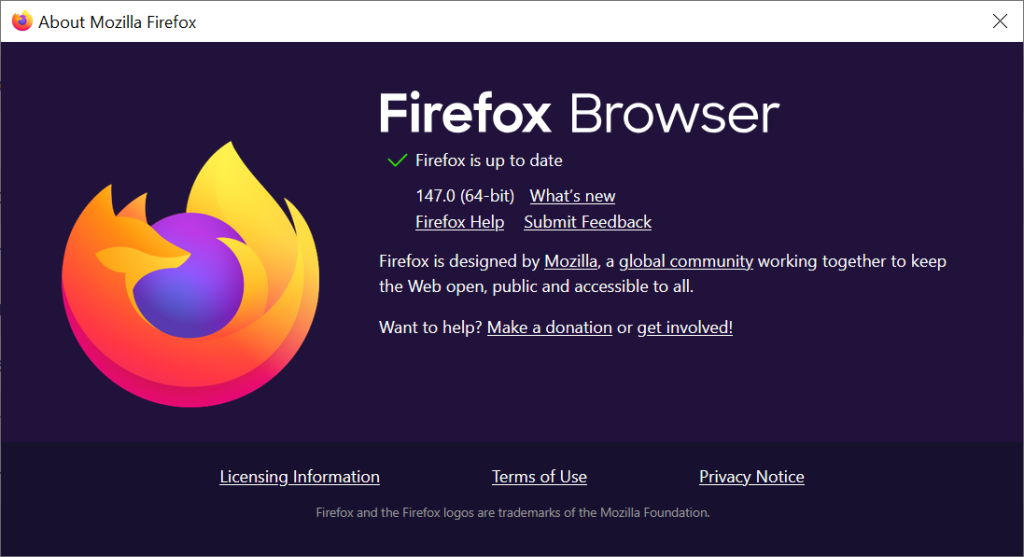
Firefox 147 released. (Image credit: Mozilla)

Closing a privacy loophole in Safe Browsing

Mozilla Firefox uses Safe Browsing from Google for security checks. This checks visited URLs to make sure they are not on a list of dangerous addresses.

Up until now, Mozilla Firefox used V4 of Safe Browsing. Under this system, Firefox downloaded a database of hash prefixes from Google. This list included only the first four bytes of a hash and not the full addresses.

When a Firefox user visited a site in the browser, it compared the first four bits of the site’s hash against the list. If a match was found, it contacted Google servers to verify if the site was on the badlist (bad then), or not (collision, not bad).

The problem here was that Firefox had to contact Google for this. This meant that Google got to see the IP address of the user’s computer and the has prefix of the site.

While local first, it was not fully private because of that.

Version 5 makes a shift to Oblivious HTTP. This adds a third-party server between the browser’s request, and thus a user’s IP address, and the Google server. The third-party server sees the IP address of the user, but only the encrypted hash that is submitted.

Google on the other hand sees the hash, which it can decrypt, but not the user’s IP address.

Site isolation support in Firefox for Android

Site isolation was introduced in late 2021 for desktop versions of the Firefox browser. The main idea was to load each site in its own separate process to avoid certain forms of attacks or privacy issues.

Now, almost four years later, Mozilla is introducing site isolation on Android. Apart from improving security, site isolation should also improve the stability of the Firefox browser on Android.

Under the old system, a crash of a website could take down other tabs or even the whole browser. With site isolation in place, only specific tabs associated with the site will crash, while all other sites and the browser itself won’t be affected.

Local network protection in Strict Tracking Protection

Only a few legitimate services require access to local network resources when you browse the Internet. However, sites may abuse the option for certain tracking forms or attacks. Fingerprinting, for example, benefits from identifying other network devices that are connected to the same network.

Starting in Firefox 147, the browser blocks requests from public websites to private RFC 1918 IP addresses, when tracking protection is set to Strict mode. Nothing changes if tracking protection is set to standard mode, which is the default.

As usual, Firefox users have the option to override this for individual sites.

Zero-Copy Video benefitting video playback on AMD GPU systems

Zero-Copy Video is a rendering technique that is designed to eliminate unnecessary transfers of data between system memory (RAM) and the graphics card (VRAM). Introduction of the feature removes one of the biggest bottlenecks when it comes to media consumption, especially on Linux systems.

To better understand the new system, it is important to understand how the old system worked. Or, more precisely, what made the old process inefficient.

When watching a video in the browser, say a 4K video on YouTube, this is what happened:

  • The GPU decodes the compressed video file.
  • The browser copies the decoded image into system RAM for the webpage frame.
  • The compositor copies the image back to the GPU for it to draw the image on the monitor.

Under the new system, the browser is no longer copying the decoded image. Instead, the GPU gives the browser a pointer to the image in its VRAM.

The main effect: The video never leaves the VRAM. This reduces memory (RAM), CPU usage, and PCIe traffic significantly.

XDG Base Directory Support

For the past 20 years, Mozilla has placed the .mozilla folder in the home folder on Linux to store configuration files and data. This has been a major annoyance for Linux users for a number of reasons:

  • Using the .mozilla folder violated the XDG Base Directory Specification, which says that files should be split into three locations based on purpose, not one location (Configuration, Data, and Cache).
  • Backup issues, as it was difficult to separate important files, such as configuration files, from trash, such as cache.
  • Some programs needed special rules to include the Firefox configuration, e.g., third-party sync software.
  • Performance problems on Enterprise networks that mounted the home directories over a network.

This changes with the release of Firefox 147. Firefox will store config files in ~/.config/mozilla and data in ~/.local/share/mozilla going forward, which resolves the long-standing issue.

Closing Words

You can check out the full release notes of Firefox 147 here. There you also find a link to the included security fixes, which, fix several issues rate high or lower, but none that appears to be exploited in the wild already.

WinSlop: The Open-Source Response to Microsoft’s AI Push—Strip the Bloat and Take Back Control of Your OS

Posted on January 12, 2026January 12, 2026 by Martin Brinkmann

When Microsoft CEO Satya Nadella argued that the discussion surrounding AI should move beyond “slop vs sophistication”, he probably did not have developers in mind that could take this literally.

Fun fact: The dictionary Merriam-Webster coined Slop the word of the year 2025.

Serial developer Belim, known for open source tools such as FlyBy11 or CrapFixer, created WinSlop as a direct response to Nadella’s plea.

What is it? WinSlop is a free open source program for Windows that removes “unnecessary, low-value system components” from the operating system that “consume resources, and reduce user control without providing meaningful benefit” according to the developer’s own description.

If you have used the developers other tools, you know what to expect. WinSlop is a lightweight tweaker for Windows that can turn off unwanted features among other things.

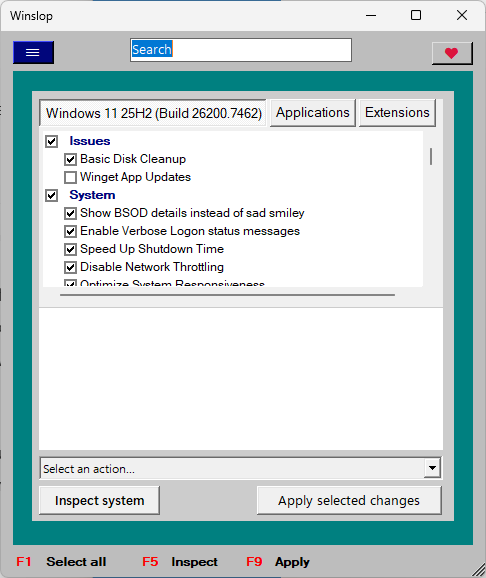
A screenshot of the WinSlop application running on Windows 11.

The tiny program launches directly when you execute it. It separates tweaks into three main tabs. The first displays components of Windows that you may disable by checking and unchecking boxes.

While AI components are a focus, it does not stop there. You can also use it to disable ads in certain places, tame Microsoft Edge, or remove unwanted features from the user interface.

The list is long and you may use the built-in search to find specific options faster.

One interesting option here is the ability to run a system check. This checks all 50 tweaks currently integrated to see whether they have been applied already. To enable a tweak, check the box in front of it. If you do not want a tweak to be applied, make sure its box is unchecked before you hit the “apply selected changes” button or press F9.

Most tweak titles are self-explanatory, but some may require a bit of research. The program lacks tooltips and does not provide additional information on the tweaks.

While it is clear what “Disable Bing Search” does, not all users may know what “Disable Hibernation” or “Optimize System Responsiveness” do. Detailed information would improve the app significantly in this regard. Experienced users may also want to know the exact tweaks that go into the system optimization.

Switching to the apps tab, you are prompted to run a system inspection. WinSlop checks for installed apps and lists apps that it considers bloatware. You may check apps individually to remove them from the system with a click on apply.

The Extensions tab, last but not least, can be used to load the Chris Titus app Windows Toolbox. It offers even more options, such as installing popular apps, tweaking Windows or enabling features such as the Subsystem for Linux. It is a separate app, which I guess is handy to have, but does not really add to the program itself.

Closing words

WinSlop is a handy tweaker for Windows that may get some publicity because its developer references the slop-quote of Microsoft’s CEO directly. However, it does not really add much to the world of tweaking programs that has not been there before.

Yes, it is easy to use and the system checker is nice, but that is about it. Still, if you have not used a tweaker on Windows yet, it is a good program to get started.

Slimming Down: How Checkpoint Updates Are Making Windows 11 Faster

Posted on January 11, 2026January 11, 2026 by Martin Brinkmann

When Microsoft released its Windows 10 operating system, it introduced a number of under-the-hood changes. One of these changed how updates were provided to Windows 10 PCs.

Up until the release of Windows 10, Microsoft released individual updates for its systems. While that gave administrators excellent control over the updates, as they could pick the ones that they wanted to install, it meant that a large number of updates had to be installed when an operating system like Windows 7 was installed after a number of years.

Microsoft tried to limit this with the release of Service Packs. These could be installed instead of all earlier updates, which improved the speed and stability of the installation process.

Cumulative updates entered the Windows world in 2015

Microsoft introduced cumulative updates with Windows 10 in 2015. It later introduced the system to earlier operating systems.

The idea was simple: instead of releasing individual updates, Microsoft would release updates that included all previous updates.

Instead of having to install dozens of updates, in some cases hundreds, Windows administrators would simply install the latest cumulative update and they would be done with the updating for the most part.

A new problem emerged: Cumulative updates reduced the number of updates that needed to be installed. However, since they included all previous updates, they grew in size over time.

Surprisingly though, this did not mean that systems downloaded full sized updates each month. Microsoft used a technique called differential downloads, or express updates, to deliver updates to Windows 10 systems.

This meant, that Windows Update downloaded only the update bits that were new. Everything that was installed already was skipped, which increased the updating speed.

The cumulative update model caused four major issues:

  • While computers only downloaded the update bits they needed, they had to compute which updates they were missing and do a lot of unpacking, verifiying and merging.
  • Fresh installs or factory resets take a long time. Computers had to download a massive update in the beginning, which would take long to install.
  • The system caused the WinSxS folder to bloat over time, which could result in storage problems on the main drive.
  • Storage was still a problem for, mostly, Enterprise customers who hosted and distributed updates from company servers.

Checkpoint updates come to the rescue

Microsoft introduced checkpoint updates in Windows 11, version 24H2. The main idea was to introduce updates regularly that would reset the cumulative updates.

They take a cue from service packs by creating new start points for cumulative updates. This addressed the major issues that Microsoft identified, e.g., instead of computing changes from the very release of the operating system, the processor would only have to do so from the last checkpoint update release.

Updates should install faster on recent versions of Windows 11 because of this. They also deal with the other problems mentioned, by reducing WinSxS storage or providing smaller, less CPU-taxing updates during fresh installs or resets.

Dell admits that PCs sell better when it does not mention AI capabilities

Posted on January 9, 2026January 9, 2026 by Martin Brinkmann

While companies such as Microsoft or Google are adding AI capabilities to more and more of their products and services, it seems that not all customers do share the excitement that these companies try to convey.

Do customers want these AI features or care about them? It is certainly too early to conclude how this will all play out. Do companies spend billions on AI research, infrastructure and products that they will never recoup because the audience is not big enough?

Dell admitted something interesting in an interview with PC Games recently during CES 2026. The company revealed that it moved away from putting AI PCs front and center in marketing stating that the message that it tried to deliver with its products instead was “not AI first”.

Dell realized that consumers were, by large, not really interested in AI PCs. They were interested in PCs, but whether these were equipped with NPUs and capable of running AI operations locally or not, was apparently not something that the majority of Dell customers prioritized.

We’re very focused on delivering upon the AI capabilities of a device—in fact everything that we’re announcing has an NPU in it—but what we’ve learned over the course of this year, especially from a consumer perspective, is they’re not buying based on AI,” Terwilliger says bluntly. “In fact I think AI probably confuses them more than it helps them understand a specific outcome.

While all recent Dell devices come with NPUs and AI PC capabilities, the company is not focusing its marketing efforts on that.

It seems likely that other PC manufacturers are experiencing the same. While none has come forward that openly yet, there seems to be a clear divider between the interests of companies that push AI and the people that buy PC products with AI capabilities.

Most AI features that Microsoft introduced in Windows 11 do not appear overly useful to the majority of Windows users. Many mimic features that every AI chat on the Internet supports. This could change the moment Microsoft introduces something truly useful, like an AI that reacts to support requests by fixing the issues automatically. Whether something like this is coming this year remains to be seen.

For now, expect to be continued to be bombarded with AI announcements and integrations in products and services. Whether this are truly useful, annoying or even obnoxious is up for every user to decide.

A Tech-YouTuber tested the speed of Windows from XP to 11 and made an astonishing observation

Posted on January 5, 2026January 5, 2026 by Martin Brinkmann

If you have used different versions of Windows, you may have discovered that some versions feel faster than others. Maybe you are still sad that Microsoft dropped support for Windows XP or Windows 7 several years ago, because you found them to be much faster than the latest and greatest versions of Windows.

A direct comparison is difficult, especially for home users, as it is necessary to run all tests on the same hardware and under the same conditions.

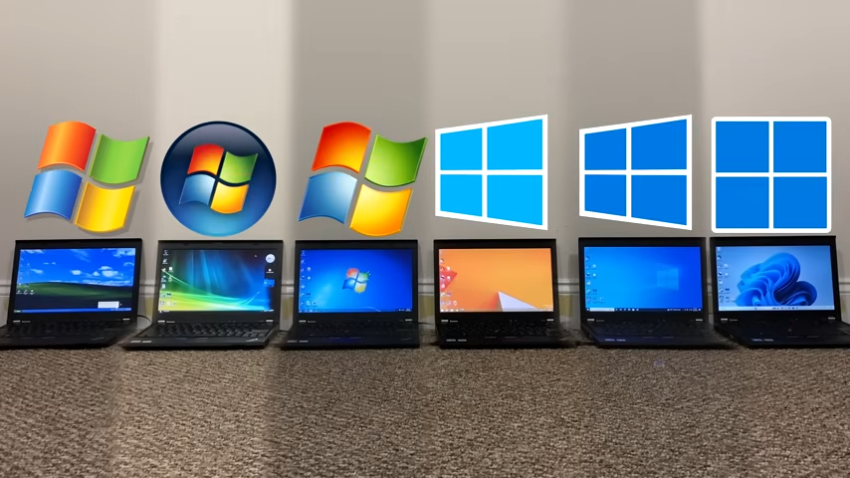
Tech-YouTuber TrigrZolt tested the performance of the six most recent Windows versions, from Windows XP all the way up to Windows 11, and publish the results on YouTube.

Key findings:

  • Windows 11 uses significantly more RAM than any other of the tested Windows versions.
  • Windows 11 does not feel as responsive as the other operating systems.

The testing platform is a Lenovo ThinkPad X220 device from 2011. It is powered by an Intel Core i5-2520M processor, 8 gigabytes of RAM and a platter-based hard drive.

What he discovered is remarkable, but the choice of hardware needs to be taken into consideration. Modern operating systems are optimized for Solid State Drives. Additionally, the processor is not supported officially by Windows 11.

How much storage space do the Windows versions occupy on disk?

  • Windows XP (18,9 GB)
  • Windows Vista (37,8 GB)
  • Windows 7 (44,6 GB)
  • Windows 8.1 (27,9 GB)
  • Windows 10 (36,7 GB)
  • Windows 11 (37,3 GB)

Microsoft’s Windows 8.1 operating system comes out first in a comparison of the boot process. It boots faster than any other candidate to boot into the desktop. Windows 11 comes last in the test.

RAM use is not as surprising, as the oldest operating system, Windows XP, requires less than a gigabyte of RAM. Windows Vista, Windows 7 and 8.1 come in second as a group, even though RAM use almost doubled here. It tripled under Windows 10 and more than quadrupled under Windows 11.

Browsing was tested as well. There, the YouTuber tried to open as many browser tabs in the browser Supermium, a Chromium-based browser, until 5 gigabytes of RAM were reached.

The clear winner of the test is Windows 8.1 with 252 open browser tabs. It is followed by Windows 7 with 235 tabs and Windows Vista with 184 tabs. Windows 10 reached 150 tabs while Windows 11 only 49 tabs. Windows XP crashed after 50 tabs were opened, which is still more than Windows 11 managed.

You can check out the full video here:

The YouTube user sums up the test in the following way: “Windows 11 is one of the slowest operating systems out of every version of Windows”.

It seems likely that Windows 10 and 11 would perform better with newer hardware and it would be interesting to see a second test that follows the same modules to find out how all operating systems would perform on a machine that is modern.

However, while hardware gets faster with every passing year, software seems to get slower and heavier as well, eating up much of the performance gains.

Windows 11 SE: Microsoft confirms the end of the operating system

Posted on January 2, 2026January 2, 2026 by Martin Brinkmann

Microsoft confirmed that Windows 11 SE is on its way out. The operating system will reach end of support in October 2026 and won’t receive updates anymore after that month’s Patch Day. It is one of several Microsoft products that reach end of support or life in 2026.

What is Windows 11 SE? Windows 11 SE is a limited version of Windows 11 that is cloud-first and specifically designed for the education market, which requires cheap, secure, and easy to manage devices.

Microsoft created the operating system as a way to compete directly with Google’s Chromebook, regain lost grounds and increase the reach of its Microsoft 365 ecosystem.

Windows 11 SE offered a simplified interface, better offline capabilities than Chrome, and manageability via Microsoft Intune for Education. Critics found Windows 11 SE to be considerably heavier than Chrome OS. Additionally, availability was limited and users could not install apps on their devices.

Windows 11 SE: the countdown to end of support

Microsoft confirms that Windows 11 SE will no longer be supported after October 2026. This does not come as a total surprise, as Microsoft announced last year already that it would not release another feature update for Windows 11 SE.

The last feature update is Windows 11, version 24H2. From October 2026, Microsoft won’t release software updates or security fixes, and won’t offer technical assistance either.

Devices will continue to work, according to Microsoft. However, Windows 11 SE devices were low-spec devices. Microsoft’s own reference device came with an Intel Celeron N4020 or N4120 processor, 4 or 8 GB of DDR4 RAM, and either 64 GB or 128 GB of eMMC storage.

Third-party manufacturers, including Dell, Lenovo and HP, created custom devices, but they all had in common that components were not designed for speed of performance.

While it may be possible to install a different operating system on the devices, it would be ironic if Chrome OS would be installed on those devices. A clean install of windows 11 may also be an option, at least on some devices. However, this will likely lead to performance issues due to the low-power processor and bare minimum storage for running Windows 11.

It seems unlikely that Microsoft is working on Windows 12 SE. Microsoft recommends that customers migrate to devices that run Windows 11, but does not seem to offer any discounts to affected customers at this point.

These Microsoft products reach end of support or life in 2026

Posted on December 31, 2025January 2, 2026 by Martin Brinkmann

2025 was a tough year for many users of Microsoft products. It was the year that support for Windows 10 ended officially, albeit with the option to extend support by a year for consumers and by up to three years for businesses.

Windows 11, version 22H2 support ended just a few months ago for business customers and version 23H2 support ended for consumers as well. Additionally, Microsoft Office 2016 and 2019 reached end of support.

Looking forward, 2026 will be another interesting year. Consumers who run Windows 10 PCs with ESU will no longer get updates from Microsoft after the one-year extension has run its course.

But that is not the only change. Windows 11, version 24H2 reaches end of support as well. Business customers have to upgrade Windows 11, version 23H2 to ensure that their devices remain supported with updates.

Here is the list of products that reach end of support or life in 2026. Note that this may not be complete, as Microsoft does not provide an easily accessible list for all of its products.

Inspiration was taken from the list over at Deskmodder, but I have fine-tuned it somewhat.

Microsoft Windows

  • Windows 10 2016 LTSB / IoT Enterprise LTSB 2016 reach end of ESU on October 13th, 2026
  • Windows 11, version 23H2 Enterprise/Education/IoT Enterprise editions reach end of support on November 10th, 2026.
  • Windows 11, version 24H2 Home/Pro editions reach end of support on October 13th, 2026.
  • Windows 11 SE, reaches end of support in October 2026.
  • Windows Server 2012 and 2012 R2 reaches end of ESU on October 13th, 2026.
  • Windows Server 2022 reaches end of mainstream support on October 14th, 2026. ESU available.

Microsoft Office

  • Microsoft Office 2021 reaches end of support on October 13th, 2026.
  • Office LTSC 2021 and Office LTSC 2021 for Mac reach end of mainstream support on October 13th, 2026.

Other Microsoft products

  • Microsoft .NET 8 (LTS) reaches end of support on November 10th, 2026.
  • Microsoft .NET 9 reaches end of support on November 10th, 2026
  • PowerShell 7.4 (LTS) reaches end of support on November 10th, 2026.
  • SQL Server 2016 reaches end of extended support on July 14th, 2026.

Generally speaking, Microsoft is supporting Windows 11 Home and Pro editions for two years, while business and Enterprise editions get three years of support.

Now You: Do you use a product or service that is reaching end of support this year? What are your plans dealing with this? Feel free to leave a comment down below.

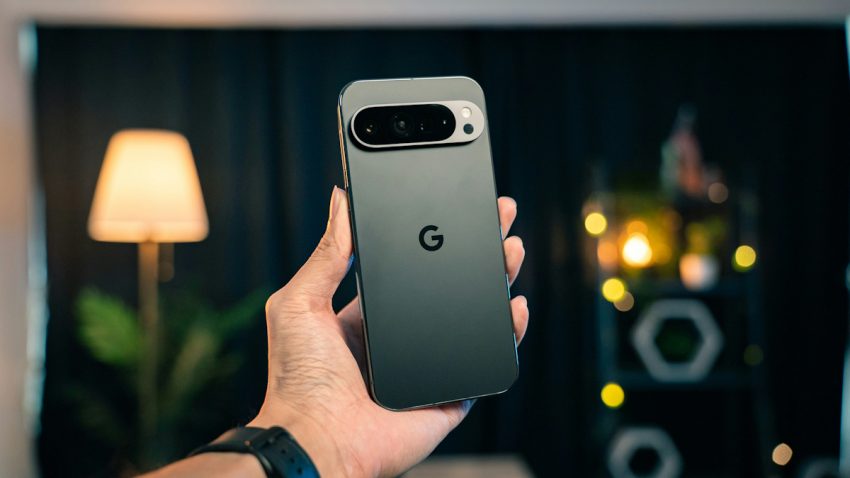
Google tests Pixel Upgrade Program that always gives customers the newest Pixel

Posted on December 29, 2025December 29, 2025 by Martin Brinkmann

Ah, the yearly phone update. Manufacturers such as Google, Samsung, or Apple release new mobile phones each year. This means that the phone that you buy today is not the hottest piece of hardware after a (maximum) of one year of usage.

That is a problem for users who always want the latest mobile device in their hands.

Google is testing what it calls the Pixel Upgrade Program in India. Announced on the official Google India blog, it sounds like a good deal on first glance: buy a new Pixel device, meet some requirements, and get future Pixel devices automatically while sending back your old devices.

This ensures, according to Google, that you have the latest and greatest Pixel device in your possession at all times.

Is there a catch? Yes, there is one. Google explains how the program works, and here are the caveats:

  • It is only available for no-cost 24-month EMI (Equated Monthly Installments) plans.
  • You need to buy the phone using credit cards from Google’s official partners Bajaj Finance or HDFC Bank.
  • You start a new EMI plan for each new Pixel device you get.

Between the ninth and fifteenth EMI, Pixel-users become eligible to upgrade. They need to trade the current Pixel device through Google’s partner Cashify. Provided that it “powers on and is free of unauthorized repairs”, an amount equal to the remaining loan balance is credited to the user’s bank account. This can be used to close the original loan.

From there, users need to start a new 24-month plan for the brand-new Pixel device.

ProsCons
Always have the latest Pixel device.Long-term renting, owning only if you make all 24 payments.
Predictable costs.Paying premium for (potentially) underwhelming upgrades
Bonus, e.g., free periods for Google AI Pro or YouTube Premium, restart with each phone.Limited to EMI and two banks.

Whenever a customer trades the old device in, the cycle begins anew. It is identical to a never-ending rent, with the benefit of getting the newest Pixel device each year.

Would I use it, if it would be rolled out worldwide? No, I would not. I do not buy in installments or on credit, and do not need the latest device each year. It may be different for others, who want or need the latest all the time.

What about you? Would you be tempted to join such a program to get the latest Pixel device each year? Feel free to leave a comment down below.

How to upgrade to Windows 11, version 25H2, if the upgrade is not offered via Windows Update

Posted on December 28, 2025December 28, 2025 by Martin Brinkmann

Microsoft released the 2025 feature update for Windows 11 in late September 2025. It was a smaller update that installs like a regular update instead of a bigger feature update. That is probably the main reason why Microsoft enabled broad distribution of the update shortly after its release.

The update should install automatically on most Windows 11 devices, provided that version 24H2 — last year’s feature update — is installed.

However, I noticed on one of my machines that Microsoft was not offering the new feature update via Windows Update.

First thing you may want to do in that case is to check if Microsoft has so-called Safeguard Holds in place.

Good to known: A Safeguard Hold blocks updates from machines, if certain issues are known that affect them. Microsoft uses the system to prevent larger issues on PCs that may be caused by updates.

Windows Update does not offer Windows 11, version 25H2 on a fully patched Windows 11, version 24H2 system.

Windows 11, version 25H2 has just three known issues listed on the official Windows 11 health dashboard. Two of these are listed as resolved, one as mitigated.

You may notice that your system is not affected by any of them. This was the case for the machine in question that I tried to upgrade.

Here are a few extra verification steps:

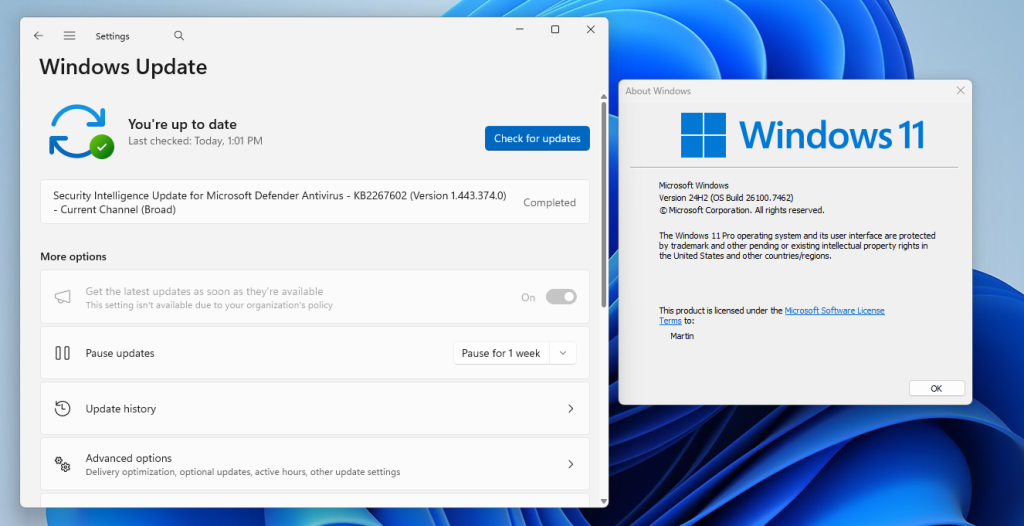
  • Make sure you have all updates installed that are offered via Windows Update. Go to Settings > Windows Update and activate the “check for updates” button.
  • Check the “get the latest updates as soon as they’re available” box.
  • Make sure the main drive has enough free storage space for the update. If it is low, say less than 20 gigabytes, you may want to consider freeing up space.

How to upgrade to Windows 11, version 25H2

Windows administrators who are in the same position have a few options. The easiest is to install a small enablement package, which upgrades the system to the latest feature update release.

There is a problem: Microsoft is not hosting the update file on its Microsoft Update Catalog website. This means that the download has to come from a third-party website, which needs to be trusted.

My recommendation is to download the package from Deskmodder, a German website with an impeccable record.

  1. Download Windows11.0-KB5054156-x64.msu from the website (or another, if you prefer that).
  2. Double-click on the update file to run the upgrade.

If things go well, Windows 11 should be upgraded to version 25H2.

  • Previous
  • 1
  • 2
  • 3
  • 4
  • 5
  • 6
  • …
  • 31
  • Next

Support This Site

If you like what I do please support me!

Any tip is appreciated. Thanks!
  • March 2, 2026 by Martin Brinkmann Don't Bother with Windows 11's new Speedtest feature
  • February 27, 2026 by Martin Brinkmann Warning! That laptop on Amazon? It comes with temporary storage
  • February 26, 2026 by Martin Brinkmann "If your printer works today, it will continue to work": Microsoft corrects previous announcement
  • February 25, 2026 by Martin Brinkmann YouTube Premium Lite subscribers get background playback and downloads with a big "but"
  • February 24, 2026 by Martin Brinkmann Firefox 148.0 is out with its AI kill switch and support for Windows 7 and 8.1 comes to an end

About

We talk, write and dream about Technology 24/7 here at Chipp.in. The site, created by Martin Brinkmann in 2023, focuses on well-researched tech news, reviews, guides, help and more.

Legal Notice

Our commitment

Many websites write about tech, but chipp.in is special in several ways. All of our guides are unique, and we will never just rehash news that you find elsewhere.

Read the About page for additional information on the site and its founder and author.

Support Us

We don't run advertisement on this site that tracks users. If you see ads, they are static links. Ads, including affiliate links, never affect our writing on this site.

Here is a link to our privacy policy

©2026 Chipp.in Tech News and Reviews