Have you ever heard of the Userchoice Protection Driver (UCPD.sys) that Microsoft added to its Windows 10 and Windows 11 operating systems in 2024? It is a protective driver designed to prevent third-party applications or scripts from making changes to Registry keys that fall into the UserChoice category. This includes system defaults, such as the web browser, PDF viewer, or widgets.
Before the introduction, apps or scripts could make changes to default settings on Windows by editing certain keys in the Registry directly. With UCPD active, Microsoft implemented a check that allows or disallows changes to these keys.
If the change comes from a legitimate Microsoft process, it is allowed. If the change comes from a non-Microsoft process,, it is not allowed.
So, using the Settings application works, while using a script to make the changes does not.
While Microsoft has not revealed much about the motivation behind the introduction of the driver, it was at least partially introduced to make hijacking of important user settings difficult.
Granted, this had the added effect that it would be harder for competitors to change the defaults, even when users wanted it to happen.
The Impact
Most users may never notice that Microsoft introduced the feature in the first place. Changing defaults via the Settings app is not prevented and so is not a direct edit to the Registry using the Registry Editor.
However, for system administrators and some advanced users, UCDP has been a major headache as it broke command line tools and scripts.
How to check if the driver is running
Here is one easy method to check if the driver is active on your Windows PC:
Open the Start menu.
Type cmd and press the Enter-key to load the Command Prompt.
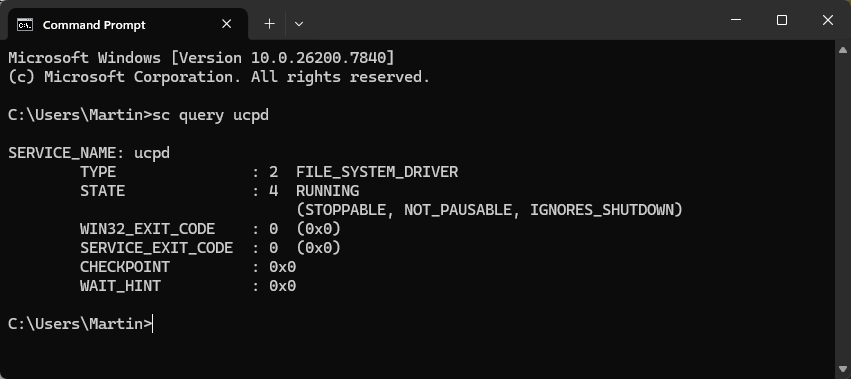
Type sc query ucpd.
If you see running next to state, then you have confirmation that the service is active.
Can you do something about it? (Should you?)
The short answer: yes, you can turn this off, but it is not as straightforward as you might want it to be.
Here are the required steps:
Run sc config UCPD start= disabled from an elevated command prompt window.
Open Task Scheduler, navigate to \Microsoft\Windows\AppxDeploymentClient, and disable the UCDP velocity task so that it does not turn the driver back on.
Reboot the system.
I suggest you check whether UCDP is running using the command prompt again to make sure.
Should you disable the feature? My advice: if you did not notice any issues so far, you might not need to disable it. If you have run into problems recently running scripts or apps, then you could consider it, especially if you run them regularly.
Keep in mind though that this is also blocking malicious scripts and apps from making those changes.
If January was the warm-up, February is the sprint.
Microsoft’s second Patch Tuesday of 2026 has arrived with significant urgency, addressing 59 vulnerabilities in total. While the total count is manageable, the severity is high, as it contains six zero-day vulnerabilities that are currently being exploited in the wild.
Here is the breakdown of what you need to know, what to patch first, and what might break.
Key Action Item: Administrators must prioritize workstation patching immediately due to three “one-click” security bypasses (Shell, MSHTML, Word) that allow code execution without user confirmation. Simultaneously, restrict and patch RDP servers to prevent the active SYSTEM-level escalation exploit (CVE-2026-21533).
Important Patches
CVE-2026-21510 — Windows Shell Security Feature Bypass Vulnerability
Security updates and non-security changes. Adds “Cross-Device resume” and MIDI 2.0 support.
Deep Dive: The Critical Vulnerabilities
Microsoft confirmed that six already exploited zero-day vulnerabilities are fixed after installing the cumulative updates. Attackers may exploit the issues on unpatched systems to bypass protections and gain system-level access.
Allows attackers to craft malicious links or shortcut files to bypass Mark of the Web (MotW) and Windows SmartScreen prompts. As a result, malicious payloads may execute on unpatched systems without the usual “Are you sure” security warnings of SmartScreen.
Allows attackers to bypass security prompts using malicious HTML files, if the Internet Explorer engine (MSHTML) is used for rendering. The threat is similar to the Windows Shell issue described above, as it may be used to skip security screens to run malicious code on target systems.
CVE-2026-21514 (Microsoft Word Security Feature Bypass)
The third of the feature bypasses, this exploits an issue in Object Linking & Embedding (OLE) in Microsoft Office. Attackers may use it to run malicious Word documents and sidestep certain protections designed to block the execution of risky external content.
CVE-2026-21519 (Desktop Window Manager Elevation of Privilege)
The vulnerability is a type confusion flaw in the Desktop Windows Manager (DWM). Attackers need basic access for exploitation, but if they have, they may use the flaw to elevate their privileges to SYSTEM level, which allows them to take control of the system.
CVE-2026-21533 (Windows Remote Desktop Services Elevation of Privilege)
Describes an improper privilege management flaw in Remote Desktop Protocol. Exploitation opens another route to SYSTEM privileges on unpatched system. Especially problematic in Enterprise environments, which usually use RDP a lot.
CVE-2026-21525 (Windows Remote Access Connection Manager Denial of Service)
A null pointer dereference issue in the VPN / Dial-up manager. A local attacker, even with low privileges, may use the issue to crash the service repeatedly.
Significant Changes in the February 2026 updates
The Virtual Secure Mode (VSM) restart loop bug is fixed.
Cross-Device resume arrives in Windows 11. When a phone is paired with the Windows system, its recent activities are now displayed in Start. You can continue those. Requires the latest Link to Windows app.
Native MIDI 2.0 support. The new protocol is now supported, which creators and audio engineers may take advantage of.
The Secure Boot change is entering the targeting phase. In this phase, Windows can determine whether the device’s UEFI is compatible with the upcoming certificate rotation. If it is, it will be queued to receive the actual update in the coming months. No user action required.
First Steps: Your Patch Tuesday Strategy
Patch the six zero-day vulnerabilities immediately. Start with user workstations.
If you paused updates in January because of the VSM restart loop bug, deploy this month’s cumulative update to get it fixed.
For years, Windows has felt less like a trusted tool and more like a construction site that never quite cleared the rubble. Whether it’s the lingering inconsistency of the UI, the intrusion of unwanted ads, the performance hiccups, or that many users now expect to experience issues when Microsoft releases an update for the operating system.
Microsoft’s flagship OS has faced a widening trust gap with its most loyal users. Now, in a strategic pivot aimed at 2026, the tech giant is launching an internal “swarming” initiative to prioritize stability and refinement over flashy new AI features.
Swarming, in this context, refers to engineering teams working on core reliability issues, including performance lags, to address major pain points of Windows users.
This year you will see us focus on addressing pain points we hear consistently from customers: improving system performance, reliability, and the overall experience of Windows.
The quote comes from the president of Windows and devices at Microsoft, and it was published by Tom Warren at The Verge on January 29, 2026.
While it is bad enough that users and organizations feel issues hitting them left and right at times, it is the image of Windows that seems to be starting to worry Microsoft. Up until now, Microsoft pushed what it thought served it best onto Windows. Ads, AI, limited user control, features that barely anyone asked for. Yes, there was the occasional feature that users liked, but most changes were met with a good portion of skepticism at best.
While Microsoft received criticism, most users did not seem to mind as long as the operating system worked. Most features could be turned off or disabled. Yes, some had the nasty habit of being turned on again at times, which was annoying.
Now it appears that Windows is at a critical junction, one that even Microsoft can’t ignore going forward.
The foundation needs to be stabilized before Microsoft can continue to use Windows as a vehicle for selling subscriptions and other products.
It remains to be seen how dedicated Microsoft will be and whether it manages to make a U-turn regarding stability of its operating system. With Linux gaining essential support for PC games, there is not really much that Windows has to offer that is not also possible on Linux.
Microsoft launched its newest operating system Windows 11 back in October 2021 to mixed reviews. Its predecessor, Windows 10, held the top spot firmly at the time while Windows 7 and Windows 8 were reaching the official end of life dates. While companies could extend support of Windows 7 by three years, Microsoft did not give home users such an option.
Microsoft CEO Satya Nadella announced during the company’s FY26 second-quarter earnings call that Windows 11 has officially surpassed one billion monthly active users.
Windows reached a big milestone: One billion Windows 11 users, up over 45% year-over-year.
In about four years, Windows 11 managed to reached the coveted one billion users mark. Windows 10, which was equally criticized when it launched in 2015, took longer to reach the important milestone.
How much longer? Not that much, it turns out. Let us take a look at the official dates that Microsoft provided for Windows 10 and Windows 11 first.
Windows 10
Windows 11
Launch Date
July 29, 2015
October 5, 2021
1 Billion Users Date
March 16, 2020
January 2026
Windows 10 reached 1 billion monthly active users 1,706 days after it was released by Microsoft. Windows 11 managed to cross the one billion monthly active users mark in 1,576 days.
That is 130 days faster. While not impressively faster, it is important to note that Windows 11 had a handicap all along: new system requirements prevented a sizeable chunk of Windows 10’s userbase from upgrading directly to Windows 11.
While Microsoft never released numbers, estimates suggest that several hundred million devices can’t be upgraded directly. While a high percentage of these devices can be upgraded by skipping the requirements checks, the technical nature of the process likely prevents this on the vast majority of devices running Windows 10.
For users, it does not really matter how fast or slow an operating system growth, provided that it manages to reach a number of users that is sizeable enough to warrant continued support.
Windows 10 Home and Pro editions will reach end of servicing later this year. It will be interesting to see what the millions of home users will do when that time comes.
Microsoft has just released another, “out-of-band” series of updates—including KB5078127 and KB5078132—to address a critical system issue currently impacting Windows 11 (versions 25H2, 24H2, and 23H2) and Windows 10 (22H2) users worldwide.
The issue occurred after installing the January 2026 cumulative updates for client and server versions of Windows.
Microsoft admits that users of Outlook were especially affected by the issue, provided that the Outlook PST files were stored in the cloud and not on the local machine.
Outlook users might notice hangs or issues when reopening Outlook. Other issues that users might experience included noticing that sent items were missing or that previously downloaded emails were downloaded again.
Windows users who use Outlook and store the PST files in the cloud should install the update immediately. Microsoft does not mention any other changes in the update, which means that users of unaffected systems can ignore it for now. It will be included in the February 2026 cumulative update.
How to check your Windows Version
To find your version, press Win + R, type winver, and hit Enter. Once you know your version, look for the corresponding update in Settings > Windows Update.
Windows Version
Update ID (KB)
New OS Build
Windows 11, version 25H2
KB5078127
26200.7628
Windows 11, version 24H2
KB5078127
26200.7628
Windows 11, version 23H2
KB5078132
22631.6495
Windows 10, version 22H2
KB5078137
19045.6812
While these frequent “out-of-band” patches can feel like a game of digital whack-a-mole, they serve as a reminder that updates do not only fix issues but may also introduce them.
As such, it is highly recommended to take necessary precautions, such as backing up the system partition before installing updates.
In a move that confirms privacy advocates’ long-held fears, Microsoft has reportedly handed over BitLocker encryption keys to the FBI, allowing federal agents to unlock the laptops of suspects in a fraud investigation without their consent.
The disclosure reveals a critical issue in how modern Windows devices handle security: convenience often comes at the cost of privacy. While BitLocker is designed to make your data unreadable to third-parties, the default settings on millions of Windows 11 PCs automatically upload the recovery key to Microsoft’s servers—creating a lawful “loophole” when served with a valid warrant.
For the suspects, this meant their encrypted hard drives were an open book. But for the average user, it serves as a grim reminder: if your recovery key lives in the cloud, Microsoft holds the master key to your digital life. Anyone else who may gain access, think malicious hackers, may also.
The good news? You can revoke their access today—if you know where to look.
Checking the status
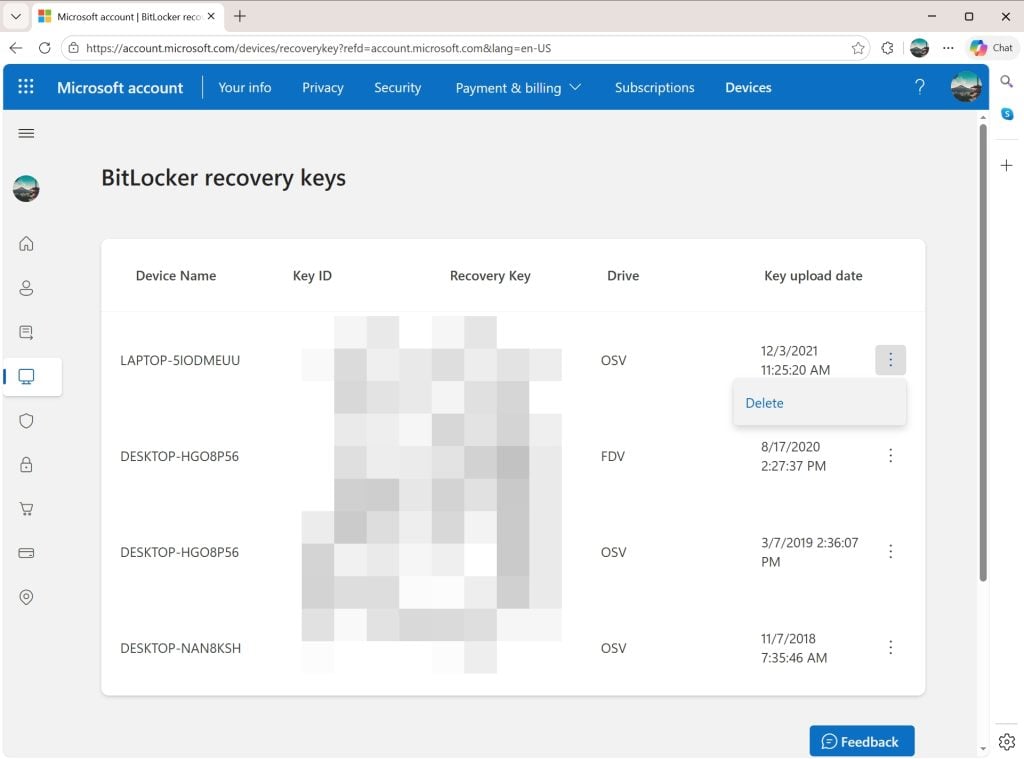
The Microsoft online website lists all BitLocker recovery keys uploaded to the cloud, even for devices that you may not use anymore.
If you do use computers with Windows 11 and a Microsoft account, chance is that BitLocker is used on the device and that the encryption keys are synced to the connected cloud storage.
The best way to find out if that is the case already is the following:
Open a web browser on your computer.
Navigate to https://account.microsoft.com/devices/recoverykey.
Sign-in to your Microsoft account (the same that you use to sign-in to Windows)
The page that opens displays all connected devices, dates, and the Bitlocker recovery key. These keys can be used to decrypt hard drives encrypted by BitLocker.
Tip: You can delete any instance here with a click on the menu icon next to an item and the selection of delete.
You can also check the status of the active computer in the following way:
Open Start.
Type CMD.
Select “run as administrator” while Command Prompt is selected.
Paste or write manage-bde -status and press the Enter-key.
Check the conversion status to find out if a drive of the computer is encrypted.
Prevent the upload of recovery keys
The Control Panel applet reveals the status of BitLocker on each drive.
The easiest option, by far, is to rely solely on local accounts on Windows 11. Since local accounts are not linked to a Microsoft account, they do not sync data to the cloud. However, it is necessary to make sure that the local account is created during the initial setup.
Another option is to avoid BitLocker altogether and use a third-party — trusted — encryption software, such as VeraCrypt instead.
For that, you have to disable BitLocker on each Windows machine. Here is how you disable it on the active machine.
Notes:
Turning off will take some time. Windows begins decrypting the selected hard drive. It can take minutes to hours, depending on the size of the drive / partition and the speed of the PC.
You can keep using the computer. While Windows decrypts the drive in the background, you can keep on using it. It may be a bit slower than usual though.
Keep the PC turned on during the entire process. Ideally, you keep the PC on until the decryption of the drive completes. Keep the Control Panel open or check the notification area for status updates.
If “turn off” is not available, you are either not logged in as an administrator or there is a policy in place that prevents you from making changes.
Method 1:
Open the Start menu and click on the Settings icon.
Select Privacy & security in the Settings app.
Look for Device encryption.
If you do not see the option, skip the process and check method 2 below.
Click on Device Encryption.
Toggle the feature to Off.
Confirm the choice by selecting turn off again.
Method 2:
Press the Start button.
Type Manage BitLocker and select the result.
Check all drives listed on the Control Panel page that opens.
If you see “BitLocker Off” next to a drive, the encryption is disabled.
Select “Turn off BitLocker” for each drive with “BitLocker on”.
Confirm your choice by selecting “Turn off BitLocker” again.
Method 3: The Pro-method
Right-click on the Start menu, select Terminal (Admin).
Type the command manage-bde -off C: and press the Enter-key.
Note: replace C: with the drive letter that you want to disable BitLocker for
Imagine this: You’ve just finished a critical document or a long email, you hit “Save,” and suddenly—nothing. Your screen freezes, the cursor spins endlessly, and your application enters the dreaded state of “Not Responding.”
If this sounds like your week, you aren’t alone. A frustrating new bug in the latest Windows 11 update is causing freezes for users relying on cloud storage.
Enterprise: Windows 10 LTSC 2021, Windows 10 LTSC 2019
Server: Windows Server 2019, Windows Server 2022, Windows Server 23H2, Windows Server 2025
Microsoft admits that the bug affects file operations, such as load or save, when cloud-storage is involved. Attempts to save files to OneDrive, Dropbox or other cloud storage services may trigger the issue. Similarly, opening files from cloud locations may also cause the freezes.
Microsoft writes:
For example, in some configurations of Outlook that store PST files on OneDrive, Outlook might become unresponsive and fail to reopen unless its process is terminated in Task Manager, or the system is restarted. In addition, sent emails might not appear in the Sent Items folder, and previously downloaded might be downloaded again.
The company says that it is working on a resolution. It does not have a universal workaround for affected users at the time of writing. While it has published a workaround for users who load Outlook PST files from cloud storage, it simply states that users should contact the application developer to learn about other access options.
I will update this article once there is a fix or a universal workaround. Keep you posted.
Just days after Microsoft released the first security updates for Windows, it is rushing out an out-of-bounds update to fix sign-in failures during Remote Desktop connections
It wouldn’t be a true Patch Tuesday if something didn’t break immediately after. If you spend the last days trying to figure out why Remote Desktop connection suddenly refuse to authenticate, you may be glad to hear that Microsoft acknowledged the issue yesterday.
Even better, the company released an out-of-bounds update on Saturday that addresses the issue.
Essential information
The issue: Microsoft notes that some Windows users “experienced sign-in failures during Remote Desktop connections”. The issue affected several Remote Desktop apps, including the Windows app.
Affected systems: Microsoft released updates for Windows 10 (KB5077796) and Windows 11, versions 24H2 and 25H2 (KB5077744)
Availability: Microsoft releases the update via Windows Update, Microsoft Update, and the Microsoft Update Catalog.
Administrators need to install the out-of-bounds update to fix the issue.
AI component updates included
While the main purpose of the update is to restore Remote Desktop connectivity, Microsoft has added several updated AI components to the update.
This affects the Windows 11 update only, as Windows 10 support is limited. Here is the list of components that are also updated when the patch is installed on a Windows 11 machine.
AI Component
Version
Image Search
1.2511.1224.0
Content Extraction
1.2511.1224.0
Semantic Analysis
1.2511.1224.0
Settings Model
1.2511.1224.0
Closing Words
The RDP issue is not the only one that Microsoft confirmed after the release of the January 2026 updates. Some Enterprise systems running Windows 11, version 23H2 were plagued by a shutdown bug that prevented the systems from shutting down properly.
Microsoft published a workaround — running the shutdown command from run or a command prompt — but no final fix for the issue at the time of writing.
If you were hoping for a quiet start to the new year, Microsoft has other plans.
The January 2026 Patch Tuesday is here, and it marks a heavy start to the year for system administrators. Microsoft has addressed a massive 114 vulnerabilities across its ecosystem, including eight critical flaws and a zero-day that require immediate attention.
While Microsoft released a large number of patches for its operating systems and services, it is CVE-2026-20805 that requires immediate attention. It is an actively exploited zero-day vulnerability in the Desktop Windows Manager (DWM) that is being used by threat actors to bypass security controls.
Add to that a “no-click” remote code execution flaw in Microsoft Office that is triggered by using the preview pane, it is clear that administrators have their hands full in the coming days to address these and others.
Beyond the security fixes, this month also brings some significant housekeeping: Microsoft is officially purging legacy Agere modem drivers from Windows images, marking the end of the road for decades-old hardware dependencies.
Key Action Item: Administrators should prioritize patching CVE-2026-20805 (DWM) immediately, as it is being used in the wild to bypass security controls.
Important Patches
CVE-2026-20805 — Desktop Window Manager Information Disclosure Vulnerability
Security updates and non-security changes. Removes old modem drivers (Agere).
Deep Dive: The Critical Vulnerabilities
While the total count of vulnerabilities is high, administrators may want to focus their attention on three specific issues: a zero-day vulnerability that is exploited in the wild, “no-click” Microsoft Office exploits, and a major issue affecting in Secure Boot.
The Zero-Day: CVE-2026-20805 (actively exploited)
CVE-2026-20805 is an Information Disclosure vulnerability that allows a threat actor to read specific memory addresses from remote ALPC ports. While this does not allow the actors to run malicious code directly, attackers may exploit the vulnerability to bypass Address Space Layout Randomization (ASLR).
This may enable them to create other remote code execution exploits that target system components directly.
The “No-Click” Microsoft Office issue
CVE-2026-20952 and CVE-2026-20953 are use-after-free vulnerabilities that allow remote code execution. The danger comes from the fact that they do not require user interaction for execution.
They rely on preview panes, either in File Explorer or Outlook, to trigger exploits. An attacker would have to get a specially crafted Office document on the user’s computer. When a user views the file in a preview area, for example by selecting it in File Explorer, the exploit triggers.
The Secure Boot bypass
CVE-2026-21265 describes a Secure Boot issue. It is not a bug in code that can be exploited, but a cryptographic expiration issue. Secure Boot certificates issued in 2011 are set to expire later this year.
Installation of this update rotates the certificates ensuring that devices will continue to boot and won’t fail to boot once the old certificates expire.
Significant changes
Microsoft removes drivers for legacy Agere modems from Windows with this update. The modems have not been manufactured for a long time and the main reason for removal is a vulnerability CVE-2023-31096. Instead of patching the driver, Microsoft decided to remove the driver from Windows instead.
The removal affects Enterprise and industrial users for the most part. It can affect point-of-sale terminals or legacy fax servers that rely on Agere modem chipsets. These will no longer work when the update is applied.
A quick check of the Device Manager should reveal whether “Agere Systems” or “LSI” models are used.
WDS Hardening enters first phase
This is only relevant if Windows Deployyment Services (WDS) is used. Microsoft is hardening WDS. The company introduces new event logging and Registry controls to block unauthenticated deployment requests.
Starting this month, logging is enabled. Administrators may enforce the block, but it is not enabled by default. From April 2026 onward, Microsoft plans to enable “block by default”.
Companies that rely on unauthenticated imaging have until April 2026 to switch to authenticated deployment. There is also a new AllowHandsFreeFunctionality Registry key, which enables the old status quo.
First Steps: Your Patch Tuesday Strategy
Patch the Zero-Day issue that is exploited in the wild immediately.
Deploy updates to mitigate the “no-click” vulnerability in Microsoft Office.
Make sure legacy modem hardware is not in use anymore.
Ensure that boot loaders are updated before certificates expire.
Windows 11, version 22H2 support ended just a few months ago for business customers and version 23H2 support ended for consumers as well. Additionally, Microsoft Office 2016 and 2019 reached end of support.
Looking forward, 2026 will be another interesting year. Consumers who run Windows 10 PCs with ESU will no longer get updates from Microsoft after the one-year extension has run its course.
But that is not the only change. Windows 11, version 24H2 reaches end of support as well. Business customers have to upgrade Windows 11, version 23H2 to ensure that their devices remain supported with updates.
Here is the list of products that reach end of support or life in 2026. Note that this may not be complete, as Microsoft does not provide an easily accessible list for all of its products.
Inspiration was taken from the list over at Deskmodder, but I have fine-tuned it somewhat.
Microsoft Windows
Windows 10 2016 LTSB / IoT Enterprise LTSB 2016 reach end of ESU on October 13th, 2026
Windows 11, version 23H2 Enterprise/Education/IoT Enterprise editions reach end of support on November 10th, 2026.
Windows 11, version 24H2 Home/Pro editions reach end of support on October 13th, 2026.
Windows 11 SE, reaches end of support in October 2026.
Windows Server 2012 and 2012 R2 reaches end of ESU on October 13th, 2026.
Windows Server 2022 reaches end of mainstream support on October 14th, 2026. ESU available.
Microsoft Office
Microsoft Office 2021 reaches end of support on October 13th, 2026.
Office LTSC 2021 and Office LTSC 2021 for Mac reach end of mainstream support on October 13th, 2026.
Other Microsoft products
Microsoft .NET 8 (LTS) reaches end of support on November 10th, 2026.
Microsoft .NET 9 reaches end of support on November 10th, 2026
PowerShell 7.4 (LTS) reaches end of support on November 10th, 2026.
SQL Server 2016 reaches end of extended support on July 14th, 2026.
Generally speaking, Microsoft is supporting Windows 11 Home and Pro editions for two years, while business and Enterprise editions get three years of support.
Now You: Do you use a product or service that is reaching end of support this year? What are your plans dealing with this? Feel free to leave a comment down below.