Chipp.in Tech News and Reviews

Windows, Security & Privacy, Open Source and more

Menu
  • Home
  • Windows
  • Security & Privacy
  • Gaming
  • Guides
  • Windows 11 Book
  • Contact
  • RSS Feed
Menu

Tag: firefox

Firefox 148.0 is out with its AI kill switch and support for Windows 7 and 8.1 comes to an end

Posted on February 24, 2026February 24, 2026 by Martin Brinkmann

Mozilla has released several updates for its web browser Firefox, including version 148.0 Stable and also updates for the extended support release (ESR) versions. It is a special day, as Mozilla is ending support for older versions of Windows and macOS with the release of Firefox 115.33.0 ESR.

Firefox 148.0: The release highlights

  • The AI kill switch and AI controls make their debut, allowing users to control AI in Firefox.
  • Important security fixes.
  • Improved PDF screen reader support for math formulas.
  • Translation improvements.
  • Telemetry adjustments.

How to download and install Firefox 148

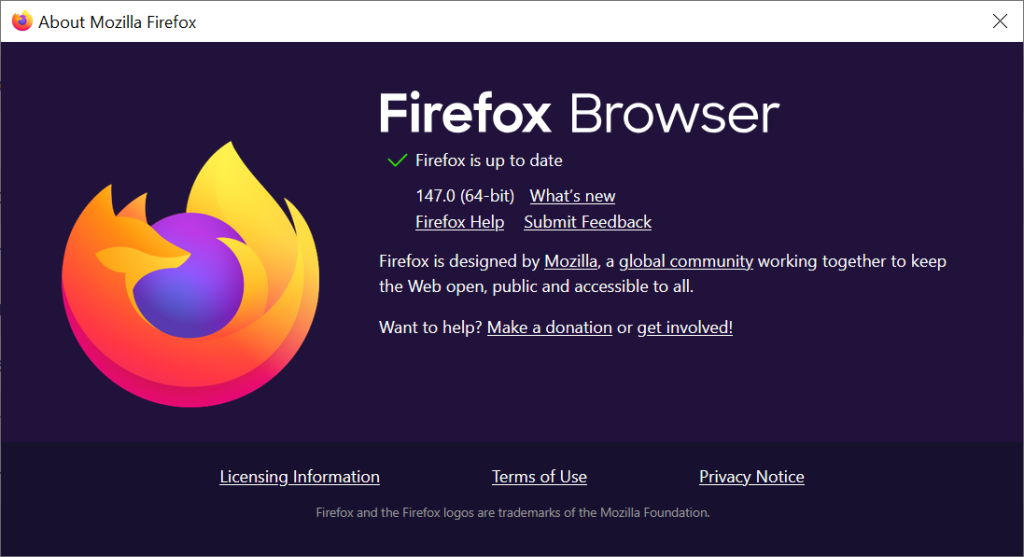
Most unmanaged Firefox installations will be updated automatically to the latest release once it has been released officially. This may take minutes, hours and sometimes even days. You can speed this up by selecting Menu > Settings > Help > About Firefox.

The new AI controls
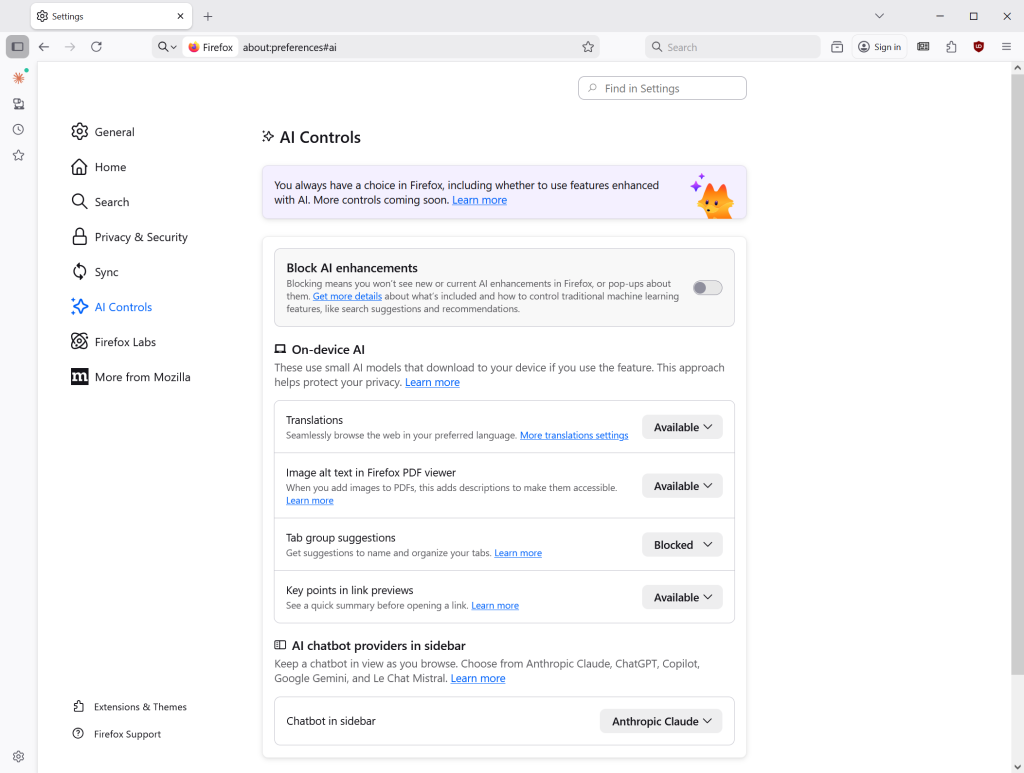
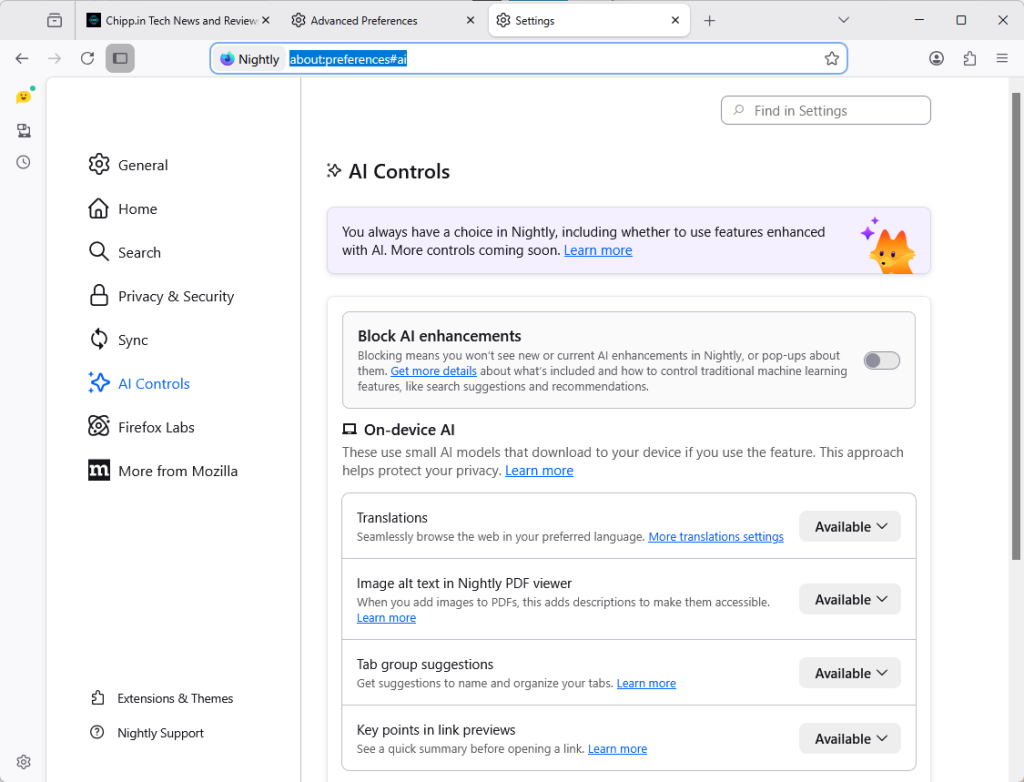
The new AI controls of the Firefox browser.

Probably the main feature of Firefox 148.0 is the new AI controls that Mozilla added to the browser. Load about:preferences#ai in the browser’s address bar or go to Menu > Settings > AI Controls to display all options.

The options are divided into two main sections: first a toggle to block all AI enhancements in Firefox with a single click or tap, and then individual controls for users who want to enable some but not other AI features.

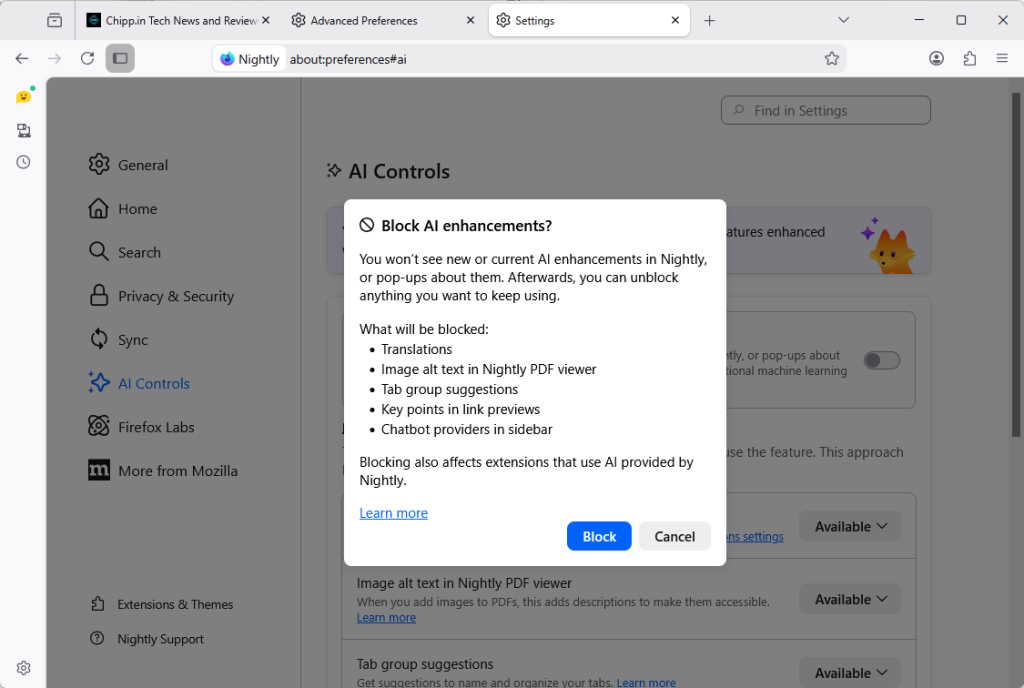
So, if you want to block all AI, toggle “Block AI enhancements” and confirm the decision. This should take care of all current and future AI features in Firefox.

The second section is divided into two parts: On-device AI and AI chatbot providers in sidebar. Here you can enable or block the following features individually:

  • Translations.
  • Image alt text in Firefox PDF Viewer.
  • Tab group suggestions.
  • Key points in link previews.
  • Chatbot in sidebar.

When you see available, it means that the feature is not active. Blocked means that it is disabled and enabled means that it is active.

A word or two about Remote Improvements

Remote Improvements are small changes to Firefox that are delivered remotely. Previously, this required for Firefox to share “technical and interaction data”, short Telemetry, with Mozilla. Starting in Firefox 148, this is no longer the case.

In other words, you can receive the fixes without sharing the data or participating in experimental studies.

Opting-out
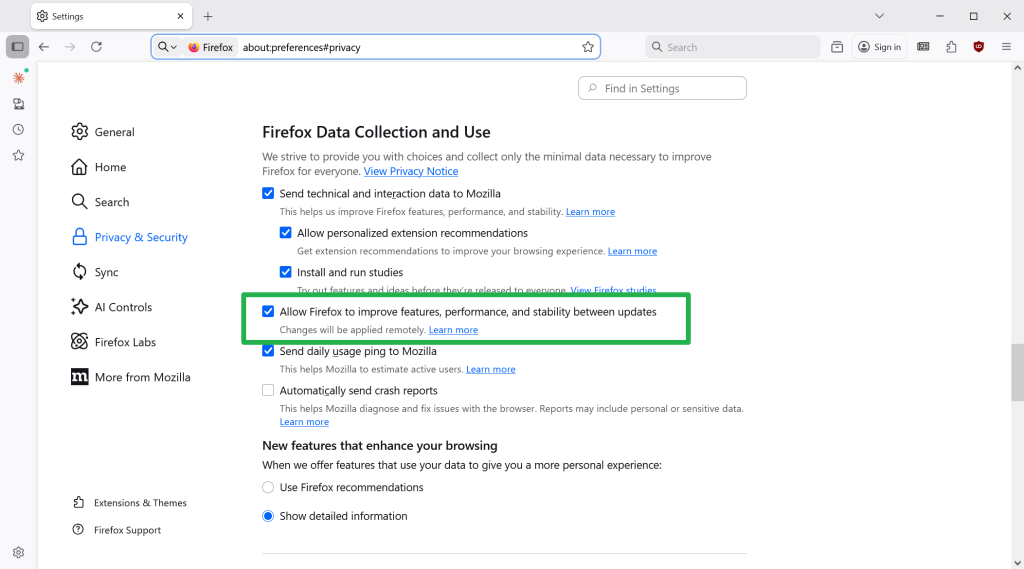
Uncheck the highlighted option to opt-out of remote updates.

The feature is on by default in Firefox 148, unless you have opted out of studies in the Settings prior to the release of Firefox 148.

To make sure that you are opted-out, do the following:

  • Load about:preferences#privacy in the address bar.
  • Scroll down to the Firefox Data Collection and Use section near the bottom.
  • Uncheck “Allow Firefox to improve features, performance, and stability between updates”.

Smaller changes in Firefox 148

  • Firefox now has improved support for screen readers accessing mathematical formulas embedded in PDFs.
  • Firefox Backup is now also available to Windows 10 users who set “Clear history when Firefox closes” to enabled. Backups will only include data that is not set to be cleared on exit in that case.
  • Translation into Vietnamese, and translation into and from Traditional Chinese is now supported.
  • New Tab wallpapers will show up on new container tabs also now.

The security updates

Firefox 148 fixes several security issues in previous versions. The severity is high and a massive 51 issues or potential issues are patched when the updated is installed.

The end of the road for old Windows and macOS versions

Mozilla is ending support for older operating systems with the release of Firefox 115.33.0 ESR. It is the last official release for systems that are no longer supported by their makers. Mozilla was the last major browser maker to support these operating systems, but this is coming to an end.

Firefox 115.33.0 continues to work on these systems, but updates won’t be released anymore. This means that security issues won’t get fixed anymore, which can be problematic as time passes by. Similarly, new web technology support is absent, which means that some sites or apps may not work correctly or at all.


Mozilla ends support for Firefox on Windows 7 and 8/8.1

Posted on February 18, 2026February 18, 2026 by Martin Brinkmann

The digital clock has finally run out for holdouts clinging to the past, forcing a critical decision for millions of PC users worldwide.

Mozilla has confirmed that it will officially terminate security updates for Firefox on Windows 7, 8, and 8.1 by the end of February 2026.

The organization is the last major browser maker that still supports the discontinued Windows operating systems.

Windows 7 support ended in January 2020 officially, but Microsoft introduced Extended Security Updates for business customers. These allowed businesses to extend support for up to three years, for a price.

Windows 8 and 8.1 support ended in January 2023, which is also the month that Windows 7 ESU support ended officially.

While Mozilla continued to support Firefox on Windows 7 after January 2023, Microsoft ended support for its Edge browser in the same month. Google followed a month later, when it released Chrome 109, the last official version of the web browser that supported the two operating systems.

Mozilla has now confirmed that it won’t release new updates for Firefox 115 ESR, the last version to support Windows 7 and 8/8.1, after February 2026.

  • Firefox 115 is now the last version supported on Windows 7, 8 and 8.1.
  • Updates will be delivered through the ESR channel until the end of February 2026.

The organization recommends that users upgrade the operating system to a supported version to “continue receiving Firefox security and feature updates”.

However, this could be problematic for a number of reasons, at least when upgrades to newer versions of Windows are considered:

  • The next direct upgrade is Windows 10. Microsoft has ended support and ESU updates are only provided until October 2026 for Home and Pro editions. Mozilla plans to continue supporting Firefox on Windows 10 though.
  • Windows 11 is supported, but it has stricter system requirements. Systems that do not meet the requirements can’t be upgraded as easily, if at all (there are some that can’t be bypassed).

Affected users might consider switching to Linux. It is a daunting task, but things have improved significantly in this regard over the years. Yes, some apps or games are not available directly, others may not run, but the vast majority of apps and games should run on Linux.

Firefox 115 ESR will continue to work after February 2026, but Mozilla won’t release any new updates for the version of the open source browser.

Total Opt-Out: How to Use Firefox 148’s New Master Switch to Block All AI Features

Posted on January 31, 2026January 31, 2026 by Martin Brinkmann

In an era where tech giants are racing to weave artificial intelligence into every corner of the browsing experience, Mozilla is handing the controls back to the user.

In a few weeks, the organization plans to launch Firefox 148 to the stable channel. It will include the “AI kill switch” that Mozilla executives hinted at earlier. With it, users of Firefox may block existing and new AI features in the browser either entirely or selectively.

Support of AI features

Firefox supports several AI features at the time off writing. This includes the option to interact with AI chatbots in the sidebar, get link preview summaries and tab suggestions, or help with tab group labeling.

In summary (as of Firefox 147):

  • Translations
  • Image alt text in Nightly PDF viewer
  • Tab group suggestions
  • Key points in link previews
  • Chatbot providers in sidebar

Not all features are available for all Firefox users. Some are limited to users who use the open source browser in English.

A detailed look at Firefox’s AI Kill Switch

The new AI Controls page of the Firefox Settings.

Starting in Firefox 148, out next month and available as a preview already, Firefox will include the option to block AI functions.

Mozilla added an AI Controls section to the preferences of the browser. You can launch Menu > Settings > AI Controls, or load about:preferences#ai directly to manage AI features in the browser.

Note: The preference browser.preferences.aiControls controls the entry in the preferences. Toggle it to True to enable it, or to False to disable it. This impacts only the display in Settings.

Firefox includes an option to disable all AI features with a single preference.

How to disable all AI in Firefox? Just toggle “Block AI enhancements” to Off. You get a prompt that explains what is going to happen. Activate “block” here to disable all AI features in the browser.

Instead of blocking everything, Firefox users may also block specific features only.

The AI Controls page divides the functions into two sections: On-device AI and AI chatbot providers in sidebar.

Each AI feature is listed with its name, a short description, and an action button. You can switch a feature from “Available” or “Enabled” to “Blocked”.

  • Available means that it can be used, but has not been up until now.
  • Enabled means that the user opted-in to use the AI feature.
  • Blocked that it is not active in the Firefox browser.

Here are the features that you can manage individually right now:

  • Translations
  • Image alt text in Nightly PDF viewer
  • Tab group suggestions
  • Key points in link previews
  • Chatbot in sidebar

Closing Words

Ultimately, Mozilla’s introduction of a global block toggle for all AI features highlights the organization’s awareness of the deep-seated skepticism toward AI among its user base. With it, it is giving Firefox users control over AI. Those who do not want it can make sure that it is disabled entirely in the browser, while everyone else may keep some or even all AI features enabled to make use of them.

By providing a clear, centralized way to opt out of AI—and ensuring that local data is purged when those features are disabled—Firefox 148 sets a high standard for how browser developers should respect individual choice. (source: Sören Hentzschel)

Firefox 147 Just Dropped: 5 Features That Make It Worth Updating Today

Posted on January 13, 2026January 13, 2026 by Martin Brinkmann

Not every monthly browser update feels like a milestone, far from it, but Firefox 147 is an exception to the rule. Released just a moment ago, on January 13, 2026, version 147 of the open source browser is not just another round of bug and security fixes — it is a comprehensive update that crosses some of the oldest items from the community’s wish list.

Whether you are a Linux user who has been waiting for 20 years for a cleaner home directory, a privacy advocate looking for improvements, or an AMD-GPU user who is now benefitting from decreased memory use and improved battery life during video playback.

Here are the five standout features in Firefox 147 that make this update essential.

Firefox 147 released. (Image credit: Mozilla)

Closing a privacy loophole in Safe Browsing

Mozilla Firefox uses Safe Browsing from Google for security checks. This checks visited URLs to make sure they are not on a list of dangerous addresses.

Up until now, Mozilla Firefox used V4 of Safe Browsing. Under this system, Firefox downloaded a database of hash prefixes from Google. This list included only the first four bytes of a hash and not the full addresses.

When a Firefox user visited a site in the browser, it compared the first four bits of the site’s hash against the list. If a match was found, it contacted Google servers to verify if the site was on the badlist (bad then), or not (collision, not bad).

The problem here was that Firefox had to contact Google for this. This meant that Google got to see the IP address of the user’s computer and the has prefix of the site.

While local first, it was not fully private because of that.

Version 5 makes a shift to Oblivious HTTP. This adds a third-party server between the browser’s request, and thus a user’s IP address, and the Google server. The third-party server sees the IP address of the user, but only the encrypted hash that is submitted.

Google on the other hand sees the hash, which it can decrypt, but not the user’s IP address.

Site isolation support in Firefox for Android

Site isolation was introduced in late 2021 for desktop versions of the Firefox browser. The main idea was to load each site in its own separate process to avoid certain forms of attacks or privacy issues.

Now, almost four years later, Mozilla is introducing site isolation on Android. Apart from improving security, site isolation should also improve the stability of the Firefox browser on Android.

Under the old system, a crash of a website could take down other tabs or even the whole browser. With site isolation in place, only specific tabs associated with the site will crash, while all other sites and the browser itself won’t be affected.

Local network protection in Strict Tracking Protection

Only a few legitimate services require access to local network resources when you browse the Internet. However, sites may abuse the option for certain tracking forms or attacks. Fingerprinting, for example, benefits from identifying other network devices that are connected to the same network.

Starting in Firefox 147, the browser blocks requests from public websites to private RFC 1918 IP addresses, when tracking protection is set to Strict mode. Nothing changes if tracking protection is set to standard mode, which is the default.

As usual, Firefox users have the option to override this for individual sites.

Zero-Copy Video benefitting video playback on AMD GPU systems

Zero-Copy Video is a rendering technique that is designed to eliminate unnecessary transfers of data between system memory (RAM) and the graphics card (VRAM). Introduction of the feature removes one of the biggest bottlenecks when it comes to media consumption, especially on Linux systems.

To better understand the new system, it is important to understand how the old system worked. Or, more precisely, what made the old process inefficient.

When watching a video in the browser, say a 4K video on YouTube, this is what happened:

  • The GPU decodes the compressed video file.
  • The browser copies the decoded image into system RAM for the webpage frame.
  • The compositor copies the image back to the GPU for it to draw the image on the monitor.

Under the new system, the browser is no longer copying the decoded image. Instead, the GPU gives the browser a pointer to the image in its VRAM.

The main effect: The video never leaves the VRAM. This reduces memory (RAM), CPU usage, and PCIe traffic significantly.

XDG Base Directory Support

For the past 20 years, Mozilla has placed the .mozilla folder in the home folder on Linux to store configuration files and data. This has been a major annoyance for Linux users for a number of reasons:

  • Using the .mozilla folder violated the XDG Base Directory Specification, which says that files should be split into three locations based on purpose, not one location (Configuration, Data, and Cache).
  • Backup issues, as it was difficult to separate important files, such as configuration files, from trash, such as cache.
  • Some programs needed special rules to include the Firefox configuration, e.g., third-party sync software.
  • Performance problems on Enterprise networks that mounted the home directories over a network.

This changes with the release of Firefox 147. Firefox will store config files in ~/.config/mozilla and data in ~/.local/share/mozilla going forward, which resolves the long-standing issue.

Closing Words

You can check out the full release notes of Firefox 147 here. There you also find a link to the included security fixes, which, fix several issues rate high or lower, but none that appears to be exploited in the wild already.

Mozilla reassures Firefox users that AI will be completely optional and include a kill-switch feature

Posted on December 20, 2025December 21, 2025 by Martin Brinkmann

Many makers of web browsers are evolving the browsers that they develop into AI-based browsers. How and to what degree depends much on the company or organization that is involved. From integrating options to chat with AI and basic AI features, such as getting a summary of a webpage, to agentic browsers, like Perplexity, that are designed to act on the user’s behalf.

Mozilla’s new CEO Anthony Enzor-DeMeo published his vision for the organization and its main software, Firefox, about a week ago. While much of what Enzor-DeMeo wrote resonated well with large parts of the community — turning Mozilla into the most trusted software company — it was a single pargraph that stood out and incurred the ire of parts of the community.

Firefox will grow from a browser into a broader ecosystem of trusted software. Firefox will remain our anchor. It will evolve into a modern AI browser and support a portfolio of new and trusted software additions.

While Enzor-DeMeo did state that “AI should always be a choice” and that it should be something that “people can easily turn off”, Firefox users expressed their concern over the AI-focus that the new Mozilla head described in the post.

The official Firefox for Web Developers account on Mastadon published several clarifications to address user concerns. The posts are attributed to Jake Archibald, who is Mozilla’s Web Developer Relations lead.

The main takeaways are the following two statements regarding AI:

  • All Firefox AI features will be opt-in.
  • Firefox will get a “kill-switch” for all AI features, which disables them completely.

Mozilla would introduce AI features in Firefox in a way that I would like all browsers to follow: make them opt-in, instead of opt-out. There are certainly users out there that use AI and will use AI features in browsers. Heck, some might even spring on the agentic-bandwagon and let AI buy stuff for them or to other things.

As long as this is optional, and not enabled by default, I would not mind much, especially if other features do not get pushed down the priority letter in favor of AI features.

How many browser users want AI in their browsers, or would start using the features once they land without knowing about them prior? I find that number hard to estimate. AI is a trend at the moment, and while companies have created some useful features powered by AI, it has not been proven yet that AI is a feature that can sustain itself once the hype ebbs down.

Now it is your turn. Have you tried AI features in browsers or elsewhere already? Is there anything that you liked in particular, or did not like? Feel free to leave a comment down below.

Firefox

Mozilla will continue to support Firefox on Windows 10

Posted on October 17, 2025October 17, 2025 by Martin Brinkmann

Now that support for Windows 10 has ended, software developers will make announcements regarding support of their products on the operating system.

Mozilla has just announced that it will continue to support Firefox on Windows 10 devices for “the foreseeable future”. While the organization did not provide a specific, at least “at the minimum until” would be nice, it guarantees that Firefox users on Windows 10 continue to receive updates for the browser.

Mozilla is also one of the few browser makers that supports Windows 7, as it extended support for the operating system several times. Considering that Windows 10 is more widely used, it is likely that support for Firefox on Windows 10 will go on for a long time.

If you remain on Windows 10, you will continue to get the same updates to Firefox you do today, with all of our latest feature improvements and bug fixes. This includes our commitment to resolve security vulnerabilities as rapidly as we can, sometimes in less than 24 hours, with special security updates. Windows 10 remains a primary platform for Firefox users. Unlike older versions of Windows like Windows 7 and 8, where Mozilla is only offering security updates to Firefox, Windows 10 will get the latest and greatest features and bug fixes just like users on Windows 11.

Mozilla recommends that Windows 10 users upgrade to Windows 11, if the PC supports it, or subscribe to Extended Security Updates for Windows 10. The latter would extend support by a year on consumer PCs and for up to three years on business PCs.

Other browser makers, including Google, have not made announcements regarding end of support of their browsers. The official Chrome Support Timelines website lists Chrome’s deprecation release and date for Windows 10 as “not yet scheduled”.

With Windows 10 used on hundreds of million of devices worldwide, even Google can’t afford to lose a sizeable chunk of users overnight, should the company decide to end support as early as it did when Windows 7 support ended.

Firefox

Firefox: how to delete files download in private browsing automatically

Posted on October 16, 2025October 16, 2025 by Martin Brinkmann

The private browsing mode of web browsers is quite useful, albeit not for the task that developers like Google or Mozilla advertise it for. While the companies make it sound like a good way to improve privacy, it is just that in one very specific use case: if someone else has access to the device, your user account and browser.

If that is not the case, it won’t really help you much, as most of the tracking happens online.

Still, it is great for accessing sites without having to worry about deleting it manually from history, accessing sites without being signed in to an account, or avoiding some tracking, as the private browsing data is separate from the regular browsing data.

Mozilla added a new option recently that deals with downloaded files. When you download files in private browsing modes, they land in the same download folder as regular downloads.

While that is wanted at times, some users might prefer the traces of downloads being deleted automatically. It is that option that is now available in the Firefox browser.

Here is how you configure it:

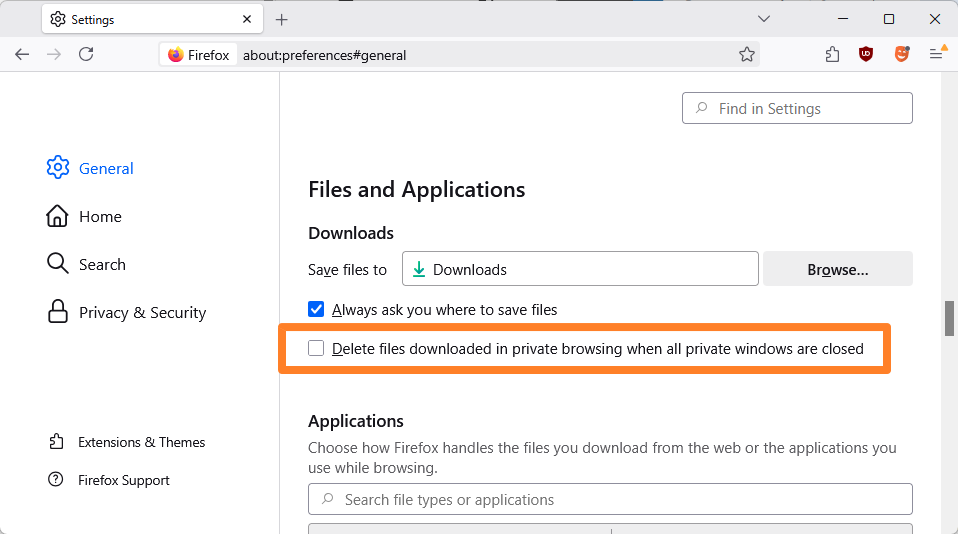
  1. Load about:preferences#general in the browser’s address bar.
  2. Scroll down to the Files and Applications section on the page.
  3. Check “Delete files downloaded in private browsing when all private windows are closed”.

This deletes downloaded files automatically once you close the last private browsing window.

Is it a useful feature? I do not know. It may help users who share accounts, as it removes any trace of a download from the system. Whether that makes sense depends on the use case. I’d say, it can also lead to confusion, as files get deleted automatically when the feature is enabled. That is probably the main reason why Mozilla decided to make it opt-in.

Firefox 143.0.4 fixes Google connection problems

Posted on October 5, 2025October 5, 2025 by Martin Brinkmann

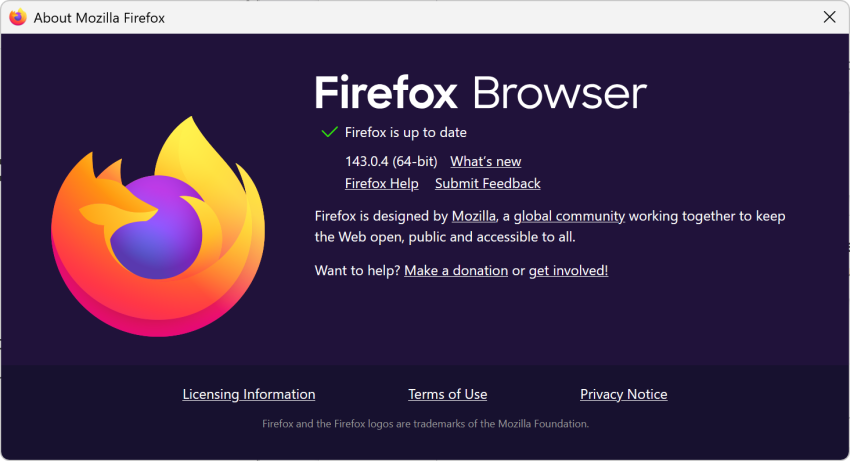
If you use Firefox and have had issues connecting to some Google-owned properties and services, then you may have experienced an issue that Mozilla fixed in Firefox 143.0.4.

The fourth point update for Firefox 143 addresses a single issue. While it is not uncommon for Mozilla to release point updates — smaller updates that fix pressing matters or security issues — it is rarer to see a single issue release.

It has been less than a week that Mozilla released Firefox 143.0.3 to address bugs and security issues in the browser.

Mozilla notes that the release improves “Firefox’ connection fallback behavior to mitigate sporadic slow/failed loads on some Google sites”. The issue affected devices with Firefox with certain third-party software installed.

The release notes do not provide any details, but the bug report over at Bugzilla does.

According to it, users started to note the behavior on Google Drive. Tests with other browsers confirmed that the issue was Firefox-specific. The investigation revealed that HTTP/3 connections were blocked, which forced Firefox to fallback to HTTP/2, but a bug caused these connections to fail to be created.

The update fixes the issue. Firefox users who use the browser to connect to Google services and noticed issues connecting to them should install it right away to fix the issue. Everyone else shouldn’t feel any hurry to install it.

The new version is available already. You can force the installation by selecting Menu > Help > About Firefox in the main menu. This should trigger the download and upgrade.

The next major Firefox release is scheduled for October 14, 2025. It is the same day that Microsoft is ending support for Windows 10 on officially.

Firefox 143.0.3 is out with security fixes and more

Posted on September 30, 2025September 30, 2025 by Martin Brinkmann

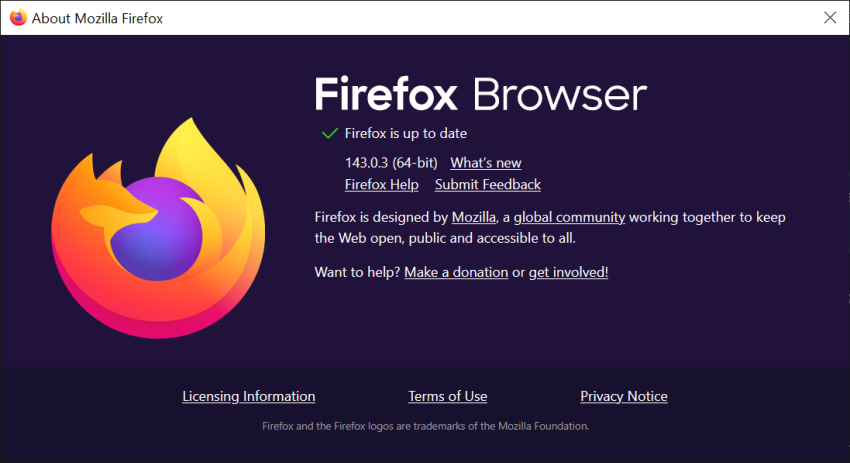
Mozilla released a new point update for its Firefox web browser today. Firefox 143.0.3 is a security update that fixes also some non-security issues in the open source browser.

The new update is available already via the browser’s automatic update feature. Existing users may speed up the installation of the update by selecting Menu > Help > About Firefox. This opens a small window in the browser that displays the current version and a check for updates.

Firefox should pick up the update automatically at this point, but you need to restart the browser once to complete the installation. Opening the page again after installation should reveal the new version.

The official security release notes reveal that Mozilla addressed two security vulnerabilities in the release. Both have a severity rating of high. They affect the JavaScript engine and the Canvas2D component of the browser. Mozilla makes no mention of exploits in the wild, but it is still recommended to update quickly.

The non-security release notes list six issues that Mozilla fixed or improved in the release. Probably the most noteworthy is a fix for extension not updating via the add-ons manager of the browser.

Another issue fixes a Firefox crash that could happen when certain extensions are installed. These caused a storage issue that could lead to Firefox crashing on start of the browser.

Firefox users who noticed long delays when opening certain websites may also see improvements after installing Firefox 143.0.3. Mozilla reduced the delays, which happen on certain websites if the network blocks UDP connections.

The three remaining fixes address minor problems in Firefox, such as Firefox View sections not collapsing or expanding as expected. You can check out the full release notes on Mozilla’s website.

Search image with Google Lens

Firefox is getting visual search capabilities powered by Google Lens

Posted on September 28, 2025September 28, 2025 by Martin Brinkmann

Mozilla is rolling out a new feature in recent versions of the Firefox web browser that introduces visual search functionality. This allows users to run visual searches by right-clicking on images.

Mozilla lists several main applications for the new feature on its Connect website.

  • Find similar products, places, or objects.
  • Copy, translate, or search text from images.
  • Get inspiration for learning, travel, or shopping.

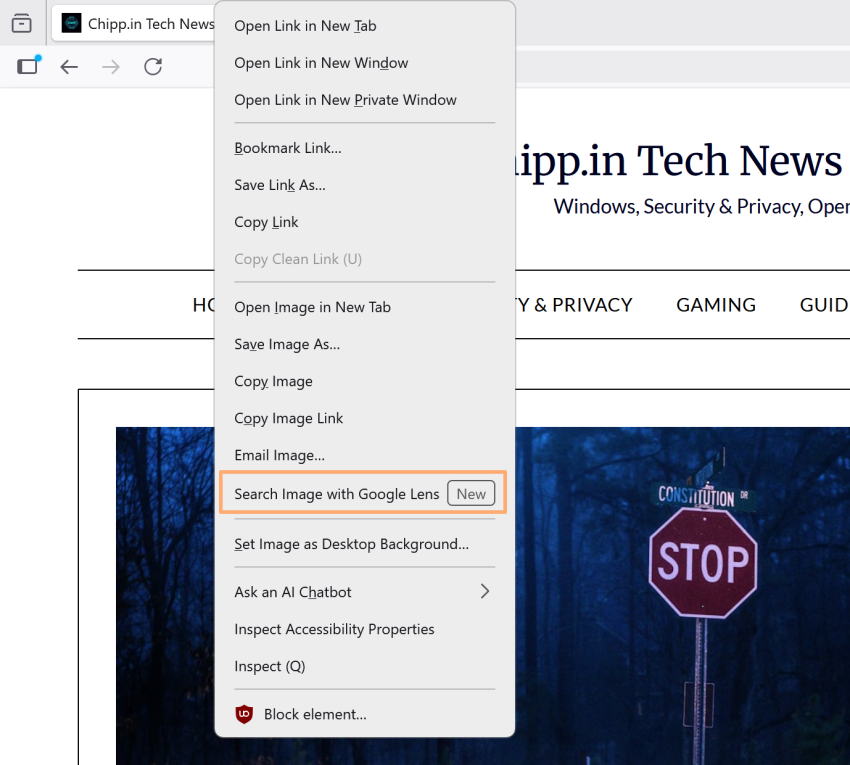
Right-click on any image displayed in the browser and select the new “Search Image with Google Lens” option to start a new search.

The feature is limited to Firefox on the desktop currently and it is rolling out worldwide. Most Firefox users won’t see it right away, but it can be enabled via about:config.

Here is how that is done:

  1. Load about:config in the browser’s address bar.
  2. Search for browser.search.visualSearch.featureGate.
  3. Click on the toggle icon to set the feature to True.
  4. Restart Firefox.

This enables the feature. You can test it by right-clicking on an image in Firefox and selecting the new Google Lens visual search option from the context menu.

Tip: you can turn off the feature at any time by setting the experimental flag to false in about:config. This removes the context menu entry in Firefox.

Here is what happens when you select the option: Firefox redirects the search request to the official Google Lens website. From there it is all Google and you should see similar images and information about the image among other things.

The feature addition will likely see mixed receptions. Some Firefox users may like the ability to run visual searches quicker through the browser’s context menu. Before that, they had to go save and upload the image to Google Lens manually or install a browser extension such as Search on Google Lens.

Others may dislike the additional entry in the context menu, for instance in fear or accidentally sending an image they view in the browser to Google Lens.

To be honest, it is unclear why Mozilla would introduce the feature natively in Firefox if an open source browser extension is already available

Now You: what is your take on this? Useful addition in Firefox or something that you have no use for?

  • 1
  • 2
  • 3
  • 4
  • …
  • 7
  • Next

Support This Site

If you like what I do please support me!

Any tip is appreciated. Thanks!
  • March 2, 2026 by Martin Brinkmann Don't Bother with Windows 11's new Speedtest feature
  • February 27, 2026 by Martin Brinkmann Warning! That laptop on Amazon? It comes with temporary storage
  • February 26, 2026 by Martin Brinkmann "If your printer works today, it will continue to work": Microsoft corrects previous announcement
  • February 25, 2026 by Martin Brinkmann YouTube Premium Lite subscribers get background playback and downloads with a big "but"
  • February 24, 2026 by Martin Brinkmann Firefox 148.0 is out with its AI kill switch and support for Windows 7 and 8.1 comes to an end

About

We talk, write and dream about Technology 24/7 here at Chipp.in. The site, created by Martin Brinkmann in 2023, focuses on well-researched tech news, reviews, guides, help and more.

Legal Notice

Our commitment

Many websites write about tech, but chipp.in is special in several ways. All of our guides are unique, and we will never just rehash news that you find elsewhere.

Read the About page for additional information on the site and its founder and author.

Support Us

We don't run advertisement on this site that tracks users. If you see ads, they are static links. Ads, including affiliate links, never affect our writing on this site.

Here is a link to our privacy policy

©2026 Chipp.in Tech News and Reviews